Social Media Screening for US Visa: What to Do (and Not Do) Before Your Interview
Tarun Chandel
Recently • 8 min read

Before your visa appointment, this might be the most crucial thing you read.
Your I-20 is with you. Your DS-160 has been turned in. Your money is in order. You've practiced your responses. You may believe that you are prepared for your social media screening interview for a US visa, but have you really looked through your Facebook, Instagram, and Twitter accounts with a US consular officer's eyes?
Thousands of Indian students lose their US student visas every year because to something they posted months or even years ago, rather than poor academic performance or financial difficulties. Since 2019, the US government has been rapidly growing its social media vetting program, which is now more comprehensive, automated, and significant than ever in 2026.
Planning to Study Abroad?
Get personalized guidance from experienced education counselors.
This is your comprehensive, truthful, and practical guidance if you are applying for an F-1 visa or any other type of US visa for social media screening students. It explains exactly what consular authorities are looking for, what you should do in advance of your interview, what you should never do, and where you may find free professional assistance.
Before you post anything else online, read it.
Why the US Government Screens Your Social Media in 2026
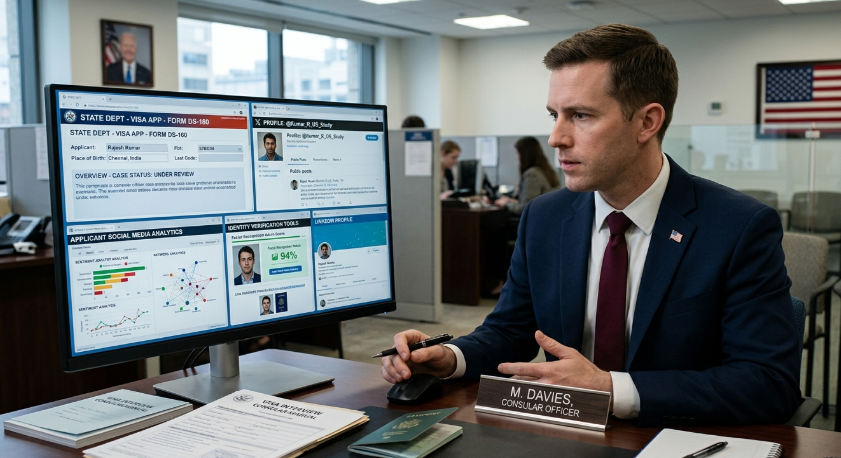
Every time you apply for a US visa, the U.S. Department of State and Department of Homeland Security are officially authorized to examine your internet presence. Social media disclosure has been required on the DS-160 form for almost all visa applicants since 2019.
You must legally reveal all of your social media usernames from the previous five years when completing your DS-160. Among the platforms covered are:
Facebook
Instagram
Twitter / X
LinkedIn
YouTube
TikTok
Snapchat
Reddit
Any other platform where you maintain a public or semi-public presence
Consular officials utilize this data, which is cross-referenced with automated screening systems, to determine whether you pose a security risk, have opinions that are at odds with US immigration law, or exhibit behavior that goes against your declared intentions as a student visa applicant.
Officers are explicitly searching for a very specific kind of mismatch when screening students for US visas on social media: the discrepancy between what you say on your application and what your digital life actually shows.
What US Consular Officers Are Actually Looking For
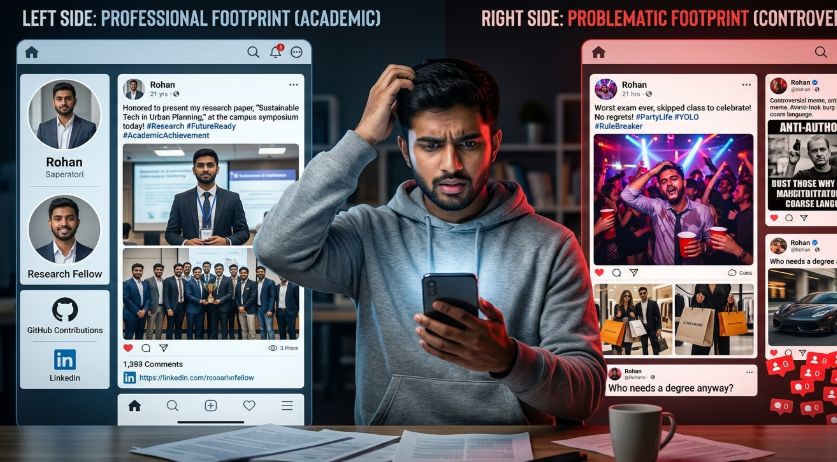
The majority of students believe that social media filtering simply identifies criminal associations or extreme content. That presumption is terribly lacking. Social media screening officials for US visas are specifically trained to recognize the following:
1. Immigration Intent Mismatch
A non-immigrant visa is the F-1 student visa. Strong ties to your native country and a sincere desire to return to India after completing your studies are legally necessary. A major warning sign is any post, caption, comment, or story that implies you intend to relocate overseas permanently.
No matter how casually expressed, posts like "can't wait to never return back," "bye India forever," or "finally departing for good" plainly contradict the intent you are claiming on your visa application. Officers are taught to spot this discrepancy.
2. Extremist, Violent, or Anti-Government Content
Posts, likes, shares, followers, and comments pertaining to violent speech, extremist organizations, or content that is antagonistic to the US government may be flagged right away. This includes material that you might have interacted with years ago but have since forgotten about.
3. Financial Lifestyle Inconsistency
You have established a direct contradiction between your paperwork and your digital life if your visa application materials indicate that you have limited financial resources but your social media posts depict pricey international holidays, luxury purchases, upscale events, and an expensive lifestyle. Officers are aware of this.
4. Work-Related Activity That Violates Visa Terms
Posts discussing earning money on a freelance basis, working for clients, creating monetized material, or engaging in employment-related activities in the US, whether from a prior visit or one you have planned, may raise major concerns about whether you intend to work unlawfully while on a student visa.
5. Political or Controversial Views
Strong political beliefs can be identified, especially anything that is critical of the US government, divisive political declarations, or involvement with contentious political activities. Because there is no clear cutoff point in this gray area, the hazard is increased rather than decreased.
6. Inconsistency With Your Academic Narrative
The legitimacy of your declared academic goal is undermined if your SOP claims that you are passionate about computer science research, but your social media accounts reveal little involvement with anything academic and a lifestyle that seems to be solely oriented on amusement and socializing overseas.
What You Must Do Before Your US Visa Interview — Complete Checklist
Step 1 — Conduct a Full Platform Audit
Examine all of your stated accounts on your DS-160, not just the ones you use the most. From the viewpoint of a consular official who is unfamiliar with you and is viewing your profile for the first time, read your previous posts, captions, tweets, comments, and favorite content.
For every piece of content, consider:
Does this suggest I want to stay in the US permanently rather than return to India?
Could this be interpreted as a security concern — even if I did not intend it that way?
Does my apparent lifestyle match the financial profile on my visa application?
Does my online persona support my stated academic purpose?
Step 2 — Clean Up Strategically and Gradually
You have the right to remove certain posts or content from your social media history. But, and this is crucial, don't deactivate all of your profiles or delete your entire account right before your interview. The act itself may seem suspicious.
Step 3 — Check Your Tagged Content
You are visible in stuff that other people have uploaded and tagged you in, so you are not just accountable for what you share. Examine every image, video, and post in which you are tagged, and remove tags from anything that can cause issues.
Step 4 — Review Your Bio, Highlights, and Pinned Content
The first thing a viewer sees is your personal bio and any content that has been pinned or highlighted. Make sure it correctly and clearly represents who you are as a student with sincere academic aspirations. Anything that could be misinterpreted by someone who does not understand your context should be removed.
Step 5 — Search Your Own Name on Google
See exactly what comes up when you type your own name into Google. While they might not show up on your DS-160, background screening programs can reveal old blog posts, forum usernames, gaming identities, Reddit accounts, and comment histories on news websites. Take care of anything that worries you.
What You Must Never Do Before Your US Visa Interview
Never Lie or Omit Accounts on Your DS-160
You are breaking the law if you have a social media account and decide not to list it on your DS-160. Even when people use various names or email addresses, the US government has advanced methods to identify accounts associated with specific people. It is more worse to be detected hiding an account than anything that could be in it.
Never Suddenly Make Everything Private
A noticeable digital pattern is created by making all of your accounts private two weeks before to your visa interview. Maintaining consistent privacy settings over time is typical. A clear warning indication is an abrupt, complete change to private settings right before a consular appointment.
Never Wipe Your Entire Digital Presence
Particularly for applicants in their twenties who are expected to have some online presence, having no social media presence at all brings its own concerns. A well maintained, spotless profile is less suspect than an abrupt removal of all digital traces.
Never Post About Your Visa Process Online
Don't share anything about the interview, your plans for life in the US, your joy about leaving India, or your visa appointment. A straightforward post like "visa interview tomorrow, wish me luck" may appear in a review and be taken as proof of a strong desire to immigrate.
Never Ignore This Preparation
The most common error made by students undergoing social media screening for US visas is to believe that the screening is insignificant or unlikely to have an impact on them. Neither is it. Due to internet content they didn't think anyone would find or care about, students with good preparation, high academic reputations, and stable incomes have been turned down.
Official Government Resources to Review Before Your Interview
Before your consulate appointment, you must be familiar with these official sources — and interlink them into your preparation process:
US Department of State — Student Visas: — Official F-1 and M-1 visa requirements, documentation, and procedures
DS-160 Application Portal: — Complete and review your DS-160 here, including social media disclosure section
SEVIS — Student and Exchange Visitor Programme: — How your I-20 and student record are tracked throughout your time in the US
US Embassy and Consulates in India: — India-specific appointment scheduling, interview guidance, and current processing updates
Study in the States — DHS Official Resource: — Comprehensive guidance for international students on F-1 visa requirements and compliance
Review all five before your appointment. Being genuinely familiar with official requirements is itself a form of preparation that consular officers recognise.
Why Yastudy Is the Smartest Free Investment You Can Make in Your US Visa Success
It takes more than merely removing a few outdated postings to pass the US visa social media screening. Presenting a comprehensive, coherent, and trustworthy application is crucial; your SOP, financial records, social media presence, and interview responses should all convey the same message.
It's challenging to develop such consistency on your own. It is far more dependable to build it with professional advice, and since such advice is completely free, there is no good reason not to take it.
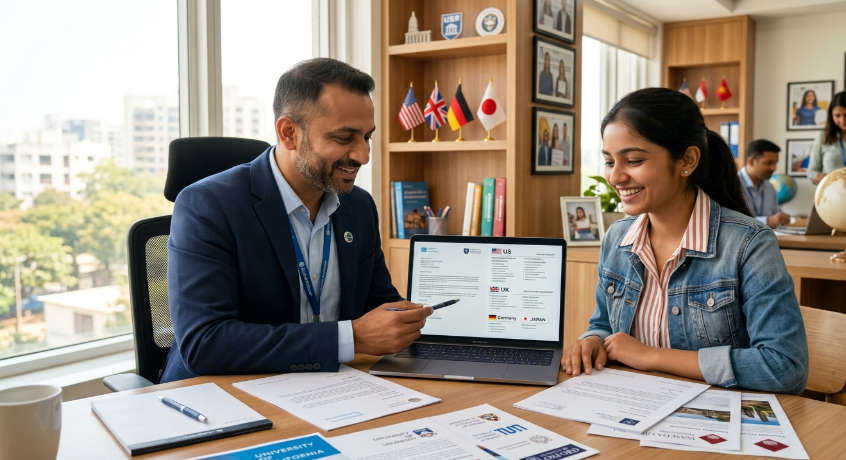
Yastudy — one of Noida's most trusted and genuinely student-first study abroad consultancies — provides complete, end-to-end US student visa preparation support at zero cost to every student. No consultation fees. No document review charges. No SOP fees. No application costs. No hidden charges. Ever.
The Yastudy Model — Free for Students, Always
In order to connect with eligible Indian students, universities in the US, UK, Germany, Canada, Japan, and other countries collaborate with Yastudy through a university-partnership model. Yastudy is paid by universities. Pupils never do.
This implies that every piece of advice Yastudy provides is solely concerned with your results rather than making the most money. There is no financial motivation to encourage you to enroll in a specific program, university, or nation. The counsel is sincere, tailored to you, and entirely in line with your interests.
Final Word — Prepare Now, Not the Night Before
If you are truly prepared, the US visa social media screening for students in 2026 won't be a barrier. It is an organized, manageable aspect of the contemporary visa procedure, and like all aspects of it, the students who effectively manage it are those who take it seriously and begin early.
Instead of starting your social media audit the week before your interview, start it as soon as you decide to apply. You should finish your DS-160 completely and precisely. Both your online presence and your SOP should convey the same message. Additionally, someone who understands exactly what consular officers are searching for should analyze your complete application.
That someone is available to you right now — for free.
Your dream of studying in the US is absolutely achievable through the right consultancy like Yastudy. Don't let an old tweet, a forgotten post, or an avoidable mistake stand between you and it.
Start Your Study Abroad Journey
Join thousands of students who achieved their dreams with Yastudy.