How Indian Students Can Get Free Education in Germany?
Aastha Sharma
Recently • 8 min read

Priya's parents sat across from her at the dining table, calculator in hand, faces tense. "We've saved ₹15 lakhs," her father said quietly. "That might cover one year in the US. Maybe half of a UK degree. We'll need to take a loan for the rest."
Priya felt her stomach drop. She'd worked so hard for this. Top grades. Strong extracurriculars. A clear vision for her engineering career. But watching her parents stress over education loans that would take a decade to repay? It felt wrong.
Then her cousin Arjun video-called from Munich. "Why are you even considering loans?" he asked. "I'm studying at the Technical University of Munich. Zero tuition fees. My living costs are less than what private engineering colleges charge in India. No loans. No financial stress."
Planning to Study Abroad?
Get personalized guidance from experienced education counselors.
"That's impossible," Priya's mother said. "Nothing is free."
But it is. And here's how.
This comprehensive guide breaks down exactly how Indian students can access free education in Germany, what it actually costs, the real challenges you'll face, and whether this path is right for you.
No sugar-coating. No hidden details. Just the complete truth about what might be the smartest financial decision of your academic career.
The Truth Behind Free Education in Germany
Let's address the elephant in the room first: "What's the catch?"
When families hear "free education in Germany," the immediate reaction is skepticism. Here's what's actually happening: Germany made a political decision in 2014 that education is a public good, not a commercial product. The German government believes that an educated workforce benefits everyone, so taxpayers fund public universities.
Think of it like India's IITs, except imagine if IITs were completely free and had spaces for hundreds of thousands of students instead of just 16,000 seats annually.
Since this policy took effect, international student numbers spiked from 301,350 to 469,485. Indian students now make up the largest international student group in Germany, with 49,008 students enrolled as of 2023-2024, representing a 262% increase over eight years.
So the "catch"? There isn't one in terms of tuition.
If you want a deeper breakdown of how tuition-free universities work and the latest updates, read: Study in Germany for Free: What You Need to Know in 2026
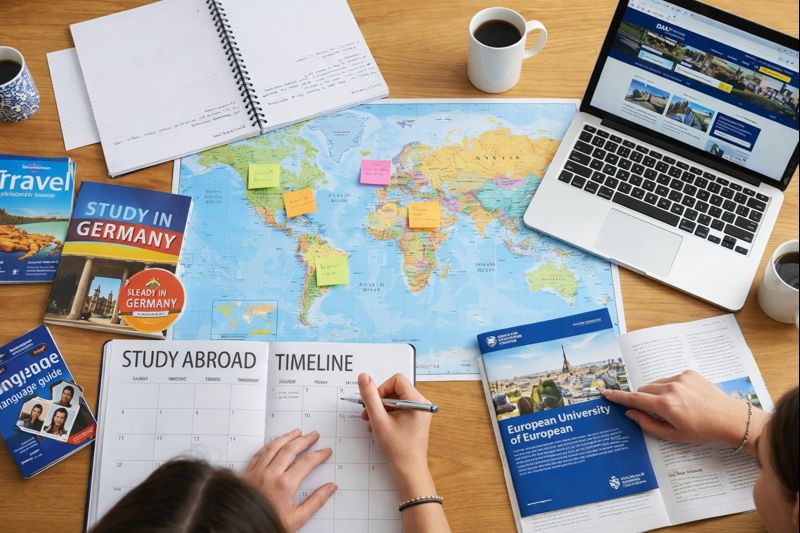
From ambition in India to reality in Germany: a step-by-step roadmap for your study abroad journey.
Breaking Down the Actual Costs: What "Free" Really Means?
Here's what confuses families: "If it's free, why do I need ₹10 lakhs in the bank?"
What You Absolutely Don't Pay?
Tuition fees at German public universities are zero. Whether your child studies mechanical engineering at the Technical University of Munich, medicine at Heidelberg University, or computer science at RWTH Aachen, the tuition cost is ₹0.
Let's compare:
United States: $30,000 to $50,000 annually (₹25-42 lakhs)
United Kingdom: £25,000 per year (₹26 lakhs)
Australia: ₹20-35 lakhs annually
Private Indian Universities: ₹15-25 lakhs
Germany: ₹0
What You Do Pay?
Semester Contribution: €150-€350 per semester (₹13,000-₹31,000). This covers administrative costs and includes unlimited public transportation across the entire German states.
Living Expenses: The German government requires proof of €11,904 per year (approximately ₹10.6 lakhs), breaking down to €992 per month (₹88,000).
This covers:
Rent: €300-€500 in smaller cities, €400-€700 in larger cities
Food: €150-€250 per month
Health insurance: €110 per month (mandatory)
Books, phone, personal expenses: €100-€200 per month
Total annual cost for German education: ₹8-12 lakhs, depending on the city
Total annual cost for US/UK programs: ₹40-50 lakhs
For a four-year bachelor's degree:
Germany: ₹35-45 lakhs total (no loans needed)
USA: ₹1.6-2 crores (requires loans)
The math isn't even close.
Real Student Success Story:
"My parents were taking out a ₹30 lakh loan for my computer science degree in the US. Then I discovered Germany through a Yastudy counsellor. I got admission to RWTH Aachen University. Zero tuition fees. My total annual cost, including rent, food, insurance, and everything, is ₹8.5 lakhs, which is less than many private colleges in India charge for tuition alone. I'll graduate debt-free while my friends in the US will be repaying loans until they're 35."
- A., Computer Science Student (Delhi to RWTH Aachen, 2022)
The Blocked Account Reality
This is where most Indian families hit their first major roadblock. The conversation usually goes like this:
Parent: "So we don't pay tuition? That's amazing! When does my child start?"
Counsellor: "Great! First, you'll need to open a blocked account with €11,904."
Parent: "Wait, what? That's ₹10.6 lakhs! I thought you said it was free?"
This confusion is completely understandable, so let's clear it up once and for all.
What Exactly Is This Blocked Account?
To get your German student visa, you must deposit €11,904 (approximately ₹10.6 lakhs) into a special German blocked account before your visa appointment.
Now here's the crucial part everyone misunderstands: This is NOT a fee. This is YOUR money.
Think of it like this: The German government wants proof that your child can support themselves financially while studying. They don't want students arriving in Germany and then struggling to afford rent or food. So they require you to prove you have funds available.
But instead of just showing a bank statement (which could be borrowed and returned), Germany requires you to deposit this money into a special account. This account then releases €992 per month (₹88,000) directly to your child's German bank account to cover living expenses.
So that ₹10.6 lakhs? It's prepaid living costs for the first year. You're not losing it. Your child is using it for rent, food, and daily expenses month by month.
The Blocked Account Process (Simplified)
Don't let service providers confuse you. Here's what actually happens:
Your child receives admission from a German university
You research blocked account providers (Expatrio, Fintiba, Coracle are most popular)
You open an account online, submit documents
You transfer €11,904 plus provider fees (₹5,000-₹15,000) from India
Account provider sends you a blocking confirmation letter
You use this letter for a visa application
Once your child arrives in Germany, they activate the account
Every month, €992 automatically transfers to their regular German bank account
Critical warning: Avoid using Indian banks like Kotak Mahindra for blocked accounts. German embassies may not accept , leading to visa delays or rejections. Stick with recognized providers that German authorities trust.
What If We Simply Can't Arrange ₹10.6 Lakhs?
Let's be honest. Some families genuinely cannot arrange this amount even with extended timelines. What then?
Scholarship options: DAAD scholarships and other funding can reduce or eliminate the blocked account requirement. If you receive a scholarship covering living expenses, German authorities accept scholarship letters instead of blocked account proof.
Alternative proof of funds: Some students use:
Bank guarantee from parents showing sufficient ongoing income
Proof that a relative in Germany will sponsor living costs
A combination of partially blocked account plus a scholarship
Realistic assessment: If arranging ₹10.6 lakhs is genuinely impossible for your family, Germany might not be immediately feasible. However, consider this: if you can't arrange ₹10.6 lakhs, could you arrange the ₹40-50 lakhs needed for the US? Often, families realize Germany is actually their most realistic option when they compare total costs.
Working with study abroad consultants who specialize in Germany can help identify scholarship opportunities and funding strategies specific to your financial situation.
Expert Insight from Yastudy's Senior Counsellor:
"The biggest mental block Indian families face is disbelief. They've been conditioned to think quality education must be expensive. When I tell parents their child can study at world-ranked universities for ₹8-10 lakhs annually total cost instead of ₹40-50 lakhs, they think I'm lying. The reality check comes when our students actually land in Germany and realize it's true. Then they regret not knowing about this sooner."
Eligibility To Study in Germany for Free?
Not everyone qualifies for German universities. Let's be upfront about who can realistically pursue this path and who faces significant hurdles.
Here's where Indian students hit their first confusion: Germany's education system is structured differently than India's.
For Bachelor's Programs: This is complicated, so pay attention.
The Indian education system provides 12 years of schooling while Germany requires 13 years for direct bachelor's admission. This creates a gap.
What does this mean practically? Most Indian students cannot directly enter German bachelor's programs right after the 12th standard. You have two paths:
Option 1: Complete one year of a bachelor's degree in India at a recognized university, then apply to Germany. Your first year in India essentially becomes your 13th year of education.
Option 2: Attend Studienkolleg (preparatory year) in Germany. This is a one-year foundation program specifically designed to bridge the gap for international students. You'll take courses in your intended field, then pass the Feststellungsprüfung (assessment exam) to qualify for university admission.
Which option is better?
Studienkolleg is faster (one year vs possibly 2-3 years completing bachelor's in India) and gets you to Germany immediately. However, places in Studienkolleg are competitive and require at least B2 German language proficiency in most cases.
Completing one year in India is easier language-wise and gives you a backup plan if Germany doesn't work out. But you spend more time and money in India first.
For Master's Programs: This is simpler but still has requirements.
Students typically need a domestic bachelor's degree of at least three years with a score of 80% or higher.
However:
Your undergraduate field must relate to your chosen master's program (you can't jump from English literature to mechanical engineering)
Your university should be recognized in the Anabin database (most reputable Indian universities are listed)
Some competitive programs require specific prerequisite courses or higher percentages
The truth about percentages: While 80% is often cited as minimum, highly competitive programs at top universities like TU Munich or RWTH Aachen may expect 85%+ or even 90%+ for certain courses. Check specific program requirements rather than assuming 80% guarantees admission.
Language Requirements
This is where Indian students get nervous. Do you need to speak German?
The answer: Not always.
Germany offers over 2,600 English-taught programs, primarily at the master's level. For these programs, you'll need:
IELTS: typically 6.0-7.0 overall
TOEFL: usually 80-100 points
For German-taught programs (which are more numerous, especially at bachelor's level), you'll need German proficiency certificates like TestDaF or DSH at the B2-C1 level.
Pro tip: Even if studying in English, learning German dramatically improves your experience. It opens part-time job opportunities, helps with daily life, and significantly boosts post-graduation employment prospects. Starting a German Language Course online or taking a Yastudy German course for beginners while still in India puts you ahead of other international students and shows genuine commitment to integration.
The Step-by-Step Process To Study In Germany
Let's break down the exact process, addressing every problem along the way.
Step 1: Research Programs (6-12 Months Before)
Use DAAD's course finder and MyGermanUniversity to search programs. 60% of Indian students study engineering and technology, with TU Munich, RWTH Aachen, and TU Berlin as top choices.
If overwhelmed, abroad education consultants help match your profile to competitive programs.
Step 2: Prepare Documents (6-9 Months Before)
You'll need:
Academic transcripts (officially translated)
Language proficiency certificate (IELTS course online prep starts 4-6 months before)
Recommendation letters (2-3)
CV and passport copy
Budget ₹15,000-₹25,000 for translation and apostille services.
Step 3: Submit Applications
Winter Semester (October start): Apply by July 15
Summer Semester (April start): Apply by January 15
Apply to 5-8 programs. Unlike the US, German applications are targeted. Application fees: €30-€75 per university through Uni-Assist.
Step 4: Open Blocked Account (After Admission)
Takes 2-4 weeks to open, another 1-2 weeks for funds to clear. Deposit €11,904 (₹10.6 lakhs) plus provider fees (₹5,000-₹15,000).
Step 5: Apply for Student Visa (3-4 Months Before)
Book appointment at German embassy in Delhi, Mumbai, Bangalore, or Chennai. Processing takes 6-12 weeks. Study abroad consultants offer visa assistance services.
Step 6: Arrange Accommodation (2-3 Months Before)
Options: Student dormitories (€200-€400), shared apartments (€300-€700), or private studios (€500-€900).
Join Facebook groups for Indian students in your destination city for housing help.
.png)
From application to arrival: The journey typically takes 12-18 months of planning, but results in a debt-free degree from a world-class university
Making Money Work: Part-Time Jobs and Scholarships
The €992 monthly allowance from your blocked account covers basics, but most Indian students work part-time to build savings and gain experience.
Part-Time Work Regulations
International students in Germany can work 120 full days or 240 half days per year. This translates to approximately 20 hours per week during semesters and full-time during semester breaks.
Student jobs typically pay:
€12-€15 per hour for general student jobs
€15-€20 per hour for skilled positions (tutoring, IT work, research assistant)
€20-€25 per hour for specialized technical roles
Working 15 hours weekly at €13/hour generates approximately €750 monthly (₹67,000), significantly supplementing living costs.
In major cities like Berlin, Munich, or Frankfurt, many startups and international companies offer English-speaking student positions, especially in IT, engineering, and research. However, learning German through courses like Yastudy's German Language Course online opens far more opportunities. Restaurants, retail, and many traditional student jobs require at least B1 German.
Scholarships That Cover Living Costs
DAAD Scholarships are the gold standard for Indian students. They offer:
Monthly stipends (€850-€1,200 depending on degree level)
Travel allowances
Health insurance coverage
Sometimes German language course funding
DAAD awards hundreds of scholarships annually to Indian students, but competition is fierce. Start your application 12-18 months before your intended start date.
Deutschlandstipendium provides €300 monthly based on academic performance and social engagement. Unlike DAAD, this scholarship is available to students already enrolled in German universities.
The Hidden Benefits Nobody Talks About
Free tuition is just the beginning. Here's what makes Germany truly special for Indian students:
Post-Study Work Opportunities
Germany offers an 18-month job-seeking visa after graduation. Germany's strong economy and skills shortages, particularly in engineering and IT, mean excellent job prospects. Starting salaries for engineers average €45,000-€55,000 (₹40-50 lakhs) annually.
Path to Permanent Residency
Unlike unpredictable US/UK immigration, Germany has clear pathways. After working 4-5 years, apply for permanent residency. With the EU Blue Card, this reduces to 21-33 months.
Quality of Life
Germany offers excellent healthcare, reliable infrastructure, and a work-life balance. Safety, efficient public transport, access to 27 Schengen countries, and vibrant Indian communities make it ideal.

Living the dream: A joyful new chapter begins on a vibrant German campus.
Why Now Is the Perfect Time for Indian Students?
The momentum is shifting dramatically. While US student enrollments from India dropped 13% in 2024, and similar drops occurred in the UK and Canada, Germany saw a 32.6% increase in applications from Indian students in 2024-25.
Experts predict Germany could host more than 114,000 Indian students by 2030 if current trends continue. This matters because:
Universities are actively recruiting Indian students
Support services for Indian students are expanding
Indian community networks in German cities are strengthening
German companies increasingly recognize Indian qualifications
The infrastructure for Indian student success in Germany is better now than ever before.
Is Free Education in Germany Worth It?
Germany offers something remarkable: world-class education without the financial burden that typically comes with it. It's not perfect. It requires planning, adaptation, and effort. But for thousands of Indian families, it's been the difference between education funded by decades of debt versus education funded by manageable savings.
The question isn't whether free education in Germany is too good to be true. It's real, it's happening, and it's been transforming outcomes for Indian students since 2014.
Ready to explore if Germany is right for you?
At Yastudy, we've guided 500+ Indian students through the complete Germany journey. Our counselors help you understand if Germany genuinely fits your situation, navigate applications, prepare documents, and secure visa approval.
Start with German Language Course online or book a free consultation to discuss your specific case. Whether you're 18 months away or just exploring options, accurate information from experienced study abroad consultants makes all the difference.
Your debt-free education journey could begin today. The only mistake is not exploring it at all.
Frequently Asked Questions (FAQ)
Question: Is free education in Germany really completely free for Indian students?
Answer:Public universities in Germany charge zero tuition fees for most programs, regardless of nationality. However, students must pay a semester contribution of €150–€350 and cover living expenses averaging €992 per month.
The education itself including lectures, exams, and access to university facilities is completely free. Overall, the total annual cost is typically ₹8–12 lakhs, mainly for living expenses, which is far lower than tuition fees alone in most other countries.
Question: Can I study in Germany without knowing German?
Answer:Yes. Germany offers over 2,600 English-taught programs, primarily at the master’s level. For these programs, you need IELTS or TOEFL scores instead of German language proficiency.
However, learning basic German greatly improves daily life, part-time job opportunities, and social integration. Starting an online German language course before arrival is highly recommended.
Question: What is the blocked account and how much do I really need?
Answer:The blocked account requires a deposit of €11,904 (approximately ₹10.6 lakhs) before applying for a German student visa.
This is your own money, not a fee. The amount is released to you as €992 per month to cover living expenses. It serves as proof that you can financially support yourself in Germany. Think of it as prepaid living expenses for your first year.
Start Your Study Abroad Journey
Join thousands of students who achieved their dreams with Yastudy.