Study in Germany for Free: What You Need to Know in 2026?
Aastha Sharma
Recently • 8 min read

Every year, thousands of Indian students face the same heartbreaking choice: compromise on the quality of education they can afford, or take on crushing debt that will follow them for decades.
Your friends who went to the US are already planning how they'll repay $80,000 in loans. Those in the UK are looking at £50,000+ in tuition alone. Meanwhile, your own family is calculating how many years of savings it will take to fund even a mediocre program.
But here's what most students don't know: over 400,000 international students are currently studying in Germany, and they're paying zero tuition fees at public universities. Not reduced fees. Not scholarships that only a lucky few receive. Zero. Nothing.
Planning to Study Abroad?
Get personalized guidance from experienced education counselors.
This isn't a marketing gimmick or a temporary offer – it's how Germany has structured its entire public education system since 2014.or a more detailed, step-by-step breakdown specifically for Indian students, read How Indian Students Can Get Free Education in Germany?
If you're skeptical (and you should be – if something sounds too good to be true, it usually is), this guide will walk you through everything: the real costs, the actual requirements, the exceptions you need to watch out for, and whether Germany is genuinely the right choice for you.
Why Germany Is Different: The Philosophy Behind Free Education
Germany operates on a fundamental belief that education should not be treated as a commercial product. This isn't just empty rhetoric – it's a national commitment reflected in their education system from kindergarten through university. While students in the UK, US, and Australia grapple with student loan crises, Germany abolished tuition fees at public universities in 2014 after years of public protests against even the modest €1,000 annual fees that existed before.
The German government understands something crucial: attracting the smartest minds to study and potentially work after graduation brings significant economic and social benefits. This forward-thinking approach has transformed Germany into Europe's top destination for international students, with over 469,000 students enrolled as of the 2023/24 academic year, and projections showing more than 405,000 international students in the 2024/25 winter semester.
Country | Average Student Loan Debt | Note on Tuition/System |
United States | $37,000 average | High tuition costs and a complex loan system. (Note: Recent data suggests this average may be higher, around $38,000 - $39,000 for a bachelor's degree.) |
United Kingdom | £45,000 average | High tuition (especially in England) financed through government loans. (Note: Some sources indicate an average of up to $55,000 USD/£45,000 GBP, making it one of the highest in the world.) |
Australia | $23,000 average | Loans (HELP) are income-contingent, meaning repayment is tied to earning above a certain threshold. |
Germany | €0 tuition | Public universities generally do not charge tuition fees for domestic and international students for most programs, though a small semester contribution fee (a few hundred euros) is required. |
The Truth About "Free" Education in Germany
What's Actually Free?
Let's be crystal clear about what "free" means in the German context. At public universities, you pay zero tuition fees for your degree program. This applies whether you're studying engineering, medicine, business, or the arts.
Public universities in Germany are funded by taxes, making education accessible to national and international students alike.
This isn't limited to EU citizens either. Whether you're from India, Nigeria, Brazil, China, or anywhere else in the world, the same principle applies – everyone can study in Germany tuition-free at public universities.
What You Still Need to Pay For?
Here's where reality meets expectations. While tuition is free, life isn't. You'll encounter costs that every student faces:
Semester Contribution (Semesterbeitrag): This ranges from €100 to €300 per semester, covering administrative expenses and other student services. Often around €300 to €400 for the whole semester, this makes roughly €700 per year. In most German states, this includes unlimited public transportation – a benefit that alone can save you over €1,200 annually in cities like Munich or Berlin.
Living Expenses: Here's the real number you need to know: €11,904 per year, or €992 per month. This is the amount the German government has determined necessary to cover rent, food, utilities, transportation, and entertainment. If you need a student visa, you'll need to deposit this amount into a blocked account before applying.
Living Costs by City:
City | Monthly Rent (1-bedroom, city center) | Total Monthly Cost |
Munich | €1,200 - €1,500 | €1,400 - €1,700 |
Berlin | €900 - €1,200 | €1,100 - €1,400 |
Leipzig | €600 - €800 | €800 - €1,000 |
Dresden | €650 - €850 | €850 - €1,100 |
Note: Costs are significantly lower if you opt for student dormitories or shared apartments
The Exceptions You Need to Know About
Not everything in German higher education is tuition-free. Understanding these exceptions helps you plan realistically:
Baden-Württemberg's Non-EU Fee
The federal state of Baden-Württemberg charges non-EU/EEA students €1,500 per semester. This affects universities in popular cities like Heidelberg, Freiburg, Stuttgart, Karlsruhe, and Mannheim. However, this fee is still remarkably affordable compared to global standards – you're looking at €3,000 per year versus $50,000+ in the United States.
Bavaria's Recent Changes
Since 2024, Bavarian universities can charge tuition from non-EU students, though currently only the Technical University of Munich has implemented this. Their fees range from €4,000-€6,000 annually for Bachelor's and €8,000-€12,000 for Master's programs. Other prestigious Bavarian universities like the University of Würzburg and TH Deggendorf remain tuition-free, meaning they have not announced any plans for charging fees to international students.
Private Universities and Specialized Programs
Private institutions charge tuition to all students, typically €5,000-€7,000 per semester (or €10,000-€20,000 per year for Master's programs). Additionally, certain non-consecutive Master's programs and "secondary degrees" (Zweitstudium) may have fees even at public universities, typically ranging from €500 to €650 per semester. Executive programs like MBAs and specialized laboratory-intensive courses may also carry fees.
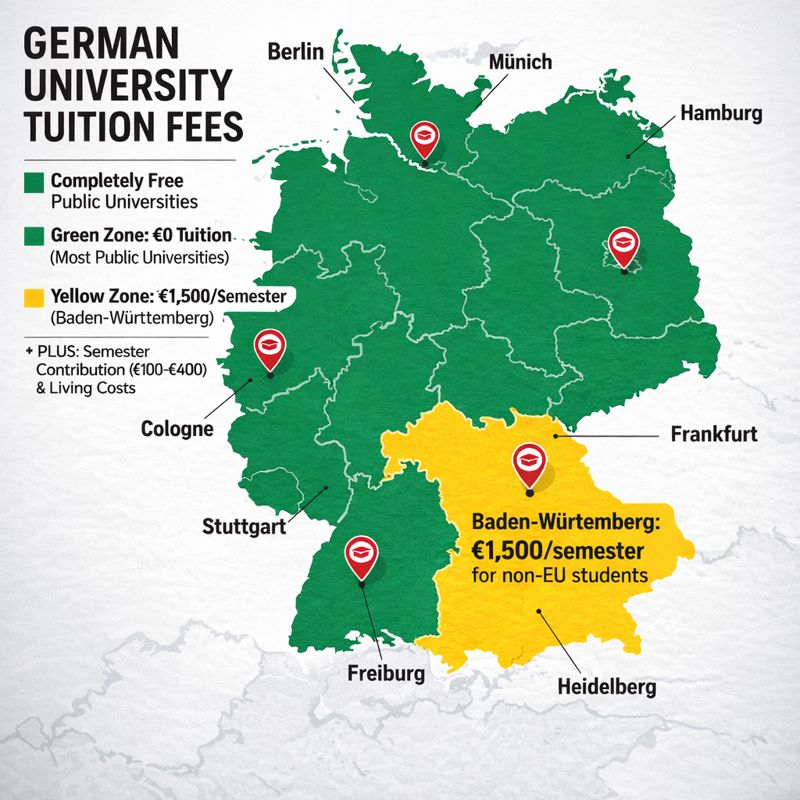
Your treasure map to tuition-free education: Most German states offer completely free public university education
Is Germany Right for You?
Consider Germany if you:
Value quality education without massive debt
Are comfortable with a structured academic system
Want to learn German and experience European culture
Hope to work in Europe after graduation
Appreciate efficiency, punctuality, and organization
Germany might not be ideal if you:
Expect the campus culture of US/UK universities (German universities are more focused on academics)
Cannot handle cold winters and grey weather
Need everything in English immediately
Prefer very flexible academic structures
Essential Requirements
Academic Credentials
Your high school diploma needs to be equivalent to Germany's Abitur. Use the Anabin database to check if your school-leaving certificates qualify. If your credentials don't directly translate, you may need to complete a one-year preparatory course called Studienkolleg, followed by a qualification exam (Feststellungsprüfung).
Language Requirements: German vs. English Programs
Here's where many students hesitate – and where there's excellent news. Over 290 universities offer more than 2,600 English-taught programs, primarily at the Master's level. You don't need to speak German to study in Germany.
For German-taught programs: You'll need DSH or TestDaF certification, typically at B2-C1 level.
For English-taught programs: IELTS scores typically require a minimum of 6.0-6.5 overall, while TOEFL scores usually range from 80-100 points, depending on the specific program.
Pro tip: Even if you're studying in English, learning German opens doors to internships, part-time work, and deeper cultural integration. Many universities offer free German language courses alongside your degree program. Start building your foundation early with courses like the Yastudy German Language Course online or the Yastudy German course for beginners.
Based on our experience, learning basic German (A1–A2) before arrival dramatically improves part-time job access and internship opportunities, even in English-taught programs.
Financial Proof
International students need to prove they can cover living expenses by depositing €11,904 per year into a German blocked account when applying for a student visa. This isn't a fee – it's your own money, released monthly (€992) to cover your living costs.
Alternative options include:
Bank guarantee from your parents
Scholarship certificate covering your expenses
A German resident sponsoring your stay
Proof of parental income or financial assets
Step-by-Step Application Process
1. Find Your Program
Use databases like MyGermanUniversity's StudyFinder or DAAD's course database to filter by:
Language of instruction
Tuition-free programs
Your field of study
City preferences
2. Prepare Your Documents
Most applications require:
Completed application form
Certified copies of academic transcripts and diplomas
Language proficiency certificates (IELTS/TOEFL or DSH/TestDaF)
Statement of Purpose (your motivation letter)
Letter(s) of Recommendation
CV/Resume
Copy of passport
Passport-sized photographs
3. Submit Through the Right Channel
Applications go through either:
Uni-assist: A central processing service for international applications (more than 170 universities)
Directly to the university: Check each institution's specific portal
4. Key Deadlines
Winter semester (starts October): Applications due July 15
Summer semester (starts April): Applications due January 15
Some programs have earlier deadlines, especially competitive ones. Start your application process at least 6-8 months before your intended start date.
How To Fund Your Life in Germany
Scholarships That Cover Living Costs
DAAD Scholarships: DAAD offers funding covering living expenses, accommodation, and health insurance. These are merit-based and highly competitive, but worth every minute of application effort. The German Academic Exchange Service (DAAD) has an official scholarship database which allows you to search for suitable scholarship options based on your country of origin.
Deutschlandstipendium: Provides €300 monthly to talented students based on academic performance and social engagement.
Erasmus+: EU-funded program offering monthly financial assistance for exchange students, covering accommodation, travel, and personal expenses.
Part-Time Work
International students can work up to 120 full days or 240 half days per year. Student jobs typically pay €12-15 per hour, helping offset living costs while gaining work experience.
An engineering graduate from Delhi NCR with a 7.4 CGPA initially believed Germany was “only for toppers.” After proper shortlisting, he applied to public universities outside Baden-Württemberg, avoided tuition-fee states, and secured admission to an English-taught Master’s program in a tuition-free university. Today, his only major annual cost is living expenses (~€11,904), funded partly through a student job, with zero education loan.
The Hidden Advantages Beyond Free Tuition
World-Class Quality
Based on our experience, Germany's universities rank among the best globally, with strict accreditation standards ensuring high-quality teaching. Your degree will be respected worldwide and valued by employers across industries. Germany has very strict standards for accrediting its educational providers, and a degree from a German university will open many doors for your career choices.
Top Tuition-Free Universities (QS Rankings 2025)
University | QS Ranking | Popular Programs |
|---|---|---|
Technical University of Munich | 28 | Engineering, Sciences, Technology |
Ludwig Maximilian University Munich | 59 | Medicine, Law, Humanities |
University of Heidelberg | 87 | Medicine, Life Sciences, Humanities |
Free University of Berlin | 98 | Social Sciences, Arts, Languages |
Humboldt University Berlin | 120 | History, Philosophy, Sciences |
Post-Graduation Opportunities
Germany offers an 18-month job-seeking visa after graduation. With Europe's strongest economy and a skills shortage in many sectors, your chances of landing a career are excellent. International graduates can search for a job that fits their qualifications, and are allowed to take any job during those 18 months. Many international students transition from student visas to work permits, eventually gaining permanent residency.
To that end, Yastudy offers visa services and SOP services.
The Lifestyle Factor
Germany offers a quality of life that balances academic rigor with cultural richness. From Berlin's vibrant arts scene to Munich's traditional charm, from world-class healthcare to efficient public transport – your student experience extends far beyond the classroom.

Your German adventure: Where world-class education meets incredible life experiences
Common Mistakes to Avoid
1. Waiting Too Long to Apply
Application processing can take months. Universities fill spots on a rolling basis for some programs. Start early.
2. Ignoring Numerus Clausus (NC)
Popular programs have admission restrictions based on GPA. Apply to multiple universities to increase your chances.
3. Underestimating Living Costs
Budget for €992 per month minimum. Living in smaller cities like Leipzig or Dresden costs significantly less than Munich or Frankfurt.
4. Neglecting German Language
Even for English programs, basic German helps with daily life, making friends, and job prospects. Start learning before you arrive.
5. Missing Health Insurance
Mandatory from day one. Budget around €110 per month for student health insurance.
Your Action Plan
12-18 Months Before:
Research programs and universities using databases like DAAD's course database
Start language preparation (German or IELTS/TOEFL for your IELTS course online)
Begin learning German basics with Yastudy German Language Course online
9-12 Months Before:
Take the required language tests
Get academic documents certified
Write your Statement of Purpose
Continue with Yastudy German course for beginners to build confidence
6-8 Months Before:
Submit university applications
Apply for scholarships
Gather financial documents
3-4 Months Before:
Accept university admission
Open a blocked account
Apply for a student visa
Secure health insurance
Arrange accommodation
1-2 Months Before:
Book flights
Join student groups online
Finalize accommodation
Prepare for departure
Study Abroad Consultants: Getting Expert Help
Navigating international education can be overwhelming. Professional study abroad consultants specialize in:
Matching you with the best countries to study abroad based on your profile
Identifying suitable study abroad programs and universities
Handling complex documentation and application processes
Visa guidance and interview preparation
Preparing your Statement of Purpose
Abroad education consultants can be particularly valuable when applying to multiple countries or if you need help understanding equivalency requirements for your specific situation.
Achieve Your Germany Study Dream with Yastudy
Germany has democratized access to world-class higher education. While "free" doesn't mean "without cost," the absence of tuition fees removes the single biggest barrier facing international students. With careful planning, realistic budgeting, and early preparation, studying in Germany transforms from a distant dream into an achievable goal.
The question isn't whether you can afford to study in Germany – it's whether you're ready to seize the opportunity. Your journey to a debt-free degree in one of the world's strongest economies starts with a single step: research your program, prepare your application, and take action.
Germany isn't just offering free education; it's offering freedom – freedom from crippling debt, freedom to focus on learning rather than financing, and freedom to build your future without the weight of loans holding you back.
With 10+ years of combined experience, the Yastudy counselling team has guided thousands of Indian students through university selection, application strategy, visa documentation, and pre-departure planning for Germany. Our expertise is built on hands-on case work, not theory, covering public universities, Studienkolleg pathways, English- and German-taught programs, and evolving state-level fee policies.
Ready to start your German education journey? Build your language foundation with Yastudy German Language Course online and join the over 400,000 international students who chose opportunity over debt, quality over cost, and Germany over everything else.
Additional Resources:
Disclaimer: Tuition policies and costs mentioned are based on 2024-2025 academic year information and subject to change. Always verify current requirements with your chosen university and official German educational authorities. Sources include studying-in-germany.org, study.eu, and DAAD official communications.
Frequently Asked Questions:
Q1. Is studying in Germany really free for international students in 2025–2026?
Answer:
Yes. Most public universities in Germany do not charge tuition fees, even for international students, during the 2025–2026 academic year. Students are only required to pay a small semester contribution, which usually covers administration, public transport, and student services.
Q2. Can Indian students study in Germany without paying tuition fees?
Answer:
Yes. Indian students can study tuition-free at German public universities, provided they meet the required academic qualifications and German or English language proficiency criteria.
Q3. Does free education in Germany affect visa approval chances?
Answer:
No. Free education does not negatively affect visa approval. German student visa decisions are based on factors such as confirmed university admission, proof of financial resources (blocked account), valid documentation, and academic intent—not tuition fees.
Q4. Which German public universities offer free education in 2025?
Answer:
Several well-known public universities in Germany offer tuition-free education, including:
Technical University of Munich (TUM)
RWTH Aachen University
Heidelberg University
Technical University of Berlin (TU Berlin)
These universities charge only a semester contribution, not tuition fees.
Start Your Study Abroad Journey
Join thousands of students who achieved their dreams with Yastudy.