What is the dMAT exam?
The dMAT is a standardised study aptitude test for people who want to start a Master's programme in Germany. It is offered by g.a.s.t., a German non-profit that runs tests through more than 1,000 licensed test centres worldwide and also conducts TestDaF (German language) and TestAS (aptitude for Bachelor's study). The dMAT format was developed with the Universities of Ulm and Kassel, its development was sponsored by the DAAD and the German Rectors' Conference (HRK), and every answer sheet is evaluated centrally in Bochum.
The test existed before the India rule: RWTH Aachen and the University of Göttingen already use dMAT subject modules to select Master's students. What changed is that on 29 June 2026 APS India made the dMAT an additional part of the APS documents for selected Indian Master's applicants. All Indian APS candidates take the same version: the Core Module plus the General Academic Module.
| The dMAT is | The dMAT is not |
|---|---|
| A required part of the APS documents for affected degree fields | A replacement for APS document verification |
| A test of reasoning and of applying knowledge to new problems | A test of memorised facts from your syllabus |
| Reported as a score and a percentile rank | A pass-or-fail exam |
| Printed on your APS certificate for every university to see | An admission guarantee or an automatic rejection |
| Enough for the visa just by taking it | A replacement for anabin recognition, the GRE, GATE or GMAT |
| Taken in English | A German language test |
Who does what: g.a.s.t., APS India and universities
| Organisation | Handles | Contact |
|---|---|---|
| g.a.s.t. (Bochum) | Registration, payment, test centre booking, test format, test day, scoring, re-checks, the dMAT certificate | kontakt@gast.de |
| APS India (New Delhi) | Who must take the test, exemptions, the degree field list, checking your dMAT certificate, issuing the APS certificate | info@aps-india.de |
| German universities | Deciding how much weight your dMAT result gets in admission | Each programme's admissions office |
| German Embassy / VFS | The student visa. Taking the dMAT is enough; there is no minimum score | Visa section |
Why Germany introduced the dMAT for Indian students
APS India has not published a separate document explaining its reasons, but the German Embassy set out the thinking to The PIE News in July 2026. Indian universities, grading practices and percentage marks vary so widely that a transcript on its own often does not let a German university compare two applicants fairly; for example, a 75% from one university and a 7.5 CGPA from another are hard to put side by side. The dMAT gives every German university one standardised result that reads the same way for every applicant.
The Embassy also said what the test is not meant to do: it is not meant to discourage qualified Indian students, a low score does not by itself stop an APS certificate, and Germany remains open to Indian applicants. It added that the test can help well-prepared students, because it gives them a standard way to show their academic strength, whatever college they come from.
The scale behind the decision
- 69,816 Indian students were enrolled at German universities in the winter semester 2025/26, up 17.5% in one year, according to DAAD India figures reported in August 2026.
- Indians are now the largest group of international students in Germany, about 13.5% of all international students.
- In the winter semester 2023/24, 60% of Indian students in Germany studied engineering and 21% law, management and social sciences (DAAD, based on Federal Statistical Office data).
Why these three degree fields first?
APS India has not said why it started with engineering, commerce and economics, and business and management. Our reading: these fields supply most Indian Master's applicants to Germany, as the figures above show, so starting there covers the largest groups. APS India calls 2026 the introductory phase and says the test is being introduced step by step. Its 15 October 2026 notice of an updated field list shows the scope is still being worked out.
How Germany's checks on Indian applicants have tightened
- The APS certificate becomes mandatory for Indian student visa applications. Germany presented it as a way to speed up admission and visa processing.
- APS India stops issuing certificates to graduates of private Indian universities that are not fully UGC-accredited (anabin status H+/- or H-).
- A minimum of 70% in Class XII is required for the undergraduate routes into Germany, from the winter semester 2026/27.
- APS India announces the dMAT as an additional part of the APS documents for selected Master's applicants.
- The first dMAT is held in India. Results follow on 12 October 2026.
- APS India confirms test dates for 16 January and 13 March 2027 (registration opened 28 October) and updates the degree field list.
Not everyone in Germany agrees
The decision has its critics. A deputy director at SRH Higher Education, one of Germany's largest private university groups, told The PIE News that admission is the universities' own responsibility, so a test placed inside APS effectively becomes an extra entry requirement. He argued that, with Germany short of skilled workers, any new requirement should complement universities' own selection rather than restrict it. For students, the practical message is the same either way: if your degree is affected, the dMAT is now part of the route.
Do I need the dMAT?
dMAT eligibility checker
Five questions, based on APS India's rules and field list Version 1.0. APS India makes the final decision from your documents.
In words: you need a dMAT certificate if all four of these are true.
- You are applying for a Master's programme in Germany.
- Your intake is the summer semester 2027 or later, including winter 2027/28.
- Your previous degree is in Engineering; Commerce, Accounting, Finance, Economics; or Business, Management.
- You completed your APS online registration and shipped your APS documents on or after 29 June 2026.
Anyone else may still take it voluntarily.
Who is exempt from the dMAT?
- Applicants for Bachelor's programmes in Germany
- PhD applicants
- Applicants whose previous degree is not in one of the three field groups
- Applicants in officially confirmed exchange, double-degree or university partnership programmes. Send the confirmation from your home university, the German partner or the programme coordinator, including your group number, with your APS documents.
- Bachelor's students who have not yet completed at least 5 semesters of a 3-year programme, or 7 semesters of a 4-year programme. This means "not yet": once you apply for APS as a Master's applicant in an affected field, the rule applies.
- Anyone covered by the 29 June 2026 transitional rule below
| Your APS situation | dMAT needed? |
|---|---|
| APS online registration completed before 29 June 2026 (documents shipped later) | No |
| Complete APS documents shipped before 29 June 2026, verification still running | No, keep your courier proof |
| APS certificate already issued | No, not for that procedure |
| Registered and shipped on or after 29 June 2026, affected field, summer 2027 or later | Yes |
| A new APS application at a later date | Rules at that time apply |
| Applying for the winter semester 2026/27 | No |
Watch for the updated field list. On 15 October 2026 APS India said an updated list of affected fields will be announced shortly. This page and the checker follow Version 1.0 of 29 June 2026, which is still the latest published list. If your degree is borderline, check aps-india.de/dmat before you decide to skip the test.
Do I need the dMAT for my degree? Degree-by-degree check
APS India's field list (Version 1.0) names 129 engineering titles, 75 commerce, accounting, finance and economics entries, and 41 business and management entries. Three rules decide most edge cases:
- The official wording decides. APS India looks at the title, branch, major, honours subject or specialisation printed on your degree certificate, transcripts and mark sheets. College marketing names and the Master's you plan to study do not count.
- One keyword is not enough. A title containing "Engineering", "Management", "Business", "Commerce", "Finance" or "Technology" is not covered for that reason alone if the degree does not belong to that discipline.
- B.Tech is judged by its branch. A B.Tech is covered only where the official branch is clearly an engineering field.
| Your Bachelor's degree | dMAT? | Why |
|---|---|---|
| B.E. / B.Tech Mechanical, Civil, Electrical, Chemical, Aerospace, Automobile, Production, Metallurgy, Mining, Marine, Petroleum | Yes | Listed engineering fields |
| B.E. / B.Tech Electronics and Communication (ECE), EEE, Electronics and Instrumentation, Telecommunication | Yes | Listed engineering fields |
| B.E. / B.Tech Computer Science and Engineering (CSE), Computer Engineering, Information Science and Engineering | Yes | Named as covered |
| B.Tech Information Technology | Depends | "Information Technology and Engineering" is listed; standalone IT is not automatically included |
| B.Tech AI, AI and ML, Data Science or Cyber Security | Depends | Standalone fields, unless APS classifies the official title as engineering |
| Software Engineering | Depends | Listed only "if awarded as an Engineering degree" |
| B.Tech Biotechnology Engineering, Biomedical, Biochemical, Bioengineering | Yes | Named as covered |
| B.Tech Biotechnology (no "Engineering" in the title) | Not auto | Biotechnology without an engineering designation |
| Food Engineering, Food Engineering and Technology, Textile Engineering, Agricultural Engineering | Yes | Listed engineering fields |
| Food Technology, Food Processing, Textile Technology, Leather, Printing, Packaging, Rubber Technology | Not auto | Technology fields without an engineering designation |
| BCA, B.Sc. Computer Science, B.Sc. IT, B.Sc. Data Science | Not auto | Named among fields not automatically included |
| B.Com, B.Com (Hons) and its specialisations (accounting, finance, banking, taxation, e-commerce, computer applications) | Yes | Commerce group |
| BAF, BFM, BBI, accounting, auditing, banking and insurance, financial markets | Yes | Accounting and finance entries |
| B.A. / B.Sc. Economics, Economics (Hons), Business Economics, Financial Economics | Yes | Economics counts as an economic science |
| BBA, BBM, BMS, BBS, BBE, BIBF | Yes | Business and management group |
| Degrees in Marketing, HRM, Business Analytics, International Business, Logistics, Supply Chain, Operations, Retail, Entrepreneurship | Yes | Listed business and management fields |
| BBA Hotel, Hospitality, Tourism, Aviation, Hospital or Healthcare Management; BHM, BHMCT, BTTM | APS decides | Sector-specific management fields need a separate formal assessment |
| B.Arch, B.Plan, Interior Design | Not auto | Architecture and planning are outside the three groups |
| B.Pharm, MBBS, BDS, Nursing, Physiotherapy | Not auto | Pharmacy and health sciences are outside the groups |
| B.Sc. Physics, Chemistry, Mathematics, Biotechnology, Microbiology, Life Sciences | Not auto | Pure and life sciences are outside the groups |
| B.A. (other than Economics), LLB, B.Ed, Library Science | Not auto | Arts, humanities, law and education are outside the groups |
"Not auto" means not automatically covered: you are outside the requirement unless APS India classifies your official degree into one of the three groups. If you are unsure, write to info@aps-india.de and keep the reply.
All 245 affected field entries, with a search box: dMAT eligibility checker.
Borderline degree and a close deadline?
Taking the dMAT voluntarily removes the risk. g.a.s.t. allows anyone to sit the test, the certificate does not expire, and a missing certificate can hold up your APS certificate for months if APS later classifies your degree as affected.
dMAT exam pattern 2027
For the APS procedure, the dMAT has two compulsory modules. Every candidate gets the same tasks, whatever their degree, so a B.Com graduate and a mechanical engineer sit exactly the same paper. All questions are single-choice and in English, and you work on a computer at the test centre.
No calculator, no paper and no notes in either module. The clock keeps running during restroom visits.
| Part | What you do | Questions | Time |
|---|---|---|---|
| Core Module (general cognitive and analytical skills) | 90 min block | ||
| Figure Sequences | Work out how figures move, rotate and change colour across four grids, then choose the 5th and 6th grids | 20 | 25 min |
| Mathematical Equations | Solve small systems of equations in which letters stand for whole numbers from 1 to 20 | 20 | 25 min |
| Latin Squares | Find the missing letter in a 5×5 grid in which each letter appears once per row and once per column | 20 | 25 min |
| Break | You stay inside the test centre. Snacks are allowed only now | – | 30 min |
| General Academic Module (applying skills to academic problems) | 90 min | ||
| Text-based problems | Read a short academic text, often with a table, figure or formula, and answer single-choice questions with four options each | About 60 | 90 min |
| Total | About 120 | About 3.5 hours | |
The three Core subtests take 25 minutes of working time each. g.a.s.t. schedules the Core Module as a 90-minute block, which includes the on-screen instructions between subtests. g.a.s.t. gives the General Academic question count as "approximately 60", an average that can be slightly higher or lower in a given test.
How much time you get per question
| Section | Time per question | What this means in practice |
|---|---|---|
| Figure Sequences | 75 seconds | Spot the rule for each figure fast; both the 5th and 6th grid must be right |
| Mathematical Equations | 75 seconds | Head maths only; find the equation that gives a value directly |
| Latin Squares | 75 seconds | Start where the row and column are most filled |
| General Academic Module | About 90 seconds, reading included | Read questions first, then go back to the text for what you need |
Core Module: the rules of each task type
The task types never change, and g.a.s.t. shows only a short reminder of the instructions during the exam. Learn these rules before test day.
Figure Sequences
- You see four grids (matrices) with one or more figures. Choose the correct fifth and sixth grid.
- Figures can change colour, rotate around their own axis, and move horizontally, vertically or diagonally.
- A change can grow by one each time ("x + 1"): one step, then two steps, then three.
- Figures never disappear, never overlap and never leave the grid. At an edge, a figure either bounces back or moves along the border.
- A figure that moves diagonally keeps moving diagonally.
Mathematical Equations
- Each task is a small system of two to four equations with letters A, B, C, D.
- Every letter is a whole number from 1 to 20, and there is exactly one solution.
- The maths is Class 9–10 algebra (substitution and elimination). The difficulty is doing it in your head, in 75 seconds, with no paper.
Latin Squares
- A 5×5 grid holds letters. Each letter appears once in every row and once in every column.
- Only the letters shown as answer options can appear in the grid.
- You find the letter for the cell with the question mark. In harder tasks you first fill other cells in your mind.
General Academic Module: what it looks like
Each problem gives you an "input" (a short text that can include figures, tables and formulas) followed by several questions with four options. g.a.s.t. says the topics can come from mathematics, computational sciences, natural sciences, engineering, business administration, economics, social sciences and humanities. You are not expected to know these topics in advance: everything you need is in the text, and the module tests how well you understand and apply it.
The official preparation booklet (2 September 2026) has four worked exercises that show the range:
| Official exercise | Subject area | Skills asked |
|---|---|---|
| Vector calculations | Mathematics | Using a formula table: scalar product, cross product, angle between vectors |
| Hydrostatics | Physics and engineering | Pressure with depth, buoyancy, reasoning about a pump and a flooded room |
| Optimal order quantity | Business administration | Applying a cost formula, predicting how a change in one input moves the result |
| Research strategies in the social sciences | Social sciences | Telling deductive from inductive research, judging which study design fits |
The pattern is clear: a commerce graduate will meet a physics passage, and an engineer will meet a business or social-science passage. Practise reading outside your own subject.
Is there negative marking in the dMAT?
g.a.s.t. describes the dMAT score as a conversion of the number of correct answers, and its preparation booklet tells candidates to guess when they do not know an answer. A wrong answer therefore costs nothing compared with a blank one. Answer every question, even in the last 30 seconds.
dMAT syllabus: what to study
There is no official syllabus or textbook. The Core Module tests skills, and the General Academic Module gives you all the information inside each problem. What you can train is the set of skills underneath:
| Skill | Where it is tested | How to build it |
|---|---|---|
| Visual pattern tracking | Figure Sequences | Follow one figure at a time across all four grids: position, then rotation, then colour |
| Mental algebra | Mathematical Equations | Daily 10-minute sets of substitution problems without paper; tables up to 20 × 20 |
| Logical elimination | Latin Squares | Timed 5×5 letter grids; always check row and column before answering |
| Fast academic reading | General Academic Module | Short texts from science, economics and social science journals or textbooks; summarise each in one line |
| Reading tables, graphs and formulas | General Academic Module | Practise "what happens to Y if X doubles?" questions on simple formulas |
| Working memory | All sections | Everything is done without notes, so practise holding two or three numbers in your head |
| Time management | All sections | Timed sets of 20 tasks in 25 minutes; skip and guess when stuck |
Full breakdown with examples: dMAT exam pattern and syllabus.
dMAT sample questions at exam level
Our trainers wrote these five questions at the "high" difficulty level of g.a.s.t.'s official preparation booklet, the hardest level g.a.s.t. publishes. g.a.s.t. notes that its own samples can differ in difficulty from the live test, so practise at the top level. Give yourself the real time limit: 75 seconds for each Core task and no paper.
Why you won't find real 26 September questions here. g.a.s.t.'s terms forbid publishing, posting or sharing any dMAT test items, and say breaches will be prosecuted; a result obtained irregularly can also be revoked. Any site offering "original dMAT questions" is putting its students at risk. Practise the task types, not leaked papers.
1. Mathematical Equations (high)
Each letter is a whole number from 1 to 20. Find C.
A − B + C − D = 3
3 × B = A
4 × B = C
B + 7 = D
- (a) 6
- (b) 8
- (c) 9
- (d) 12
Show answer
(b) 8. Write A, C and D in terms of B and put them into the first equation: 3B − B + 4B − (B + 7) = 3, so 5B − 7 = 3 and B = 2. Then C = 4 × 2 = 8 (and A = 6, D = 9). The fast route is to spot that three equations all hang off B.
2. Mathematical Equations (high)
Each letter is a whole number from 1 to 20. Find B.
C + D − A = 4
2 × C = D
16 − C = A
4 × C − 3 = B
- (a) 13
- (b) 15
- (c) 17
- (d) 19
Show answer
(c) 17. Put D = 2C and A = 16 − C into the first equation: C + 2C − (16 − C) = 4, so 4C − 16 = 4 and C = 5. Then B = 4 × 5 − 3 = 17. Watch the sign when you open the bracket; that is where most mental slips happen.
3. Latin Squares (high)
Each letter A to E appears once in every row and every column. Which letter belongs in the highlighted cell?
| ? | C | D | ||
| D | ||||
| C | D | A | ||
| E | A | B | C | D |
| C | E |
- (a) A
- (b) B
- (c) D
- (d) E
Show answer
(b) B. Row 1 and column 2 together leave B or E, so you need two helper cells. First, row 5's last cell must be B: row 5 lacks A, B and D, and column 5 lacks B, C and E. Now column 5 holds A, D and B, so row 1's last cell must be E, the only letter both still need. Row 1 then holds C, D and E, leaving A or B for the "?", and column 2 already has an A. Three deductions in your head inside 75 seconds is what the hard tasks demand.
4. Figure Sequences (high)
Two figures move through a 4×4 grid at the same time. Find both rules, then choose the 5th and 6th grids.
- (a) 5th: arrow row 3, column 1, pointing up; dark dot row 3, column 2 · 6th: arrow row 1, column 4, pointing right; orange dot row 3, column 1
- (b) 5th: arrow row 4, column 1, pointing up; dark dot row 3, column 2 · 6th: arrow row 1, column 1, pointing right; orange dot row 3, column 1
- (c) 5th: arrow row 3, column 1, pointing up; orange dot row 3, column 2 · 6th: arrow row 1, column 4, pointing right; dark dot row 3, column 1
- (d) 5th: arrow row 3, column 1, pointing left; dark dot row 3, column 2 · 6th: arrow row 1, column 4, pointing up; orange dot row 3, column 1
Show answer
(a). The arrow moves clockwise along the border by one more cell each time (1, 2, 3, then 4 and 5 cells) and turns 90° clockwise every step, so it lands on row 3, column 1 pointing up, then row 1, column 4 pointing right. The dot moves one cell along row 3, bounces off the right edge and comes back, switching between dark and orange each step. Option (b) keeps the arrow at three cells a step, option (c) swaps the dot's colours and option (d) gets the rotation wrong. This is the "x + 1" rule from the official booklet, combined with a second figure.
5. General Academic Module (high)
Price elasticity of demand. The price elasticity of demand E compares how strongly the quantity demanded reacts to a price change: E = (percentage change in quantity) ÷ (percentage change in price). Demand is called elastic when the absolute value of E is greater than 1, and inelastic when it is smaller than 1. A firm's revenue is price × quantity. For small price changes, raising the price lowers revenue when demand is elastic and raises revenue when demand is inelastic.
Question A. A firm raises its price from ₹200 to ₹220, and sales fall from 1,000 to 850 units. What is the absolute value of E, and how is demand classified?
- (a) 0.67, inelastic
- (b) 1.5, elastic
- (c) 1.5, inelastic
- (d) 0.15, inelastic
Show answer
(b). The price rises 10% and quantity falls 15%, so the absolute value of E is 15 ÷ 10 = 1.5, which is greater than 1: elastic. Revenue confirms it: ₹2,00,000 before, ₹1,87,000 after.
Question B. For another product, the absolute value of E is 0.4. The price is raised by 10%. What happens to revenue, approximately?
- (a) It falls by about 4%
- (b) It rises by about 6%
- (c) It rises by about 10%
- (d) It stays the same
Show answer
(b). Quantity falls by 0.4 × 10% = 4%. New revenue is 1.10 × 0.96 = 1.056 times the old revenue, a rise of about 6%. No calculator: 1.1 × 0.96 is 0.96 + 0.096.
Question C. Using only the text, what must be true at the price where the firm's revenue is highest?
- (a) The absolute value of E equals 1
- (b) E equals 0
- (c) Demand is elastic
- (d) The quantity sold is at its highest
Show answer
(a). If demand were elastic, a small price cut would raise revenue; if it were inelastic, a small price rise would. At the highest point neither move helps, so demand is neither elastic nor inelastic: the absolute value of E is exactly 1. This "transfer" step, going one level beyond what the text states, is typical of the General Academic Module.
Want more? Practise every task type with worked solutions on our Figure Sequences, Mathematical Equations, Latin Squares and General Academic Module pages, then take the free timed dMAT sample test.
dMAT exam dates 2026–27
| Sitting | Registration | Test day | Results and certificate |
|---|---|---|---|
| 1st sitting | 29 June – 15 September 2026 (closed) | 26 September 2026 | 12 October 2026 (published) |
| 2nd sitting | Open (opened 28 Oct 2026), closes 4 January 2027 | 16 January 2027 | 8 February 2027 |
| 3rd sitting | Open (opened 28 Oct 2026), closes 1 March 2027 | 13 March 2027 | 5 April 2027 |
APS India confirmed the 2027 test dates on 29 October 2026: 16 January and 13 March 2027. Registration opened on 28 October 2026 on the g.a.s.t. portal. Registration closes on 4 January 2027 for the January test (results on 8 February 2027), and 1 March 2027 for the March test (results on 5 April 2027). Test centres have limited seats and can fill before the deadline, so register as early as possible.
Live tracker with every announcement: dMAT exam dates and the next test.
Which intake can you make? dMAT timing planner
APS India issues your APS certificate only after it has checked your dMAT certificate, and most German universities need the APS certificate with your application. So the dMAT date you book decides your realistic intake. The schedule for the first sitting was built around the usual 15 January application deadline for the summer semester.
| Your situation | Summer 2027 (starts April) | Winter 2027/28 (starts October) |
|---|---|---|
| Exempt (APS registered or shipped before 29 June 2026) | Possible | Realistic |
| Sat the 26 September 2026 dMAT | Possible: certificate since 12 October, then APS and the 15 January deadlines | Realistic |
| Will sit the 16 January 2027 dMAT | Unrealistic for most programmes: results arrive after most 15 January deadlines | Best option, especially for programmes with early deadlines |
| Will sit the 13 March 2027 dMAT | No | Works for programmes with later deadlines (many non-EU deadlines fall around 15 July); tight for early-deadline programmes |
Our advice for winter 2027/28 applicants
- Register with APS India and send your complete academic documents now. You do not have to wait for the dMAT; APS India can start checking the rest of your file in the meantime.
- Book the 16 January 2027 dMAT now; registration is open. It leaves time for a retake in March if you are unhappy with your score.
- Join the 60-day batch from 12 November or the 30-day batch from 16 November.
- Send the dMAT certificate to APS India the day it is released, then apply to universities as soon as the APS certificate arrives.
dMAT fee in rupees and the total cost
The dMAT fee is €150, charged by g.a.s.t. and paid online by card during registration (payment at a test centre is possible only in exceptional cases). At roughly ₹110 to the euro, that is about ₹16,500. Your bank's exchange rate and international card charges decide the final amount, so keep a small buffer.
| Item | Paid to | Amount |
|---|---|---|
| dMAT test fee | g.a.s.t. | €150 (about ₹16,500) |
| APS verification fee | APS India | ₹18,000 |
| Fees before you apply anywhere | About ₹34,500 | |
| Retake (optional) | g.a.s.t. | €150 per attempt |
| Score review (optional) | g.a.s.t. | €30 for one module, €60 for both; refunded if your result is corrected |
| Travel to the test centre | – | Depends on your city; book early |
| Coaching (optional) | Your choice | See Yastudy dMAT course fees |
Cancellation, refunds and changes
| When | What happens |
|---|---|
| Within 14 days of your booking being confirmed | Statutory right of withdrawal: tell g.a.s.t. explicitly (e-mail to kontakt@gast.de) and the fee is refunded |
| Up to the registration deadline | Cancel in the participant portal. Refund minus an administrative fee of up to 15% (you get back at least €127.50) |
| After the registration deadline | No refund, including if you are ill, do not turn up, stop the test or are excluded |
| Change of test date or centre | Only by agreement with g.a.s.t.; ask before the registration deadline |
| g.a.s.t. cancels the test (for example too few candidates) | Full refund |
| A part of your test cannot be scored because of a g.a.s.t. technical fault | You may retake the test at one of the next dates |
How to register for the dMAT: step by step
Registration, payment and centre booking are handled only by g.a.s.t. APS India does not register you and cannot reserve seats.
- Check anabin first. Look up your university and degree in anabin. If your institution is H+/- or H-, a dMAT certificate will not make your degree eligible, so sort that out before you pay.
- Open the g.a.s.t. registration page (dMAT test dates and centres), pick a test date and a centre in your city, and create your participant account.
- Enter your name exactly as in your passport. After registration, name changes are possible only by agreement with g.a.s.t.
- Use the ID you will bring on test day. The ID on the day must be the same document you registered with. If you get a new passport later, update it in the portal.
- Upload a passport-style photo before the registration deadline. Without it you will not be admitted.
- Pay €150 online. Registration becomes binding once g.a.s.t. confirms it and the fee is paid; keep the confirmation e-mail.
- Need special arrangements? Candidates with recognised special needs must register at least ten weeks before the test and apply for accommodations during registration.
- Open the demo test in the portal under "Exam Preparation" and watch the five official videos.
- Check the portal a few days after the registration deadline for the centre address, reporting time and meeting point. For the first sitting these appeared from 18 September.
What you need to register
- Passport (recommended) or Aadhaar card, the same one you will bring on test day
- A recent passport-style photo as a digital file
- An e-mail address you check daily (look in spam for g.a.s.t. mails)
- A card that works for international payments in euros
dMAT test centres in India
For the first sitting, g.a.s.t. offered the dMAT in ten Indian cities: Ahmedabad, Bengaluru, Bhopal, Chandigarh, Chennai, Kolkata, Mananthavady, Mumbai, New Delhi and Pune. It is also available in Berlin (Germany) and Kathmandu (Nepal). The final list for each date is shown during registration, and seats are given first come, first served, so popular cities fill up.
| You live in | Nearest dMAT centres |
|---|---|
| Delhi NCR, Uttar Pradesh, Uttarakhand, Haryana, Rajasthan (north) | New Delhi |
| Punjab, Himachal Pradesh, Jammu and Kashmir, Chandigarh | Chandigarh, New Delhi |
| Bihar, Jharkhand | Kolkata, New Delhi |
| West Bengal, Odisha, Assam and the North-East | Kolkata |
| Madhya Pradesh, Chhattisgarh | Bhopal |
| Gujarat, Rajasthan (south) | Ahmedabad |
| Maharashtra, Goa | Mumbai, Pune |
| Karnataka, Telangana, Andhra Pradesh | Bengaluru, Chennai (there is no Hyderabad centre yet) |
| Tamil Nadu, Puducherry | Chennai |
| Kerala | Mananthavady (Wayanad), Bengaluru, Chennai |
Plan to reach the city the evening before. Late arrivals are not admitted, and there is no refund.
dMAT test day: rules and what to bring
Bring
- The same original ID you registered with (passport or Aadhaar for Indian candidates)
- Your participant number and exam ID, and your participant portal login
- Any extra document your test centre asked for by e-mail
- Water in a transparent bottle without a label, and food for the break (you cannot go to a canteen or leave the building)
Not allowed
- Phones, smartwatches, fitness bands, ordinary watches, in-ear headphones, smart glasses or any device that stores or sends information
- Calculators, rulers, notepaper and taking notes of any kind
- Bags, jackets and caps at your desk; only your ID may be on the table
Rules that catch candidates out
- Arrive early. If you reach the room during or after the general instructions, you are not admitted, even if you are only a few minutes late.
- A ringing phone means exclusion. Phones handed in for storage must stay switched off for the whole test.
- The clock does not stop. Restroom visits during a module eat into your time; use the 30-minute break.
- No eating during the modules, only in the break.
- Sign the consent form. It lets g.a.s.t. send your result to APS India. Without it your result cannot be transferred.
- Do not share questions afterwards. Posting or discussing test content online is forbidden and g.a.s.t. says it will take legal action.
- Missing a module ends the test. If you do not sit any part, no certificate is issued.
dMAT score, result and certificate
Your dMAT certificate shows two numbers for each module:
| On the certificate | What it means |
|---|---|
| dMAT score (0–200, separately for the Core Module and the General Academic Module) | Your number of correct answers converted to a standard scale. 100 is the average of all candidates |
| Percentile rank | The share of candidates who scored the same as you or lower. A percentile rank of 70 means 70% scored the same or lower and 30% scored higher |
| Total score | The two module scores added together |
Because the test is standardised, scores and percentiles are compared with all candidates at all centres and on all test dates, so a January score means the same as a March one.
What is a good dMAT score?
No pass mark exists for APS or the visa, and no university had published a minimum General Academic score by October 2026. In practice:
- Above 100 in both modules means you are above the average candidate.
- A percentile rank of 70 or higher puts you in the top 30%. That is a sensible target for competitive public universities such as the TU9 group, where your dMAT sits next to your grades on the APS certificate.
- A low score does not by itself stop your APS certificate. It can, however, weaken an application to a selective programme, which is why many students retake.
| Module | dMAT score | Percentile rank | What it means |
|---|---|---|---|
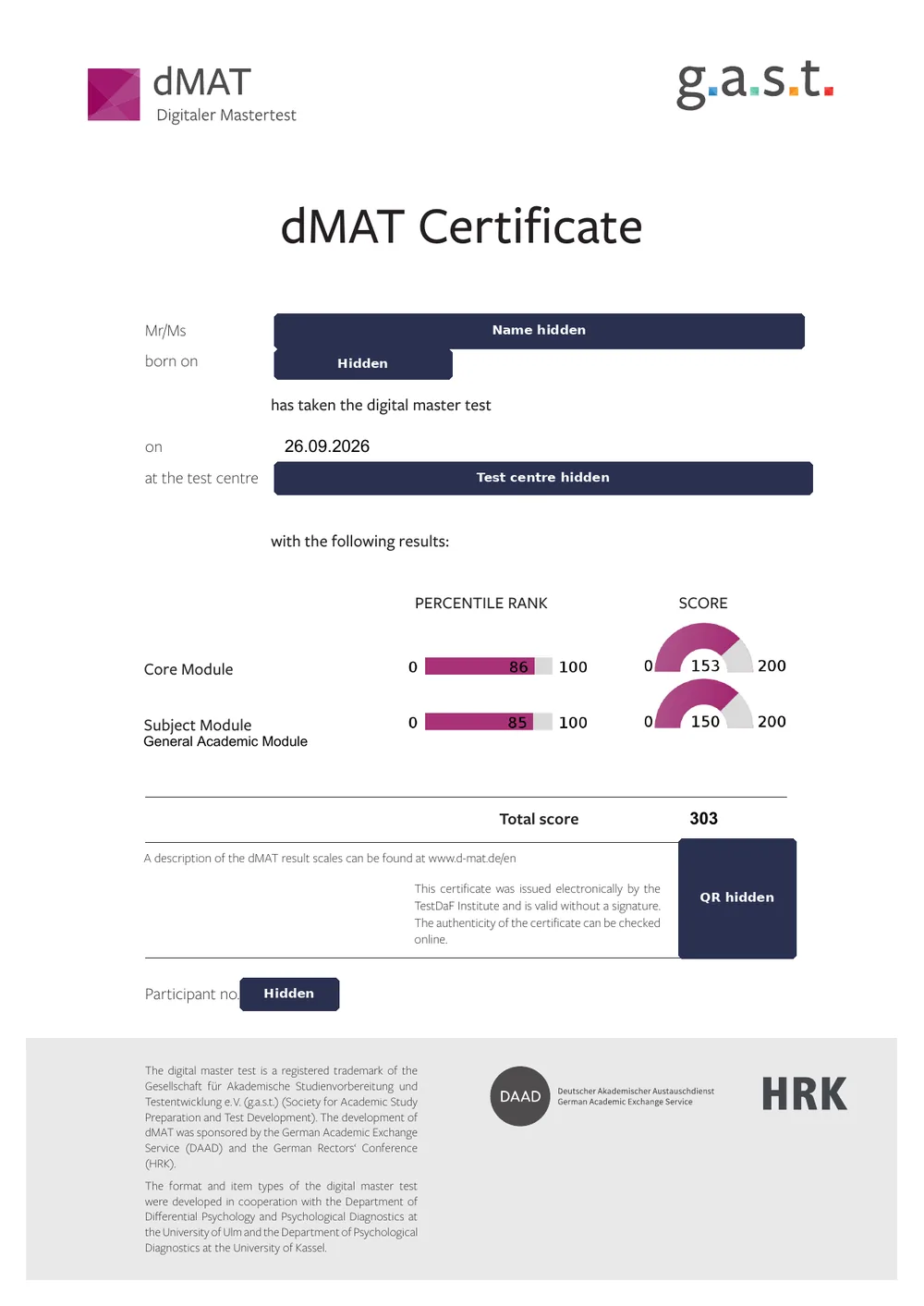
| Core Module | 153 | 86 | Top 14% of candidates |
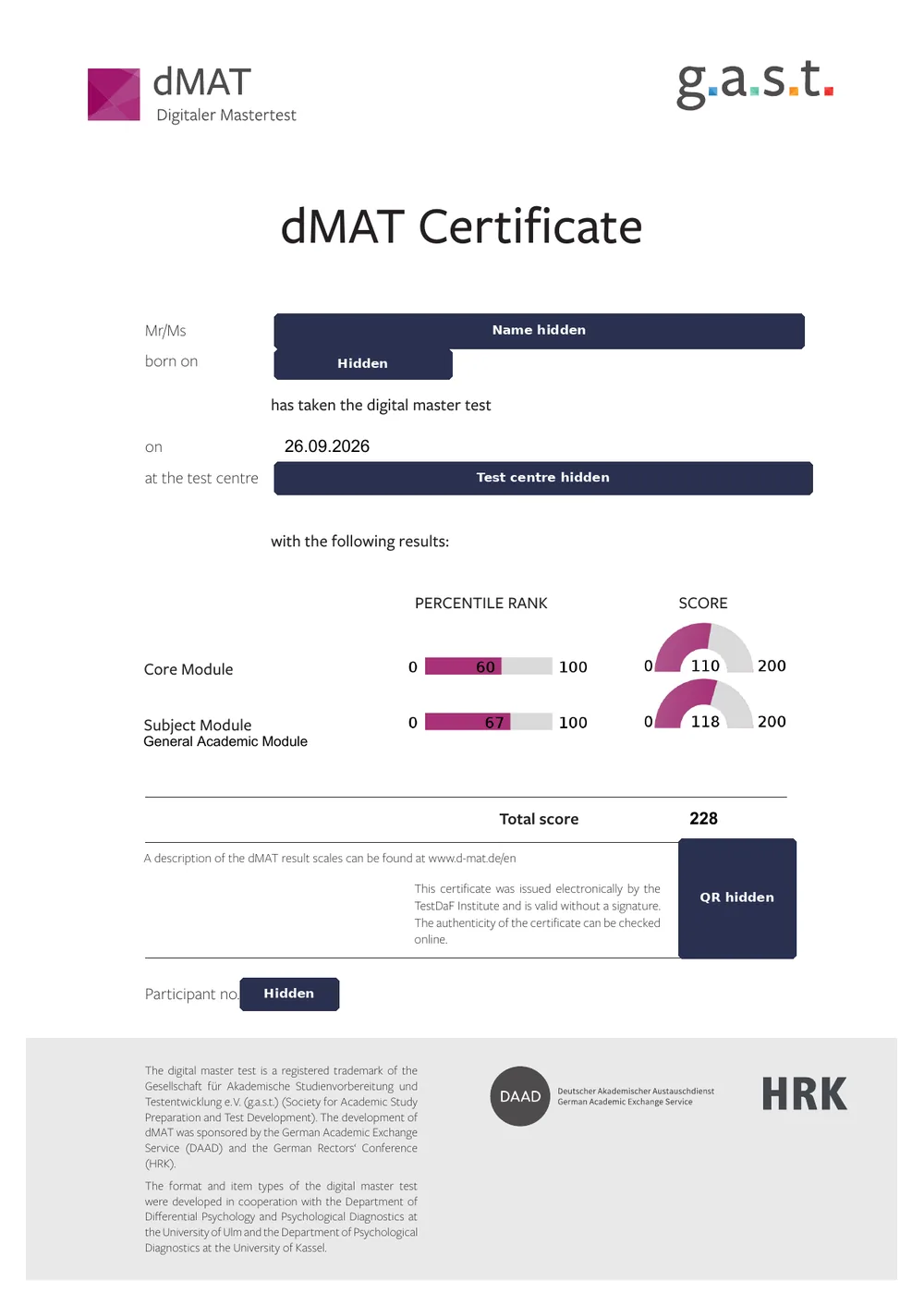
| Core Module | 110 | 60 | Better than or equal to 60% of candidates |
| General Academic Module | 150 | 85 | Top 15% of candidates |
| General Academic Module | 118 | 67 | Better than or equal to 67% of candidates |
From the certificates of two Yastudy students, shown in Why you can trust this guide. Percentiles are calculated against all candidates on all dates, so they can shift slightly as more people take the test.
How to check your dMAT result
- Log in to the g.a.s.t. participant portal on the result date. Results are not sent by e-mail or given by phone.
- Download your dMAT certificate as a PDF and keep the original file unchanged.
- Submit it to APS India (and, if a university asks, to the university or uni-assist).
Step-by-step guide: dMAT result 2026.
Unhappy with your result?
- Score review: request it in the portal within four weeks of the result. It costs €30 for one module or €60 for both, refunded if your result changes.
- See your answers: you can ask g.a.s.t. to inspect your exam after results are out (up to 30 minutes, no notes or devices).
- Complaint about the test centre: send it in writing to the g.a.s.t. Examination Board within five working days of the test.
- Retake: there is no limit on attempts. Each attempt needs a new registration and the full fee.
How long is the dMAT score valid?
g.a.s.t. says the dMAT certificate is valid indefinitely. A September 2026 result still counts for the winter 2027 intake, and you can use a result for a 2028 application. A university that receives the certificate directly may set its own age limit.
How the dMAT fits into the APS process
- Check anabin for your university and degree.
- Register for the dMAT with g.a.s.t.
- Register with APS India and send your complete APS documents. You do not need to wait for the dMAT. APS India can start verifying the rest of your file while you wait for the result.
- Take the dMAT and sign the consent form at the centre.
- Download the dMAT certificate and submit it to APS India.
- Receive your APS certificate. It states that you took the dMAT and shows your results. APS processing takes from a few days to about two weeks in many regular cases, longer if your college is slow to answer verification requests.
- Apply to universities (directly or via uni-assist), then for your student visa.
Send every academic document the first time. Only the dMAT certificate may follow later. APS India does not accept additional or updated mark sheets together with the dMAT certificate for the same APS procedure. A missing semester mark sheet can mean starting a new paid APS application.
For the APS side in detail, see our APS certificate guide. If you want your APS file checked before you courier it, our APS support team does that.
How German universities use the dMAT
Through APS (all affected Indian applicants)
Your dMAT result is printed on your APS certificate, so every university you apply to will see it. Each university decides independently how to weigh it. APS India is clear that a good result does not guarantee admission and a low result does not automatically lead to rejection.
As a selection test with subject modules
A few programmes already use the dMAT with their own subject modules instead of the General Academic Module:
| University | Programme | dMAT module |
|---|---|---|
| RWTH Aachen University | M.Sc. Battery Science and Technology in Engineering | One subject module: Chemistry, Physics, Computer Science, Electrical Engineering or Mechanical Engineering |
| University of Göttingen | M.Sc. (Applied) Data Science | dMAT Data Science: recommended for international applicants and planned as part of selection from the summer 2027 intake |
Programme-wise details: which German universities use the dMAT score.
dMAT and the German student visa
For the visa application, g.a.s.t. states that taking the dMAT is sufficient. No minimum score is needed. What the visa officer needs is your APS certificate, which already reflects the dMAT.
What happens next with the dMAT
The dMAT is only a few months old, and APS India calls 2026 its introductory phase. Some changes are already confirmed; others are our expectation from how the rule has been rolled out so far. We keep the two apart.
Confirmed by APS India or g.a.s.t.
- Confirmed test dates: 16 January 2027 and 13 March 2027; registration is open.
- An updated list of affected degree fields was published on 29 October 2026.
- Every affected APS certificate now shows your dMAT result, so every university you apply to sees it.
- The certificate does not expire and attempts are unlimited.
- The University of Göttingen plans to use dMAT Data Science results in selection from the summer 2027 intake.
What we expect (our assessment)
- A regular test calendar. Two sittings within one quarter suggest dates every few months as demand grows.
- Universities reading the score. Competitive programmes are likely to look at your percentile next to your grades, and some may publish preferred ranges.
- A changing field list. The update could narrow or widen the scope, so borderline degree holders should take the test rather than wait.
- More weight for strong scores from lesser-known colleges. The dMAT is the one result every university can compare directly.
- Scams. Expect "exemption" and "leaked paper" offers. Only APS India grants exemptions, and sharing test content is prosecuted.
What this means for you
- Applying for winter 2027/28? Book the 16 January 2027 test now on the g.a.s.t. portal (registration is open); it leaves March free for a retake.
- Register with APS now and send every academic document in one go.
- Degree on the borderline? Take the test rather than wait for the new field list.
- Aim for above 100 in both modules, the average of all candidates.
- Bookmark d-mat.de and aps-india.de/dmat, or check this page; we update it the day anything changes.
How to prepare for the dMAT
The dMAT rewards practice more than knowledge. The task types never change, there is no calculator and no paper, and the clock is tight. Students who practise the exact formats, in their head and against a timer, improve fastest.
Start with the free official material
- Preparation booklet (PDF, 2 September 2026): full instructions for all three Core task types with six exercises each at low, medium and high difficulty, plus four General Academic exercises, all with worked solutions.
- Five official videos on d-mat.de: an introduction, Figure Sequences, Mathematical Equations, Latin Squares and the subject module, showing how each task looks on screen.
- Demo test in your participant portal under "Exam Preparation", available once you register.
- Digital TestAS material: the Core Module of the digital TestAS uses the same three task types (Figure Sequences, Mathematical Equations, Latin Squares, 25 minutes each), so g.a.s.t.'s TestAS preparation material gives you extra Core practice. It does not cover the General Academic Module.
g.a.s.t. warns that its sample questions may differ in difficulty from the real test, so do not treat them as a full mock.
6-week dMAT study plan (1–1.5 hours a day)
| Week | Focus | What to do |
|---|---|---|
| 1 | Know the test | Read the official booklet end to end. Solve every example untimed and without paper. Watch the five videos. Note which task type feels hardest. |
| 2 | Mathematical Equations | Revise substitution and elimination. Learn tables to 20 × 20. Daily sets of 20 systems, first untimed, then in 25 minutes. |
| 3 | Latin Squares and Figure Sequences | Daily 5×5 grids and figure series. Learn the movement rules (bounce, border, diagonal, x + 1) until you can name them instantly. |
| 4 | General Academic Module | One mixed-subject passage a day: physics, economics, statistics, social science. Answer the questions, then explain each answer in one line. |
| 5 | Speed | Timed sets: 20 Core tasks in 25 minutes; 15 General Academic questions in 22 minutes. Practise skipping, guessing and moving on. |
| 6 | Full rehearsals | Two full-length timed mocks with a 30-minute break, no phone, no paper. Review every mistake. Rest the day before the test. |
Only three weeks left?
Week 1: booklet, videos and untimed practice of all four task types. Week 2: timed Core sets every day and one General Academic passage a day. Week 3: two full mocks and targeted work on your weakest section.
Section-by-section strategy
Figure Sequences
- Track one figure at a time across all four grids; when several figures move, each has its own rule.
- Check in a fixed order: position, then rotation, then colour.
- Count steps between grids. If the count goes 1, 2, 3, it is an "x + 1" rule.
- At the border, decide early whether the figure bounces back or slides along the edge.
- Remember that both the fifth and sixth grid must be right for the task to count.
Mathematical Equations
- Read all the equations first. One usually gives a value directly (B = 6) or a simple link (B = 2 × A).
- Rewrite every letter in terms of one letter, then solve once.
- Use the 1–20 rule to rule out answers fast: a fraction or a negative number means you made a slip.
- Check your answer in one other equation before you click.
Latin Squares
- Start from the row or column with the most letters filled in.
- List the candidates for the "?" from its row, then cut them using its column.
- If two candidates remain, fill a neighbouring cell first, as in sample question 3 above.
General Academic Module
- Read the questions before the text so you know what to look for.
- Formula questions often ask what happens when one input doubles or halves. Reason with the formula instead of calculating.
- Everything you need is in the text. Do not answer from memory if the text says something different.
- Do not get stuck on one passage. About 90 seconds per question means some passages must be finished in four or five minutes.
Last 7 days before the dMAT
- Two full mocks at the same time of day as your real test
- Re-read the task rules once; no new topics
- Check the portal for your centre address and reporting time; plan the route and the travel buffer
- Keep your ID, participant number and exam ID together
- Sleep well the last two nights; pack water in a clear unlabelled bottle and food for the break
Do you need coaching for the dMAT?
Not necessarily. A disciplined student can prepare with the official booklet, the demo and the plan above. Coaching helps most if you need structure, many more practice questions than the official booklet offers, timed full-length mocks, or help with the General Academic Module outside your own subject.
dMAT vs TestAS, GRE, GATE and GMAT
| Test | Run by | Who it is for | Needed for APS India? | What it tests |
|---|---|---|---|---|
| dMAT | g.a.s.t. | Master's applicants; required for affected Indian degree fields | Yes, for affected fields from summer 2027 | Reasoning (Core) and applying academic knowledge (General Academic) |
| TestAS | g.a.s.t. | Bachelor's applicants to German universities | No | Same Core task types as the dMAT, plus a subject module |
| GRE General | ETS | Master's applicants; asked for by some German programmes | No | Verbal reasoning, quantitative reasoning, analytical writing |
| GATE | IISc and IITs | Indian engineering graduates; some German programmes ask for or accept it | No | Subject knowledge in your engineering discipline |
| GMAT | GMAC | Management and MBA applicants | No | Quantitative, verbal and data insights |
g.a.s.t. states that the dMAT does not replace the GRE or GATE. If a programme asks for the GRE, you still need it, and a GRE or GATE score does not exempt you from the dMAT either. See GRE, GATE and GMAT for German Master's, our TestAS preparation and GRE coaching.
dMAT myths vs facts
Most of the confusion about the dMAT comes from second-hand advice. Here is what students tell us they heard, against what g.a.s.t. and APS India actually say.
- "dMAT means Digital Master Aptitude Test" or "Digital Mathematics Test"The official name is digital Master Test. g.a.s.t.'s terms also use "Digital Master Assessment Test". Other expansions are wrong.
- "A low score means APS will reject me"APS India says a low score does not automatically lead to refusal of the APS certificate.
- "There is a cut-off score"No pass mark exists for APS or the visa. Each university decides how to use the result.
- "It is only for engineers"Commerce, accounting, finance, economics, business and management graduates are covered too.
- "Engineers get engineering questions and commerce students get commerce questions"Every APS candidate gets the same tasks, and the General Academic Module mixes subjects.
- "I can take it online from home"Only on a computer at a licensed g.a.s.t. test centre.
- "My GRE or GATE score exempts me"No. The rule depends only on your degree field, intake and APS dates.
- "Private university applicants don't need it"The rule sits inside APS, and you need the APS certificate for the visa whichever university you choose.
- "I need German for the dMAT"The modules for APS are in English.
- "I must finish the dMAT before I apply for APS"No. Send your APS documents first and add the dMAT certificate later.
- "The certificate expires after two years"g.a.s.t. says it is valid indefinitely; only a university receiving it directly can set a limit.
- "An agent can get me an exemption or an earlier date"Exemptions are decided only by APS India, and dates only by g.a.s.t. Nobody else can change either.
- "I can share the questions online after the test"Forbidden. g.a.s.t. says any breach will be prosecuted.
10 dMAT mistakes that cost Indian students an intake
- Guessing your eligibility from "CS" or "IT". B.Tech CSE is covered; BCA and B.Sc. Computer Science are not automatically. Check your exact degree title.
- Waiting for the dMAT before starting APS. Send your APS documents now; APS India can verify them in the meantime.
- Sending an incomplete APS file. Only the dMAT certificate can follow later, never extra mark sheets.
- Booking the March sitting for an early-deadline programme. Map your university deadlines first, then pick the sitting.
- Entering a name that does not match your passport. After registration, only g.a.s.t. can change it.
- Forgetting the photo upload. No photo by the deadline means no entry.
- Bringing a different ID. Registered with Aadhaar? Bring that Aadhaar. Got a new passport? Update it in the portal.
- Arriving late. Once the general instructions start, the door closes, and the fee is lost.
- Not signing the consent form. Without it, your result cannot reach APS India.
- Practising with pen and paper. The real test allows no notes at all. Practise in your head from day one.
Why you can trust this guide
This page is written by the team that prepares Indian students for the dMAT every week, and every rule on it links back to g.a.s.t. or APS India.
Results from our students
Two students who prepared with Yastudy for the first dMAT in India agreed to share their certificates. Both scored above the average of 100 in both modules, and one finished in the top 15% in both. Names, dates of birth, test centres, participant numbers and QR codes are hidden.
Who writes and reviews this page
The Yastudy Germany Desk writes it, and our dMAT trainers review the exam sections. Team members have studied in Germany themselves, at a Studienkolleg and in a German-taught degree at TU Munich, and our counsellors plan APS and dMAT timelines for Master's students every week. Our trainers teach every task type from the official g.a.s.t. material, without notes, the way the test is taken.
How we check it
- Rules, dates and fees come only from g.a.s.t., APS India and the universities themselves, and each one is linked in the sources at the end.
- Where we give our own view, such as what a good score is or what will happen next, we say so.
- The sample questions are our own and labelled as such. We never publish live test content; g.a.s.t. prohibits it.
Update log
- Confirmed 2027 test dates (16 January and 13 March), registration open on g.a.s.t. portal, updated degree field list of 29 October 2026, and new November batches.
- Added the mid-January and mid-March 2027 test dates and APS India's notice of an updated field list; new sections on why the dMAT applies to India and what happens next; eligibility checker; two student certificates and real score-to-percentile points; exam-level practice questions.
- All facts re-checked against g.a.s.t. and APS India after the first test.
Spotted something out of date? E-mail admission@yastudy.com with "Correction" in the subject line.
Yastudy is the study-abroad and test-prep brand of Europass Immigration Private Limited (CIN U69202BR2023PTC063627). We are not part of, or authorised by, g.a.s.t., APS India or the German Embassy. Test dates, rules and results come only from them.
Prepare for the dMAT with Yastudy
Smart preparation for the dMAT
About 110 students prepared for the dMAT with Yastudy trainers this intake. Every course is built around the official task types, the real time limits and the no-notes rule, with practice at the official "high" difficulty level.
| Course | Best for | What you get |
|---|---|---|
| dMAT Live Course (60 days) | Students who want a teacher and a timetable | Live online classes, recordings, study material, timed mock tests, performance reports, WhatsApp doubt support |
| dMAT Complete Preparation | Self-paced learners | Recorded classes for every task type, practice sets and mock tests |
| dMAT Crash Course (30 days) | The last weeks before your test | Short, intensive revision and full-length practice |
| APS Support | Anyone sending an APS file | Your APS document set checked before you pay the fee and courier it |
Applying for a Master's in Germany as well? Our Master's in Germany guide covers universities, costs, applications and the visa.
dMAT FAQs: 53 questions Indian students ask
No question matches that. Try "fee", "BCA", "centre" or "score".
Basics
What is the dMAT exam?
The dMAT (digital Master Test) is a computer-based aptitude test for Master's study in Germany, run by g.a.s.t. Since 29 June 2026 it has been a required part of the APS documents for Indian Master's applicants whose degree is in engineering, commerce, accounting, finance, economics, business or management, from the summer semester 2027 intake onwards.
What is the full form of dMAT?
digital Master Test. g.a.s.t.'s terms and conditions also call it the "Digital Master Assessment Test". Expansions such as "Digital Master Aptitude Test", "Digital Master Admission Test" or "Digital Mathematics Aptitude Test" are wrong.
Who conducts the dMAT?
g.a.s.t. (Gesellschaft für Akademische Studienvorbereitung und Testentwicklung e.V.) in Bochum, the non-profit that also runs TestDaF and TestAS. APS India requires the certificate but does not conduct the test.
Is the dMAT mandatory for a Master's in Germany?
Only for Indian Master's applicants whose previous degree is in engineering; commerce, accounting, finance or economics; or business or management, who apply for the summer semester 2027 or later and who registered with APS and shipped their APS documents on or after 29 June 2026. For everyone else it is optional.
Why did Germany introduce the dMAT?
According to the German Embassy, Indian institutions and grading practices vary so much that transcripts alone do not always give German universities comparable information. The dMAT adds one standardised result. The Embassy said it is not meant to discourage qualified Indian students.
Does the dMAT replace the APS certificate?
No. It is an additional document inside the APS procedure. APS India still verifies your documents, and it issues the APS certificate only after your dMAT certificate has been submitted and checked.
Is the dMAT the same as TestAS?
No. Both are run by g.a.s.t. and share the same Core task types, but TestAS is used for Bachelor's admission, while the dMAT is for Master's applicants and is part of APS for affected Indian degree fields.
Does the dMAT replace the GRE or GATE?
No. g.a.s.t. says the dMAT does not replace tests such as the GRE or GATE. If a programme asks for the GRE, you still need it, and a GRE or GATE score does not exempt you from the dMAT.
Eligibility
Do B.Tech students need the dMAT?
Yes, if the official branch is an engineering field, such as Mechanical, Civil, Electrical, Electronics and Communication or Computer Science and Engineering. A B.Tech with a non-engineering or unclear branch, such as standalone AI, Data Science or Biotechnology, is not automatically covered.
Do B.Tech CSE and IT students need the dMAT?
B.Tech Computer Science and Engineering, Computer Engineering and Information Science and Engineering are covered. B.Tech "Information Technology and Engineering" is covered, but Information Technology as a standalone title is not automatically included.
Do BCA or B.Sc. Computer Science graduates need the dMAT?
Not automatically. APS India lists BCA, Computer Applications, B.Sc. Computer Science, B.Sc. IT and B.Sc. Data Science among fields not automatically included, unless APS classifies your official degree into one of the three affected groups.
Do B.Com and BBA graduates need the dMAT?
Yes. B.Com and its specialisations, accounting, finance and banking degrees, and BBA, BBM and BMS are affected fields. Sector-specific BBAs such as Hotel, Tourism, Aviation or Hospital Management are assessed separately by APS India.
Do B.A. or B.Sc. graduates need the dMAT?
B.A. and B.Sc. Economics graduates do, because economics is in the commerce group. Other B.A. and B.Sc. degrees, such as Physics, Chemistry, Mathematics, Biotechnology or humanities subjects, are not automatically included.
Do I need the dMAT for an MBA or MIM in Germany?
It depends on your previous degree, not on the programme you apply for. A B.Tech or B.Com graduate applying for an MBA or Master in Management needs it; a B.Sc. Physics graduate does not, unless APS classifies the degree differently.
I am in my final year. Do I need the dMAT?
If your degree is in an affected field and you apply for the summer semester 2027 or later, yes. APS India exempts only Bachelor's students who have not yet completed at least 5 semesters of a 3-year programme or 7 semesters of a 4-year programme.
I already have an APS certificate. Do I need the dMAT now?
No. Applicants who have completed the APS procedure do not have to take the dMAT for that procedure. If you ever submit a new APS application, the rules in force at that time apply.
Can I take the dMAT voluntarily?
Yes. g.a.s.t. allows anyone to take the dMAT. It is worth considering if your degree is a borderline case or if a university you are targeting values the score.
Do I need the dMAT for the winter 2026/27 intake?
No. The requirement applies to the summer semester 2027 intake and later intakes.
Exam pattern and syllabus
What is the dMAT exam pattern?
Two modules in English with single-choice questions. The Core Module has Figure Sequences, Mathematical Equations and Latin Squares, 20 tasks and 25 minutes each, scheduled as a 90-minute block. After a 30-minute break comes the 90-minute General Academic Module with about 60 questions on short academic texts.
How many questions are in the dMAT?
About 120: 60 in the Core Module (20 per subtest) and about 60 in the General Academic Module. g.a.s.t. says the General Academic count is an average and can be slightly higher or lower.
How long is the dMAT exam?
About three and a half hours: two 90-minute modules and a 30-minute break. Add time for check-in and identity checks.
Is there a dMAT syllabus?
No official syllabus is published. The Core Module tests reasoning skills, and the General Academic Module gives you the information within each problem, with topics from mathematics, computer science, natural sciences, engineering, business, economics, social sciences and humanities.
Is there negative marking in the dMAT?
g.a.s.t. describes the score as a conversion of the number of correct answers, and its preparation material tells candidates to guess when unsure. Answer every question.
Can I use a calculator or rough paper in the dMAT?
No. Calculators, rulers, notepaper and note-taking are not allowed, and electronic devices are banned. A breach means immediate exclusion.
Is the dMAT in English or German?
English. The current subject modules, including the General Academic Module used for APS, are administered in English.
Is the dMAT difficult?
The concepts are simple, but the conditions are hard: 75 seconds per Core task, no paper, and academic texts from outside your subject. With four to six weeks of targeted, timed practice, most students handle it well.
Dates, fee and registration
When is the next dMAT exam?
On 16 January and 13 March 2027 (confirmed by APS India on 29 October 2026). Registration opened on 28 October 2026 on the g.a.s.t. portal. Deadlines are 4 January 2027 (results 8 February) and 1 March 2027 (results 5 April).
When does dMAT registration for 2027 open?
Not yet. Registration opened on 28 October 2026 on the g.a.s.t. portal. Deadlines are 4 January 2027 (for the 16 January test) and 1 March 2027 (for the 13 March test).
What is the dMAT exam fee in rupees?
€150, paid online to g.a.s.t. when you register. That is about ₹16,500 at roughly ₹110 to the euro; your bank's rate and card charges decide the exact amount. It is separate from the ₹18,000 APS fee.
How do I register for the dMAT?
Online through the g.a.s.t. registration portal: choose a test date and centre, create an account with your name exactly as in your passport, upload a passport-style photo and pay €150. Registration is complete only after payment.
Can I take the dMAT online from home?
No. The dMAT is taken only on computers at licensed g.a.s.t. test centres.
Where are the dMAT test centres in India?
For the first sitting: Ahmedabad, Bengaluru, Bhopal, Chandigarh, Chennai, Kolkata, Mananthavady, Mumbai, New Delhi and Pune. The test is also offered in Berlin and Kathmandu. The final list for each date appears during registration.
Is there a dMAT test centre in Hyderabad, Patna or Lucknow?
Not in the first sitting's list. Students from Telangana usually choose Bengaluru or Chennai, students from Bihar choose Kolkata or New Delhi, and students from Uttar Pradesh choose New Delhi. Check the list when registration opens, as centres can be added.
Can I cancel or reschedule my dMAT?
You can cancel in the portal until the registration deadline and get the fee back minus up to 15%. Within 14 days of booking you also have a statutory right of withdrawal. After the deadline there is no refund. Date or centre changes need g.a.s.t.'s agreement.
Which ID do I need on dMAT test day?
The same original ID you used to register: a passport or Aadhaar card for Indian candidates. If you received a new passport after registering, update it in the participant portal first.
Score and result
How is the dMAT scored?
Each module gets a dMAT score from 0 to 200, with a mean of 100, and a percentile rank. The total score is the sum of the two module scores. Results are compared with all candidates at all centres and dates.
What is a good dMAT score?
There is no official benchmark yet. Scores above 100 are above average, and a percentile rank of 70 or more puts you in the top 30%, a sensible target for competitive programmes. On the 26 September 2026 test, a score of about 150 in either module was roughly the 85th percentile.
What is the dMAT passing score or cut-off?
There is none for APS or the visa. A low score does not automatically lead to refusal of the APS certificate. Universities decide individually how to use the result.
When are dMAT results announced?
For the 26 September 2026 test, results were published on 12 October 2026, 16 days later. Result dates for the January and March 2027 tests will be announced with the test dates.
How do I download my dMAT certificate?
Log in to the g.a.s.t. participant portal on the result date and download the certificate as a PDF. Results are not sent by e-mail or phone. Then submit the certificate to APS India.
Can I get my dMAT result re-checked?
Yes. Request a review in the portal within four weeks of the result. It costs €30 for one module or €60 for both, refunded if your result is corrected.
How many times can I take the dMAT?
As many times as you like. Each attempt needs a new registration and the full €150 fee.
How long is a dMAT score valid?
g.a.s.t. says the certificate is valid indefinitely. A university that receives it directly may set its own age limit.
APS, universities and visa
Will a low dMAT score get my APS certificate rejected?
No, not by itself. APS India states that a low score does not automatically lead to refusal of the APS certificate, provided the other APS requirements are met.
Can I submit my APS documents before taking the dMAT?
Yes. APS India can start checking your documents before the dMAT certificate is available. Only the dMAT certificate may follow later; all academic documents must be in your first submission.
Do German universities see my dMAT score?
Yes. Your dMAT result is printed on the APS certificate, so every university you apply to can see it and decide how to weigh it.
Do I need a minimum dMAT score for the German student visa?
No. g.a.s.t. states that taking the dMAT is sufficient for the visa application.
Preparation
How long does it take to prepare for the dMAT?
Most students need four to six weeks at one to one and a half hours a day. Three weeks can work if you already practise mental maths and reading regularly.
Where can I find official dMAT preparation material?
On d-mat.de: the preparation booklet with instructions, exercises and worked solutions, and five videos. Once you register, a demo test is available in the participant portal under "Exam Preparation".
Can I prepare for the dMAT without coaching?
Yes. Many students prepare with the official booklet, the demo and a timed study plan. Coaching helps if you want structure, more practice questions and full-length mock tests.
Why India and what's next
Why does the dMAT apply only to Indian students?
The requirement is part of APS India's procedure for applicants with Indian degrees. The German Embassy explained that Indian institutions and grading practices vary widely, so a standardised test helps German universities compare applicants. The test itself is open to anyone and is also offered in Germany and Nepal.
Will more degree fields be added to the dMAT list?
APS India published an updated list of affected fields on 29 October 2026. It adds mixed B.Sc., B.A. and B.Com degrees whose main subject is commerce, economics, business or management, and exempts bachelor students with fewer than 5 semesters (3-year degree) or 7 semesters (4-year degree).
Will German universities set minimum dMAT scores?
None had published a minimum for the General Academic Module by October 2026. Each university decides how to use the result, so check the admission page of every programme you apply to.
More dMAT guides from Yastudy
- Who needs the dMAT: degree-by-degree checker
- dMAT exam dates 2027 and registration tracker
- dMAT exam pattern and syllabus
- dMAT result 2026: certificate, score and next steps
- Figure Sequences: rules and practice questions
- Mathematical Equations: method and practice questions
- Latin Squares: method and practice questions
- General Academic Module: sample passages and questions
- Free timed dMAT sample test
- Which German universities use the dMAT score
- APS certificate for Indian students
Sources
All checked on 31 October 2026.
- APS India: Digital Master Test (dMAT) for selected Master's applicants in India (updated 15 October 2026)
- APS India: dMAT India: List of Affected Previous Degree Fields, Version 1.0 (29 June 2026)
- APS India: News and updates (UGC accreditation notice of 3 June 2024; Class XII criteria of 23 February 2026)
- g.a.s.t.: dMAT for graduate students in India
- g.a.s.t.: FAQ: dMAT for graduate students in India
- g.a.s.t.: dMAT overview, structure, certificate and universities
- g.a.s.t.: Terms and Conditions, including the special terms for the dMAT
- g.a.s.t.: dMAT Preparatory Materials, General Academic Module (PDF) (2 September 2026)
- g.a.s.t.: Information for Exam Candidates on 26 September 2026 (PDF)
- g.a.s.t.: Structure of the digital TestAS
- German Consulate General Mumbai: Visa newsletter on the APS requirement (4 October 2022)
- University of Göttingen: Applied Data Science M.Sc.: application (18 June 2026)
- The PIE News: Germany adds new test to pre-visa checks for Indian master's applicants (7 July 2026)
- The PIE News: Germany says new dMAT will not be a "pass-fail barrier" for Indian students (15 July 2026)
- The PIE News: Number of Indian students in Germany rises to record high (26 August 2026)
- Kashmir Reader: DAAD figures on Indian students in Germany by subject (11 September 2024)