How to Prepare for a University Admission Interview Abroad
Divyanshi Singh
Recently • 8 min read

How to Prepare for a University Admission Interview Abroad
You have submitted your applications, and now an email arrives: the university would like to interview you. For many international applicants, this brings excitement and nerves in equal measure. The good news is that admissions teams only invite candidates they are seriously considering. A university admission interview is your chance to show who you are beyond your grades, test scores, and essays.
This guide covers everything you need to prepare for a study abroad interview, from understanding interview formats to answering common questions, handling online interviews across time zones, and following up afterwards.
Planning to Study Abroad?
Get personalized guidance from experienced education counselors.
Why Universities Conduct Admission Interviews
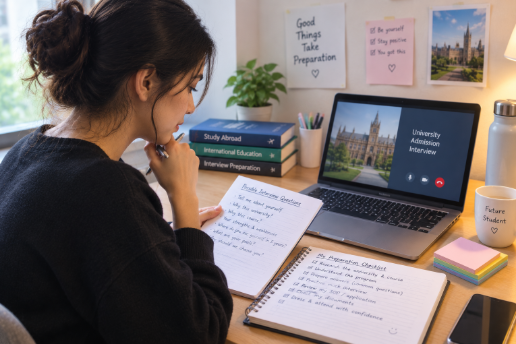
Your application shows what you have done. The interview shows who you are. Admissions officers use interviews to:
• Verify authenticity: confirm that your achievements and essays are genuinely yours.
• Assess communication skills: check that you can express ideas clearly, especially if you will study in a second language.
• Evaluate fit: see whether your goals match the course and campus culture.
• Understand your potential: gauge curiosity, maturity, and how you think through problems.
Treat it as a two-way conversation. You are also deciding whether the university is right for you.
Types of University Admission Interviews
Find out your format early, because preparation differs for each one.
• Alumni interviews: informal, 30 to 60 minutes, common for US colleges. Expect questions about your interests and motivation.
• Admissions officer interviews: more structured, focusing on academics, goals, and readiness for life abroad.
• Academic interviews: used by Oxford, Cambridge, and other competitive programs. You may be given a problem and asked to think aloud.
• Multiple Mini Interviews (MMI): short timed stations for medicine, dentistry, and veterinary courses, testing ethics, communication, and teamwork.
• Online and recorded interviews: live video calls on Zoom or Teams, or asynchronous recordings on platforms such as Kira Talent.
Note: a student visa interview at an embassy is a separate process and needs its own preparation.
Preparation also reduces stress. When you know what to expect, you can focus on listening and connecting with the interviewer instead of worrying about surprises.
Research the University and Course
Specific enthusiasm is far more convincing than generic praise. Before your interview, research:
• The course: modules, teaching style, placements, and two or three subjects that genuinely excite you.
• The faculty: professors whose research matches your interests. Mentioning a recent paper shows real initiative.
• Campus life: societies, research centers, internships, and how you could contribute.
• The city and country: show you have thought about living there, not just studying there.
Create a one-page cheat sheet for each university with course details, key facts, and three reasons you are a strong fit. Review it the night before, but do not memorize it word for word.
Common University Interview Questions and How to Answer Them
Questions about you
"Tell me about yourself." Do not recite your CV. Use a present, past, future structure in 60 to 90 seconds: what you are doing now, how you got here, and where you want to go.
Example: "I'm currently finishing my final year in science, where a school project on water quality sparked my interest in environmental engineering. That led me to volunteer with a local cleanup group, and now I want to study this at your university, where the sustainable cities program lets me work on real urban problems."
Questions about motivation
Expect "Why this subject?", "Why our university?", and "Why study abroad instead of at home?". Avoid answers like "foreign universities are better." Instead, name specific research strengths, teaching methods, or interdisciplinary opportunities that support your goals.
Questions about experience
For "Describe a challenge you overcame" or "Tell me about a failure," use the STAR method: Situation, Task, Action, Result. Spend the most time on what you learned, since reflection matters more than the achievement itself.
Questions about academic interests
Be ready to discuss a book, article, documentary, or personal project in depth. If you mention it, expect follow-up questions.
Questions about life abroad
Show maturity and realism: how you will build a support network, adapt to a new culture, and manage your budget.
Questions you should ask
Never answer "Do you have any questions?" with no. Try: "What do first-year students find most challenging, and how does the department help?" or "Can undergraduates get involved in research?" Avoid questions answered on the website.
Practice Your Interview Answers Out Loud
Knowing your answers and delivering them are different skills. To build confidence:
• Record yourself on video and check filler words, speed, eye contact, and posture.
• Do mock interviews with a teacher, counselor, alumni, or a friend. Practicing with someone unfamiliar feels closer to the real thing.
• Think aloud for academic interviews. Say "My first instinct is X, but that might not work because..." Interviewers value your reasoning process.
• Time your answers. Most should last one to two minutes.
• Listen to native accents from your destination country through podcasts and lectures.
If English is not your first language, do not worry about a perfect accent. Speak slightly slower than feels natural, ask politely for clarification if needed, and describe a word in other terms if you forget it. Clarity and confidence matter most.
Prepare for an Online University Interview

• Time zones: convert the time carefully and confirm whose time zone is listed.
• Technology: test your internet, camera, microphone, and the platform a day before. Keep a mobile hotspot as backup and note the interviewer's contact details.
• Environment: choose a quiet, well-lit room with a neutral background, face the light, and silence your phone.
• In-person interviews: arrive in the city the day before, plan your route, bring printed documents, and arrive 15 minutes early.
Dress, Body Language, and Cultural Awareness
Dress smart but comfortable, in solid, muted colors. On video, look at the camera when speaking, sit upright, and smile naturally. In many Western universities, interviewers expect you to speak confidently about your achievements and share your own opinions. That is not bragging as long as you are honest and gracious. Respectful disagreement is often welcomed.
How to Manage Interview Nerves
• Reframe: nervousness and excitement feel alike, so tell yourself "I am excited."
• Breathe: inhale for four counts and exhale for six before you begin.
• Pause: it is fine to say "Let me think for a second."
• Accept imperfection: one small slip will not define your interview.
• Look after yourself: sleep well and eat something light beforehand.
Common Admission Interview Mistakes to Avoid
Do not memorize scripts, skip university research, criticize your school or country, overuse buzzwords like "passionate" without evidence, exaggerate achievements, or arrive with unresolved technical problems. If you do not know an answer, say so honestly and explain how you would find it.
After the Interview: Follow Up
Send a short thank-you email within 24 hours. Thank them, mention one topic you enjoyed discussing, and restate your interest. Then reflect on what went well, and get back to your other applications, scholarships, and visa planning.
Interview Preparation Timeline
• 2 to 3 weeks before: research the university, create your cheat sheet, and identify key stories.
• 1 to 2 weeks before: practice aloud and complete one or two mock interviews.
• 3 to 4 days before: test technology, set up your space, and confirm the time zone.
• Day before and day of: review notes lightly, sleep well, log in early, and smile.
Final Thoughts
Preparing for a university admission interview abroad is about telling your story clearly and honestly: why you love your subject, what you have done to pursue it, and why this university is the right place to continue. You do not need to be a perfect candidate. You need to be a genuine, well-prepared one. Remember that your interviewer is usually rooting for you and hoping to meet someone who will thrive on campus.
Frequently Asked Questions (FAQ)
How long does a university admission interview last?
Most last 20 to 60 minutes. Multiple Mini Interviews use several stations of 5 to 10 minutes each.
How do I prepare for a university interview abroad?
Research the course and faculty, practice common questions aloud, run a mock interview, test your technology, and prepare questions to ask the interviewer.
What should I wear to an online university interview?
Wear smart, neat clothing in solid, muted colors. Dress fully, not just from the waist up, to help you feel focused.
What if I don't understand a question during the interview?
Politely ask the interviewer to rephrase it. This is completely acceptable and shows good communication skills.
Is an admission interview the same as a student visa interview?
No. The admission interview is with the university and decides your place. The visa interview is with an embassy or consulate and assesses your eligibility to study abroad.
How do I answer "Why do you want to study abroad?"
Be specific. Mention a particular research strength, teaching style, or opportunity at that university, and explain how an international experience supports your long-term goals.
Can I bring notes to an online interview?
Check the instructions first. A small list of your questions for the interviewer is usually fine, but avoid reading answers from a screen, as it makes you sound scripted.
Should I send a thank-you email after my interview?
Yes. A short, sincere email within 24 hours thanking the interviewer and mentioning one topic you enjoyed leaves a positive final impression.
What happens if my internet fails during a video interview?
Reconnect quickly, then email or call the contact person listed in your invitation. Universities understand that technical problems happen, especially across countries.
Does a poor English accent affect my chances?
No. Interviewers care about clarity, confidence, and engagement, not a perfect accent.
Start Your Study Abroad Journey
Join thousands of students who achieved their dreams with Yastudy.