Change University After Student Visa? Country-Wise Guide 2026
Divyanshi singh
Recently • 8 min read
Can You Change Your University After Getting a Student Visa? A Country-Wise Guide (Canada, USA, UK, Australia & Germany 2026)
By Yastudy | Updated November 2026 | Rules, steps and risks for Indian students
Planning to Study Abroad?
Get personalized guidance from experienced education counselors.
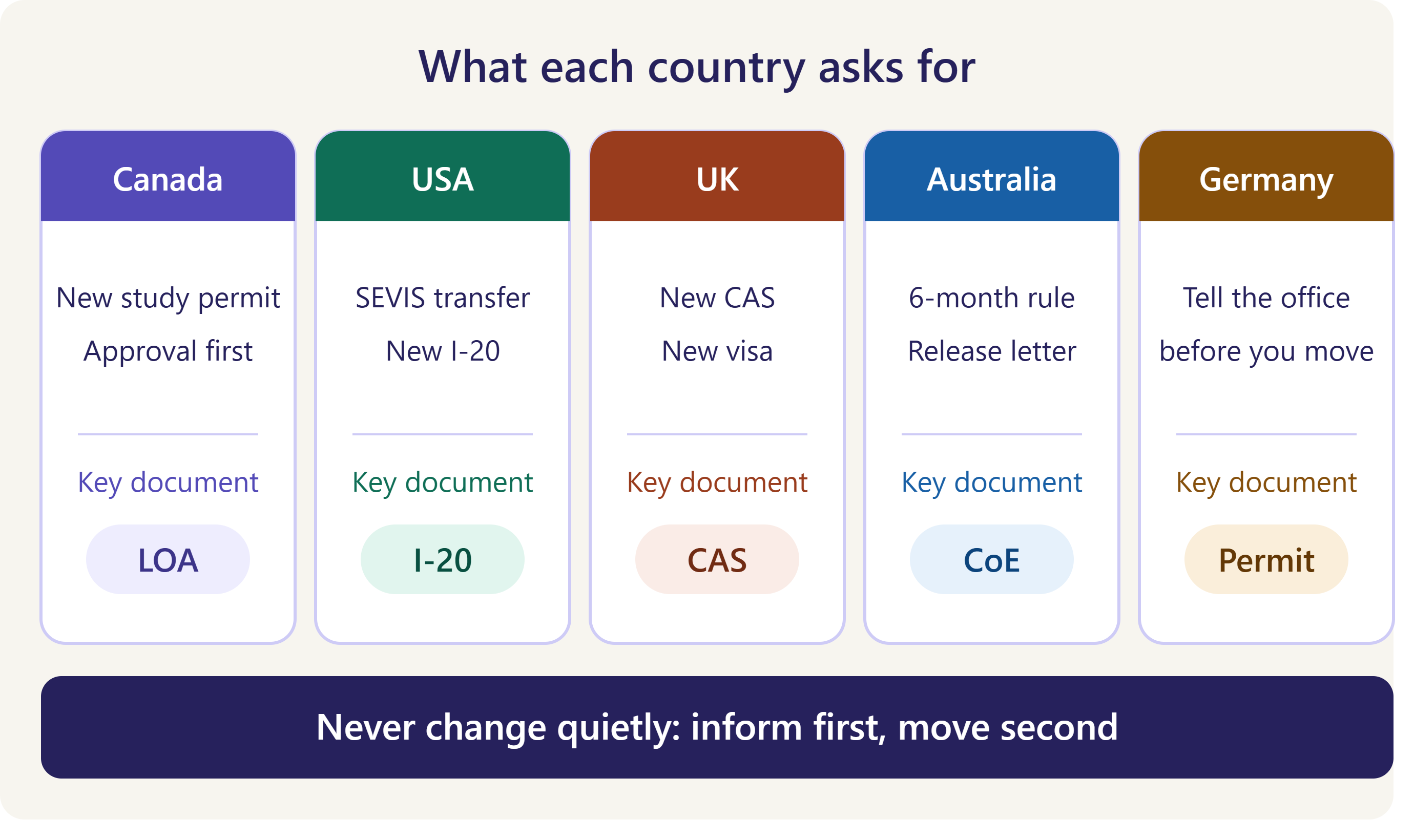
Quick answer: Yes, you can often change your university or course after getting a student visa, but never quietly. Your visa is tied to something specific, such as a school, a course or a study record. In Canada you now need a new study permit before you switch. In the UK a new university means a new CAS and a new Student visa. In the USA you do an official SEVIS transfer and get a new I-20. In Australia you must usually finish six months of your main course first, or get a release letter. In Germany you tell the foreigners’ office before you change. Move first and ask later, and you can lose your visa.
1. Why Students Want to Change (and Why It Is Not Unusual)
Almost every student has a moment of doubt after getting the visa. Maybe you did not expect this:
• A better scholarship arrives from another university after you have already paid a deposit.
• You realise the course is not what you thought, or it does not match your career plan.
• The city is too expensive or too far from jobs.
• Your education loan was sanctioned for a different amount, and the first choice no longer fits the budget.
• You find out the university’s reputation or placement record is weaker than the brochure said. Our guide on how to check if a foreign university is genuine can help you spot these problems early.
• Your visa was refused for one university, and you want to try another. Read about your options in our post on deferred admission after visa rejection.
Changing your mind is normal. The danger is changing it in the wrong way. This guide explains how each country treats a change of university or course, step by step.
2. The Golden Rule: Know What Your Visa Is Tied To
A student visa is not a general permission to study anywhere. It is linked to a specific record.
Country | What your permission is tied to | Key document |
Canada | A Designated Learning Institution (DLI) named on a post-secondary study permit | Letter of Acceptance (LOA) and study permit |
USA | A school’s SEVIS record | Form I-20 |
UK | A licensed sponsor (university) and a course | Confirmation of Acceptance for Studies (CAS) |
Australia | A course at a registered provider, with conditions on level and progress | Confirmation of Enrolment (CoE) |
Germany | Your purpose of stay (study), with notes about your university and course on the permit | Admission letter and residence permit |
Once you know this, the rest is simple. Changing your university means changing the thing your permission is attached to, so the immigration system must be told, and in some countries it must approve first.
3. Two Very Different Situations
Situation A: You have the visa but have not travelled yet
This is the more delicate case. The visa or permit was issued based on one admission. If you plan to switch before you fly, you usually need a new admission document from the new university and a clear answer from the embassy or immigration authority about whether the visa can be used, updated or must be applied for again. Never travel on a document for a university you do not plan to attend.
Situation B: You are already in the country
Here the process is more established, but the rules are stricter in some countries. In most cases you must notify the authorities or the university’s international office before you leave the first programme. Doing it in the wrong order is the most common way students put their status at risk.
4. Canada: Changing Your DLI
The rule since November 2024
Before 8 November 2024, many post-secondary students could change school by simply updating IRCC through their online account. That is no longer possible. According to the University of Victoria’s guidance on IRCC changes, students who want to change DLIs must either apply to extend their current study permit from inside Canada or apply for a new study permit from outside Canada. The BC Institute of Technology says the same thing: a change of DLI means applying for a study permit extension.
What you generally need
• A new Letter of Acceptance from the new DLI
• A Provincial or Territorial Attestation Letter (PAL/TAL), unless you qualify for an exemption. UVic notes that from 1 January 2026, students applying for a master’s or doctoral degree at a public DLI no longer need a PAL
• A letter explaining why you are changing schools
• Supporting documents such as proof of funds and transcripts, if IRCC asks for them
Can you start at the new school straight away?
Not any more. Interim measures that allowed some students to start while waiting expired on 1 May 2025. Law firms and universities now advise that you should wait for approval of the new permit before you begin studies at the new school. While you wait, you must keep meeting all the conditions of your current permit.
Extra Canada tips
• Check that the new school is on the official DLI list before you accept.
• Check that your new programme is eligible for a post-graduation work permit if that matters to you.
• Remember the financial proof rules. Our guide on Canada’s CAD 20,635 financial proof rule explains what to prepare.
• If a permit application is refused, read our post on what to do if your Canada student visa is rejected.
Risk if you ignore the rule: studying at a school that is not named on your permit can lead to the permit being cancelled and, in serious cases, removal from Canada.
5. USA: The F-1 SEVIS Transfer
How it works
In the United States, an F-1 student is allowed to transfer to another school or programme, and the process is official and clear. The Department of Homeland Security’s Study in the States page explains the steps:
1. Tell your Designated School Official (DSO) at your current school that you want to transfer.
2. Your DSO and the DSO at the new school choose a transfer release date. On that date, the new school becomes responsible for your SEVIS record.
3. After the release date, your new DSO issues you a new Form I-20.
4. Register for classes and contact your new DSO within 15 days of the program start date shown on the new I-20.
Until the transfer release date, you must keep your status at your current school by studying full time (or being on authorised practical training).
Your visa stamp
Many US universities explain that if your F-1 visa stamp is still valid, you do not need a new visa just because you transferred schools. The school name on your old visa may not match your new I-20, and that is normal. If you leave the US and your visa has expired, you will need a new visa to come back, using the new school’s I-20.
If you have a visa but have not entered the US yet
If you want to attend a different school from the one on your visa, talk to the DSO at the new school before you travel. ICE guidance for school officials and several US universities say you will usually need a new I-20 from the new school, and in many cases a new visa that matches the new school’s record. Do not enter the US using the first school’s I-20 if you do not plan to attend it.
Gaps and timing
• If more than five months pass between your last F-1 activity and your new programme start, you may not be eligible for a normal transfer and may need a new initial I-20.
• After finishing a programme, you have a 60-day grace period in which a transfer can be completed.
• Missing the 15-day check-in at the new school can put your status at risk.
For the wider US picture, read our guides on the new fixed-term F-1 rules and social media screening for US visas.
6. United Kingdom: New University Means New CAS and New Visa
Changing sponsor
Your UK Student visa is linked to the university or college that sponsors you. If you want to move to a different institution, you cannot just stop attending one and start at another. UK immigration guidance summarised by advisers and universities says that changing sponsor requires a new Student visa application with a new CAS from the new sponsor, and you must not start at the new institution until the new permission is granted.
Many students can make this application from inside the UK, provided they meet the requirements. One university’s guidance adds that you will need to withdraw from your current programme, and you may have to meet academic progression rules.
Changing course at the same university
This is sometimes simpler. Within the same sponsor, the university may be able to report a change of course to the Home Office without a new visa application, but only if certain conditions are met. For example, if the new course would run past your visa expiry date, or is not closely related to your original course, you will normally need a new period of permission first. Always ask your university’s international student advice team before you make any change.
UK checklist
1. Make sure the new university is a licensed student sponsor. Check the Register of Licensed Sponsors: Students and our verification guide.
2. Get an offer and a new CAS from the new university.
3. Apply for the new Student visa on GOV.UK, either from inside or outside the UK, as your situation allows.
4. Do not start the new course until the visa is granted.
5. Tell your old university, so that it can report your change correctly.
For documents and fees, see our UK student visa requirements guide, and for the digital visa process read our post on the UK e-visa.
7. Australia: The Six-Month Rule
Your main rule
An Australian student visa comes with conditions, including staying enrolled in a course at the same or higher level than the one your visa was granted for, and keeping satisfactory progress and attendance (visa condition 8202). The government’s Study Australia page explains that rules for changing your course or provider depend on how long you have studied.
Changing provider: before and after six months
• Within the first six months of your main (principal) course: You generally need a letter of release from your current provider, and you need a letter of offer from the new one. Universities list approved reasons, such as not meeting entry requirements for your main course if you hold a packaged offer. If your provider lets you transfer, it informs the Department of Home Affairs.
• After six months: You usually do not need your provider’s permission. You tell your provider, and it lets the Department of Home Affairs know. You will get a new Confirmation of Enrolment (CoE) from your new provider.
When you may need a new visa
You are likely to need a new student visa application if you want to change to a lower level of study, move to a different type of study such as an English language course, or if the new course runs longer than the time left on your visa. If you move from one course to another, the new CoE needs to be in place quickly. For example, RMIT warns that without a new CoE within 28 days of your old one finishing, your visa may be cancelled.
Extra Australia tips
• Home Affairs can look again at your plans, such as a change of field or level, when it assesses a new visa application.
• Keep proof of the reason for the change, especially if you ask for a release letter.
• Read our posts on Australia’s Evidence Level 3 and the fake documents crackdown so that your new application is clean and consistent.
8. Germany: Change With the Foreigners’ Office, Not Around It
Germany works differently from the countries above. Your residence permit for study is based on your purpose of stay, which is full-time study at a recognised institution. The city of Düsseldorf’s information service notes that the permit is not tied to one particular university, but it may include notes about your university and course that the immigration authority must amend. Changing your degree programme is treated as a change of purpose, but if you are admitted by the university, there is generally a legal entitlement to continue the permit as long as the other requirements, such as a positive study outlook and proof of funds, are met.
If you have a visa but have not arrived yet
There is no simple, formal way to swap universities once your visa has been issued. The visa was granted based on your original admission. Before you do anything, write to the German embassy or visa centre that handled your case, explain the change, and attach your new admission letter. Ask in writing whether the visa can be used, or whether you must apply again. Do not rely on a friend’s or agent’s answer. Our Germany student visa checklist and visa interview guide explain how your documents will be checked.
If you are already in Germany
• Tell the foreigners’ office (Ausländerbehörde) first. The city of Munich’s immigration service says a change of programme or university needs prior authorisation and a new residence permit that allows the change, and that you must notify the office immediately and no later than 14 days after the new enrolment. The university of Magdeburg also says you should notify the office before changing.
• Bring documents: a statement explaining the reasons, a description of your planned studies, a statement from the examination or international office, and proof of de-registration from the old programme and enrolment in the new one.
• Expect a small fee. Munich lists about €50 for a change, and more if the permit is extended at the same time. Fees differ by city.
• Rule of thumb: Several advisers say that changing once within the first 18 months (about three semesters), within the same field of study, is usually easier. Treat this as a general pattern, not a guarantee, because each city office decides for itself.
Other Germany points
• If you move cities, register your new address. Our city registration page explains the step.
• If you need to extend your permit, see our visa extension page.
• Keep your blocked account and funds in order. Read our blocked account guide.
• If you are on a Studienkolleg or preparatory course, the rules about courses and working can differ. See our Studienkolleg guide.
• If you are still applying, check uni-assist deadlines for the new university.
9. Other Countries
Rules in New Zealand, Ireland and other destinations also depend on the immigration authority and your visa conditions. The safe approach is the same everywhere: ask the new institution’s international office, ask the immigration authority in writing, and wait for confirmation before you move.
10. Country-by-Country Comparison
Question | Canada | USA | UK | Australia | Germany |
Can you change university? | Yes | Yes | Yes | Yes | Yes |
New visa or permit needed? | New study permit (extension or new application) | Usually no new visa if the stamp is valid, but a new I-20 | Yes, a new Student visa | Sometimes, e.g. lower level or longer course | Residence permit amended or reissued |
Who do you inform first? | IRCC, with the new LOA | Current DSO | Your current and new university | Current provider, then Home Affairs through the provider | Foreigners’ office |
Can you start before approval? | No, wait for approval | After the transfer release and new I-20 | No, wait for the new visa | After the correct CoE and conditions | Not before notifying the office |
Biggest risk | Permit cancellation | Losing status if you miss the 15-day check-in | Studying without valid permission | Visa cancellation if no new CoE | Refusal if you switch first and ask later |
This table gives general guidance. Always confirm with the immigration authority and your university.
11. Your Universal 8-Step Checklist
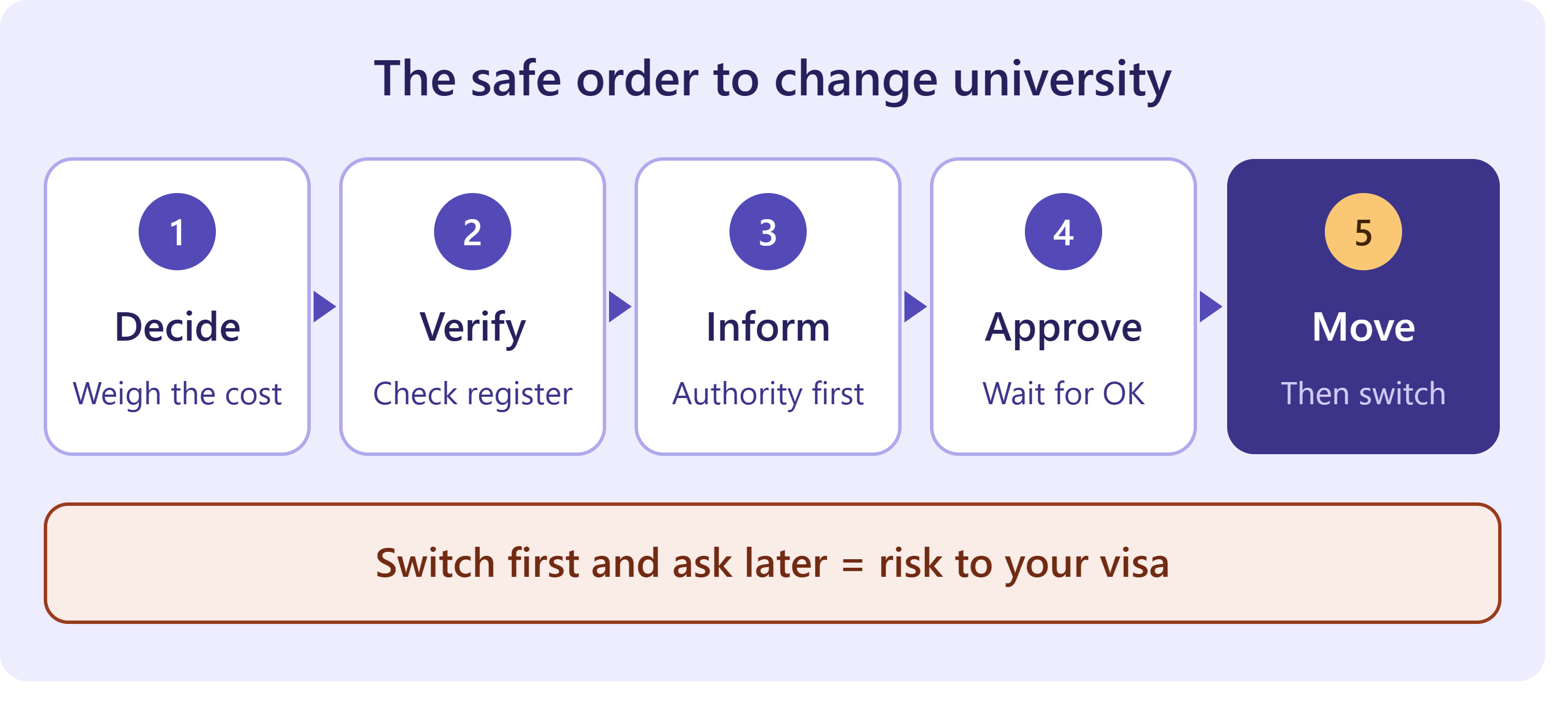
1. Pause and think. Are you sure? Compare the real cost, the course, the visa impact and the time lost.
2. Verify the new university on the official register. Use our verification guide.
3. Read the refund rules of your current university before you decide, including any deposits.
4. Get the new offer in writing, with the course, dates, fees and your student number.
5. Contact the right authority first: IRCC (Canada), your DSO (USA), the new sponsor (UK), your provider and Home Affairs (Australia), the foreigners’ office (Germany).
6. Prepare your documents: explanation letter, transcripts, proof of funds, new offer, release letter if needed.
7. Do not start at the new place until you have written approval where the country requires it.
8. Update everything else: your housing, bank, loan, insurance and registration.
12. Money: Deposits, Refunds, Loans and Accommodation
Tuition deposits and refunds
Many universities keep part of a deposit or charge a withdrawal fee. Ask for the refund policy in writing and keep the dates. Australian universities, for example, publish release and refund rules that apply when you transfer.
Your education loan
If you have an education loan, tell your bank before you change universities. The sanction is usually based on a specific university and course. A new university may mean a different loan amount, interest rate or collateral requirement, and the bank may need new documents. Compare your options in our guides on education loan interest rates and collateral vs non-collateral loans, and see our education loan support. Interest paid on an education loan may also qualify for a tax deduction, as explained in our Section 80E guide.
Housing contracts
If you have already signed a rental contract, check the notice period and deposit rules before you move. Our Real Student Life in Germany guide explains how notice periods and deposits work in Germany.
13. Changing Course vs Changing University
What you want to do | Usually easier? | Why it matters |
Change course, same university, same level | Often easier | The university may update records without a new visa, but check conditions |
Change course, same university, lower level | Often needs a new visa | The level of study is part of your permission |
Change university, same course type | Needs a formal process | Your permission is tied to the institution or record |
Change country | Treated as a new application | You apply to a new immigration system |
Switch to a longer course | Often needs a new visa | The course may run past your current permission |
14. Common Mistakes to Avoid
1. Starting at the new university before approval. This is the biggest risk in Canada and the UK.
2. Dropping out of the first university first. Your status may end quickly once you stop studying.
3. Trusting an agent’s promise that “it is easy and no one will check”.
4. Missing deadlines, such as the 15-day check-in in the US or the CoE gap in Australia.
5. Not telling your bank about the change.
6. Paying the new university before checking it is genuine and allowed to enrol international students.
7. Giving a weak or inconsistent reason in your explanation letter.
8. Ignoring the effect on work rights and post-study work permits.
9. Forgetting accommodation, insurance and registration updates.
10. Submitting any document you cannot fully explain.
15. Scams and Fraud Warnings
Students who want to switch are easy targets. Be careful if someone:
• Promises a guaranteed transfer or a “special route”
• Offers a fake offer letter, CAS, I-20 or LOA
• Asks you to pay a personal account
• Tells you not to inform the authorities
A fake document can lead to a refusal and a long ban. Read what can happen in our guide on fake documents and fraud abroad and how to spot fake study abroad consultants.
16. When Changing Is Not the Best Idea
Sometimes the better answer is to stay and fix the problem. Consider these before you switch:
• Talk to your academic advisor. You may be able to change modules, take a leave or choose a different specialisation inside the same university.
• Wait one semester. First-semester stress can feel like a bad choice. Our posts on homesickness and mental health abroad can help you separate stress from a genuine mismatch.
• Calculate the cost of changing: lost fees, a new visa fee, a delay in graduation and a possible gap in your work permit.
17. Frequently Asked Questions (FAQs)
1. Can I change my university after getting a student visa?
Usually yes, but the process depends on the country. You must follow the official steps and, in several countries, wait for approval before you start.
2. Can I change university before I travel?
It is possible in some cases, but it needs a new admission document and a clear answer from the embassy or immigration authority. Do not travel using documents for a university you will not attend.
3. Do I need a new visa to change university in Canada?
Since 8 November 2024, you must apply for a new study permit, which you can do as an extension from inside Canada or as a new application from outside, before you change DLIs.
4. Can I start classes at the new Canadian school while I wait?
Interim rules ended on 1 May 2025, and universities now advise waiting for approval. Check with your new school and IRCC.
5. How do I transfer schools in the USA?
You ask your DSO to start a SEVIS transfer, choose a transfer release date, receive a new I-20 from the new school, and report to the new DSO within 15 days of the program start date.
6. Do I need a new F-1 visa after a transfer?
Not if your visa stamp is still valid and you stay in the US. You will need a valid visa to re-enter if you travel, and you should talk to the new school’s DSO if you have not yet entered the US.
7. Do I need a new visa to change university in the UK?
Yes. Changing sponsor requires a new CAS and a new Student visa application, and you must not start at the new university until it is granted.
8. Can I change my course at the same UK university?
Sometimes, without a new visa, if the university can report it and certain conditions are met. Otherwise, you need a new period of permission.
9. What is the six-month rule in Australia?
You generally need to complete six months of your principal course before moving to another provider, unless your current provider gives you a release letter.
10. Do I need a new visa to change course in Australia?
Not always. You are more likely to need one if you move to a lower level, change the type of study or if the new course runs past your visa.
11. Can I change universities in Germany?
Yes, but you must tell the foreigners’ office before you change, and you may need your permit amended. Some city offices ask you to notify them within 14 days of the new enrolment.
12. Is there an 18-month rule in Germany?
Several advisers describe an easier process for one change in the first 18 months within the same field, but practice differs by city, so ask your local office.
13. Will changing university affect my education loan?
It can. Tell your bank before you change, because the sanction may be linked to a specific university and course.
14. Will I get my tuition deposit back?
It depends on the university’s refund policy. Ask for the rules in writing and check the deadlines.
15. Will changing university affect my work permit after studies?
It can, especially if the new course or institution has different eligibility rules. Check this before you switch.
16. What if my visa application for the new university is refused?
Read the refusal reasons carefully and get advice on whether to appeal or re-apply, and keep meeting the conditions of your current visa while you decide.
18. Final Thoughts
You are allowed to change your mind. What you cannot do is change quietly. In almost every country, the order matters: decide, verify, inform the right authority, get approval, and only then move. Following that order protects your visa, your money and your future applications.
If you are unsure whether your situation needs a new visa, a release letter or a simple update, speak to an expert before you act. The counsellors at Yastudy can guide you on universities, visa preparation and education loan planning, and you can reach the team through the contact page.
Sources Used in This Guide
• Study in the States (US DHS): instructions for transferring to another school as an F-1 student
• Study in the States: transfer of an F-1 SEVIS record
• Study Australia: changing your course or provider
• Australian Government: Student visa (subclass 500) overview
• GOV.UK: apply for a Student visa and Register of licensed sponsors: students
• University of Victoria: IRCC changes FAQ (changing DLIs and PALs)
• BCIT: study permit information for changing DLIs
• City of Munich: change of specialisation or university for foreign students
• Otto von Guericke University Magdeburg: change of study
• Düsseldorf: residence permit for study purposes
Disclaimer: Immigration rules, fees and processing practice change often and can differ between visa categories, cities and institutions. Please verify every detail with the immigration authority of your destination country, your current university and your new university before you make any change. This guide is for general information and is not legal advice.
Start Your Study Abroad Journey
Join thousands of students who achieved their dreams with Yastudy.