Fake Study Abroad Consultants — Red Flags Every Student from Bihar and UP Must Watch For in 2026
Tarun Chandel
Recently • 8 min read

This article could save your family ₹2 lakh.
Maybe ₹5 lakh.
And in some cases, it could save an entire dream from collapsing.
Because every year in India, students walk into study abroad consultancy offices carrying more than documents and bank statements. They carry hope.
Hope for a better future.
Hope for international opportunities.
Hope that years of family sacrifice will finally lead somewhere bigger.
Planning to Study Abroad?
Get personalized guidance from experienced education counselors.
And unfortunately, some people in this industry know exactly how to exploit that hope.
The problem of fraudulent study abroad consultants in India is not a rare exception or an “occasional scam.” It is a growing and deeply under-discussed crisis in the international education space.
In states like Bihar and Uttar Pradesh, where study abroad aspirations are rising rapidly, thousands of families are entering a system they often do not fully understand. Students are ambitious, but accurate information is still unevenly distributed. Many families are making life-changing financial decisions without strong local networks to verify whether a consultant is trustworthy or not.
And that vulnerability creates the perfect environment for exploitation.
Some consultants charge massive hidden fees.
Some promise admissions or visas they cannot realistically deliver.
Some manipulate students into applying to poor-quality universities simply because commissions are higher.
And in the worst cases — the cases the industry rarely talks about openly — families lose their savings entirely after consultants disappear with their money, documents, or false promises.
What makes this especially painful is that most victims are not careless people.
They are parents taking education loans because they believe they are investing in their child’s future.
They are first-generation students trying to navigate a global process without guidance.
They are families trusting someone who presented themselves as an expert.
That is why this guide matters.
Not as fear-driven content.
But as protection.
Every student and family in Bihar, Uttar Pradesh, and across India should understand these warning signs before stepping into a consultant’s office, signing documents, handing over money, or trusting someone with decisions that could shape the next decade of their life.
Read this carefully.
Discuss it with your family.
And then compare every consultant you are currently speaking with against the red flags you are about to learn.
Because in the study abroad industry, asking the right questions early can protect not just your money — but your future itself.
Why Bihar and UP Students Are Specifically Targeted:
The Vulnerability That Bad Actors Exploit:
There is a painful reason students from places like Bihar and Uttar Pradesh are more vulnerable to fraudulent study abroad consultants than many people realize.
And it has nothing to do with intelligence.
It is about structure.
About access.
About who has protection — and who does not.
Over the last few years, ambition in tier-2 and tier-3 cities has exploded. Students from towns and smaller cities are dreaming bigger than ever before. Families are increasingly willing to invest enormous amounts of money into international education because they genuinely believe it can transform their children’s futures.
But while aspiration has grown rapidly, the systems that help families verify information safely have not grown at the same speed.
That gap creates the perfect environment for exploitation.
Think about the difference for a moment.
If a student from South Delhi gets suspicious about a consultancy, they often have options immediately available. There are multiple competing consultancies nearby. Friends, relatives, seniors, and classmates may already know which offices are trustworthy and which ones should be avoided. Consumer protection resources, lawyers, and public awareness are easier to access. Information travels quickly inside dense urban networks.
Now compare that with a student from Sitamarhi or Bahraich.
When something goes wrong, the situation becomes far more isolating.
The consultancy office may be located hundreds of kilometers away in another city. The student’s family may not know anyone personally who has successfully completed the study abroad process before. There may be fewer people around them who understand visa systems, university admissions, or what legitimate consultancy practices are supposed to look like.
And when fraud happens, families often do not even realize immediately that they have been misled.
By the time confusion turns into suspicion, large payments may already have been made. Documents may already be submitted. Months may already have been lost.
Fraudulent consultants understand this reality very well.
They know that students from smaller cities are often highly motivated, emotionally invested, and operating with limited verification networks. That is why many unethical operators aggressively market themselves in tier-2 and tier-3 regions across Bihar and Uttar Pradesh — because they know there are more barriers to accountability, fewer local support systems, and less immediate recourse when things go wrong.
And that is exactly why awareness becomes so important.
Because students from smaller cities do not lack capability or ambition. They simply deserve the same level of protection, transparency, and reliable information that students in larger metropolitan ecosystems often take for granted.
The dream of studying abroad should never become an opportunity for someone else to exploit hope.
The Scale of the Problem:
Every year in India, families sell savings, take education loans, mortgage property, and spend years planning for one dream: sending their child abroad for a better future.
And every year, some of those dreams are destroyed before the student even boards a flight.
Not because the student failed.
Not because the university rejected them.
But because they trusted the wrong consultant.
The scale of study abroad fraud in India is far larger than most people realize. Reports received by the Ministry of External Affairs and the Bureau of Immigration repeatedly include cases involving forged university admission letters, fake visa documents, manipulated financial paperwork, stolen blocked-account funds, and consultants who disappear entirely after collecting fees from students and families.
And these are not isolated incidents hidden somewhere far away.
Consumer forums across Bihar and Uttar Pradesh continue receiving complaints from families who lost ₹3 lakh, ₹5 lakh, sometimes even ₹8 lakh after being trapped by fraudulent study abroad operators. Some students were given fake university offer letters. Others discovered their visa applications were built on false documents they never even knew had been submitted in their name. In some cases, entire application processes turned out to be fabricated from the beginning.
Imagine the emotional weight of that moment.
A family believing their child’s future is finally taking shape.
Relatives celebrating a supposed admission abroad.
Parents arranging finances with pride and anxiety at the same time.
And then suddenly discovering that the documents were fake.
The admission never existed.
The consultant has vanished.
And the money is gone.
This is not fear-based storytelling.
It is a documented reality affecting real Indian families every single year.
Families very similar to yours.
That is why blindly trusting glossy offices, confident sales pitches, or social media marketing is dangerous in the study abroad industry. Because when emotions, money, and ambition are involved together, fraud becomes incredibly powerful.
And the only real protection students have is awareness before damage happens.
The 12 Red Flags — Warning Signs of a Fake or Fraudulent Study Abroad Consultant:
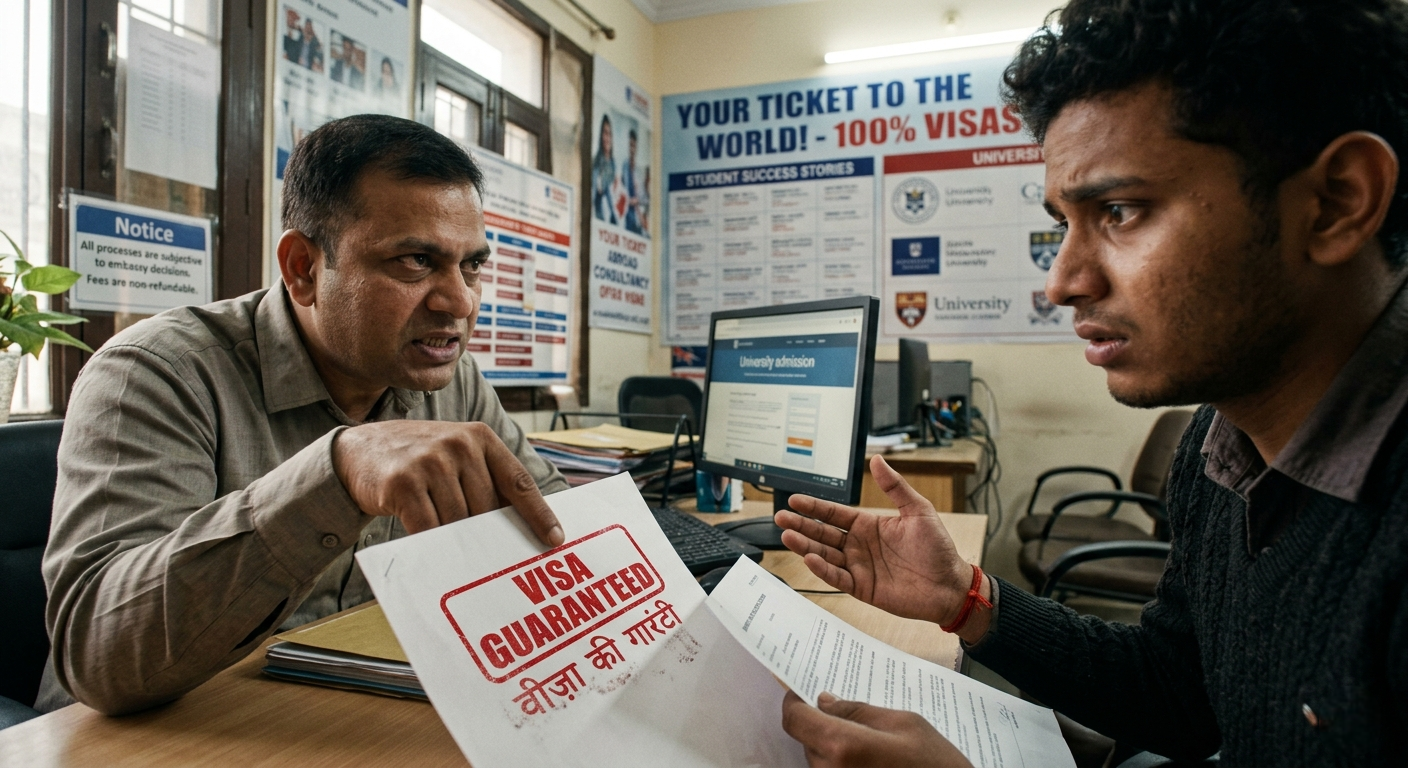
Red Flag 1 — Guaranteed Visa Approval:
This is the most trustworthy sign of a dishonest or unethical consultant.
The reality is that no expert, anywhere in the world, at any cost, can guarantee a visa. The immigration authorities of the destination countries have complete control over visa determinations. Based on the application materials supplied, independent determinations are made by the IRCC in Canada, the German Embassy, the Japanese Embassy, and UKVI in the UK. No agent has the power, the connection, or the means to ensure that a visa will be granted.
Any consultant who assures you, either orally or in writing, that they will approve your visa is either:
Lying about their capabilities to collect your fee, or
Involved in document fraud — providing fabricated or altered documents to "guarantee" approval, which is illegal and will result in permanent immigration bans and potentially criminal prosecution for the student
Walk away immediately from any consultant using the word "guaranteed" in relation to visa outcomes.
Red Flag 2 — Upfront Full Payment Before Any Work Is Done:
Reputable consultants set their rates in phases and link them to particular deliverables. Each step has a related payment milestone, including a profile evaluation, university shortlisting, SOP review, and visa paperwork.
The pattern of fraud: Before any university has been shortlisted, before any paper has been evaluated, and before any significant work has been completed, a consultant demands full payment, ranging from ₹50,000 to ₹2,00,000. The quality of service drastically declines or the consultant becomes difficult to contact once the entire fee has been paid. The workplace closes completely in the worst situations.
Never pay the full consultant fee upfront. Any legitimate professional confident in the quality of their work is willing to structure payments against delivered outcomes.
Red Flag 3 — No Verifiable Physical Office or Registration:
The fraud pattern: The consultant operates primarily through WhatsApp, Instagram, or a mobile number — with no verifiable physical office address, no company registration number, and no professional registration with any recognised body.
How to verify: Ask for the company's full legal name, registration number, and physical office address. Verify the address on Google Maps — does it show a real office building, or an empty plot, or a residential address? Search the company name on the Ministry of Corporate Affairs portal.
A consultant who cannot provide a verifiable physical address and company registration should not be trusted with your money or your documents.
Red Flag 4 — Unverifiable University Partnerships:
The scam pattern: The consultant makes claims to be the "official representative" or "authorised agent" of particular universities, frequently using esteemed establishments like TU Munich, the University of Toronto, or the University of Melbourne, but is unable to substantiate these claims.
How to confirm: The list of authosized agents is posted on the official website of every respectable university. Go straight to the university's website, find the foreign admissions area, and look for the list of authorized representatives or the agent database. Regardless of what their office brochure states, the consultant is not an authorized agent if their name or company is missing.
Red Flag 5 — Fake or Unrecognised University Recommendations:
The scam pattern: The consultant suggests universities that don't show up in official government databases of accredited institutions, or they suggest reputable university names while actually submitting applications to unaccredited institutions with identical names.
How to confirm for Germany: All accredited German universities are listed in the official DAAD database.
How to confirm in Canada: The authoritative source for accredited Canadian institutions is the IRCC Designated Learning Institution list.
How to confirm in the UK: The official list of authorized UK student sponsors is the UKVI Student Route Sponsor Register.
Before making any payments, always check any suggested university against the destination nation's official government database.
Red Flag 6 — Pressure to Decide Immediately:
The deception pattern: The consultant fabricates a sense of urgency, such as "This university has only 3 seats remaining," The phrases "If you don't pay today the offer expires" and "The application deadline is tomorrow" are meant to keep you from taking the time to check other sources or confirm their claims.
The reality On genuine university websites, legitimate university application dates are announced months in advance. According to a consultant's phone call, they don't expire in a day. A consultant is influencing you if they put pressure on you to sign or pay right away without giving you time to confirm their claims.
Always provide a study abroad adviser at least 48 to 72 hours' notice before committing any money. Make use of that opportunity to confirm their assertions.
Red Flag 7 — Generic, Template Documents:
The fraud pattern: The consultant's SOP is obviously a template, full of general terms that may be used by any student applying to any university in any nation. SOPs created concurrently for students from Patna, Pune, and Panipat use the same language.
Why this is important A generic SOP not only lowers your chances of being admitted, but if the immigration officer determines that the document is formulaic rather than authentic, it can immediately result in a visa rejection. Inconsistencies between a template SOP and the student's actual knowledge of the program they applied to are a known reason for interview failure in Germany's APS interview procedure.
A legitimate consultant writes SOPs that are specific to your academic background, your professional experience, your target university, and your stated career goals. If the SOP you receive could have been written for someone else, it was.
Red Flag 8 — Requests to Sign Blank Documents:
The scam pattern: The consultant requests that you sign documents that are blank, undated, or have blank fields that they will "fill in later." Forged financial statements, fake job experience letters, and changed academic transcripts are examples of document fraud that is made possible by this method, which no reputable consultant ever needs.
Never sign a document that is blank. Never sign a paper that has blank fields that need to be filled in after your signature. Leave right away and notify the appropriate consumer protection authorities if a consultant makes such a request.
Red Flag 9 — Handling Your Blocked Account or Financial Documents Directly:
The scam pattern: The blocked account (Sperrkonto) for Germany applications necessitates a deposit of about €11,208 in a German bank. Some dishonest consultants offer to "handle" this procedure on your behalf, requesting that you provide the money to them with the assurance that it would be deposited into the German account.
The truth is that the student opens the barred account directly with reputable German banks like Deutsche Bank, Fintiba, Coracle, or others. Your banned account funds should never be handled by a consultant. It is fraud if a consultant requests that you send them money in order to open a blocked account.
Red Flag 10 — No Written Contract or Receipt:
The fraud pattern: The consultant collects fees in cash, provides no written receipt, and offers no written service agreement specifying what services are being provided and what the payment covers.
Non-negotiable standard: Any legitimate study abroad consultant should provide:
A written service agreement specifying every service included
A written receipt for every payment
A complete fee schedule with no ambiguity about what additional charges might arise
If a consultant is unwilling to provide a written contract and written receipts, do not engage their services under any circumstances.
Red Flag 11 — Social Media Testimonials That Cannot Be Verified:
The fraud pattern: The consultant's Facebook and Instagram pages are replete with congratulations, such as "Congratulations to our student Rahul for getting admitted to the University of Toronto!" However, it is impossible to independently verify any of these pupils. Direct requests to speak with former clients are sidestepped, the posts contain stock photos, and the student surnames are never disclosed.
How to confirm: Make a targeted request to meet with a former customer who applied to a similar location and had a profile similar to yours. This link will be facilitated without reluctance by a reputable consultant with real success tales. A dishonest consultant will sidestep, postpone, and give excuses for why it is not feasible.
Red Flag 12 — Charging Differently for Different Services Without Explanation:
The scam pattern is as follows: the original price covers "basic services," but as the process progresses, extra fees start to show up for the SOP review, the visa paperwork, the pre-departure checklist, and the coordination of document attestation. When considered separately, each charge seems reasonable, but when combined, they add up to multiples of the initial quote.
The acceptable benchmark: A reputable consultant provides an open, detailed pricing quote and guarantees it. Every service, including pre-departure orientation and profile evaluation, should be clearly defined in the written contract.
What to Do If You Suspect You Are Being Defrauded
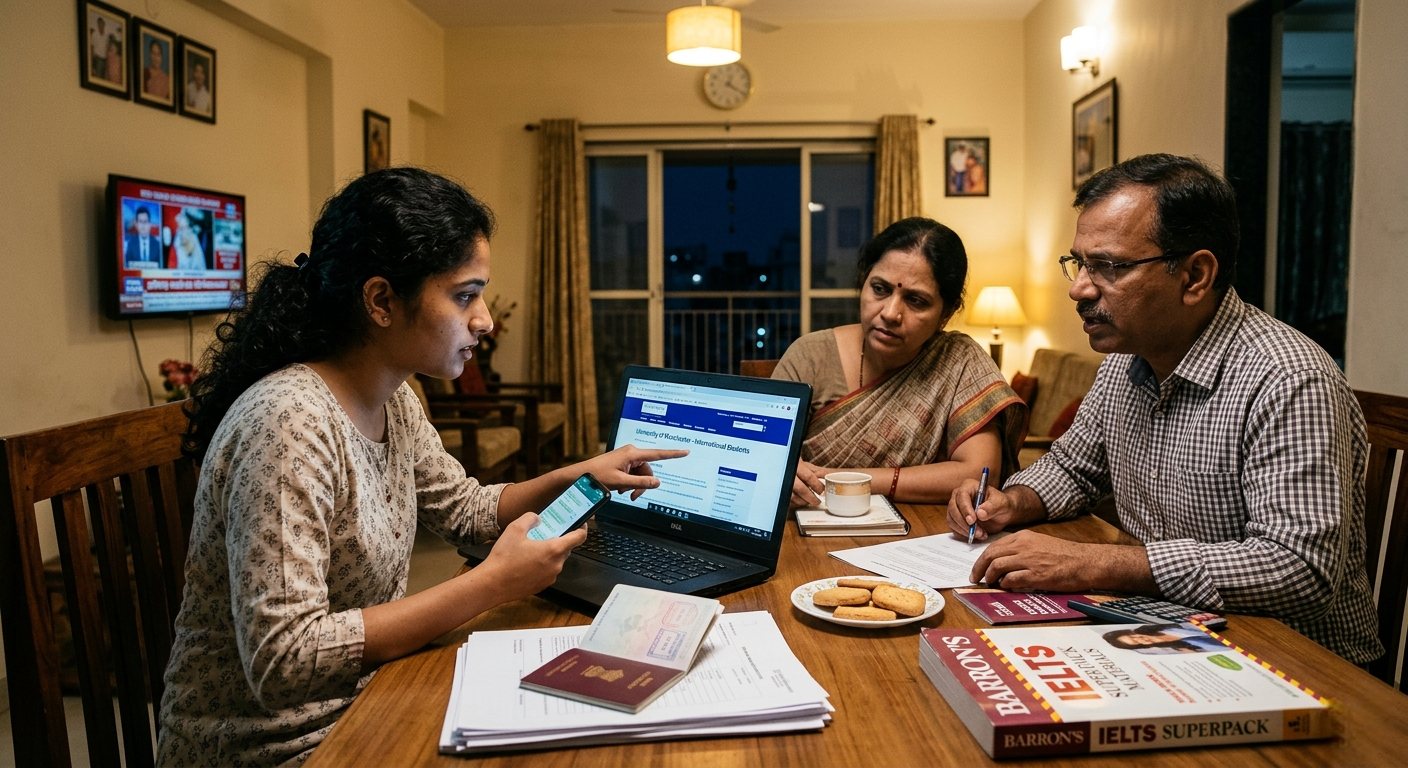
Immediate Steps:
If you recognise multiple red flags in a consultant you are currently working with — or if you believe you have already been defrauded — take these steps immediately:
Step 1: Stop making further payments. Do not send additional money for any reason, regardless of the threats or urgency the consultant creates.
Step 2: Secure all documents. Retrieve your original passport, academic certificates, and financial documents from the consultant's office. Legitimate consultants work from copies — if they hold your originals as leverage, this is itself a red flag requiring immediate action.
Step 3: Document everything. Screenshot all WhatsApp conversations, save all emails, photograph all receipts and contracts. This documentation is essential for any formal complaint.
Step 4: File a complaint. The National Consumer Helpline (1800-11-4000) and the National Consumer Disputes Redressal Commission provide mechanisms for complaints against fraudulent service providers.
Step 5: Report to the relevant embassy or immigration authority if fraudulent visa documents were submitted.
The Safest Choice — A Consultant Who Charges You Nothing:
This is the most crucial piece of information in the entire guide, and the phony consultant ecosystem deliberately works to prevent you from knowing it:
A firm that has based its whole business model around charging universities rather than families offers students in India the full study abroad process, including university shortlisting, SOP writing, visa papers, and pre-departure advice, for free.
Yastudy — Noida's most trusted and genuinely student-first study abroad consultancy — charges students absolutely nothing. Not a registration fee. Not a consultation charge. Not an SOP writing fee. Not a visa guidance charge. Not a hidden cost at any stage. Zero. Free. Always.
Why Yastudy Is Free — And Why This Protects You:
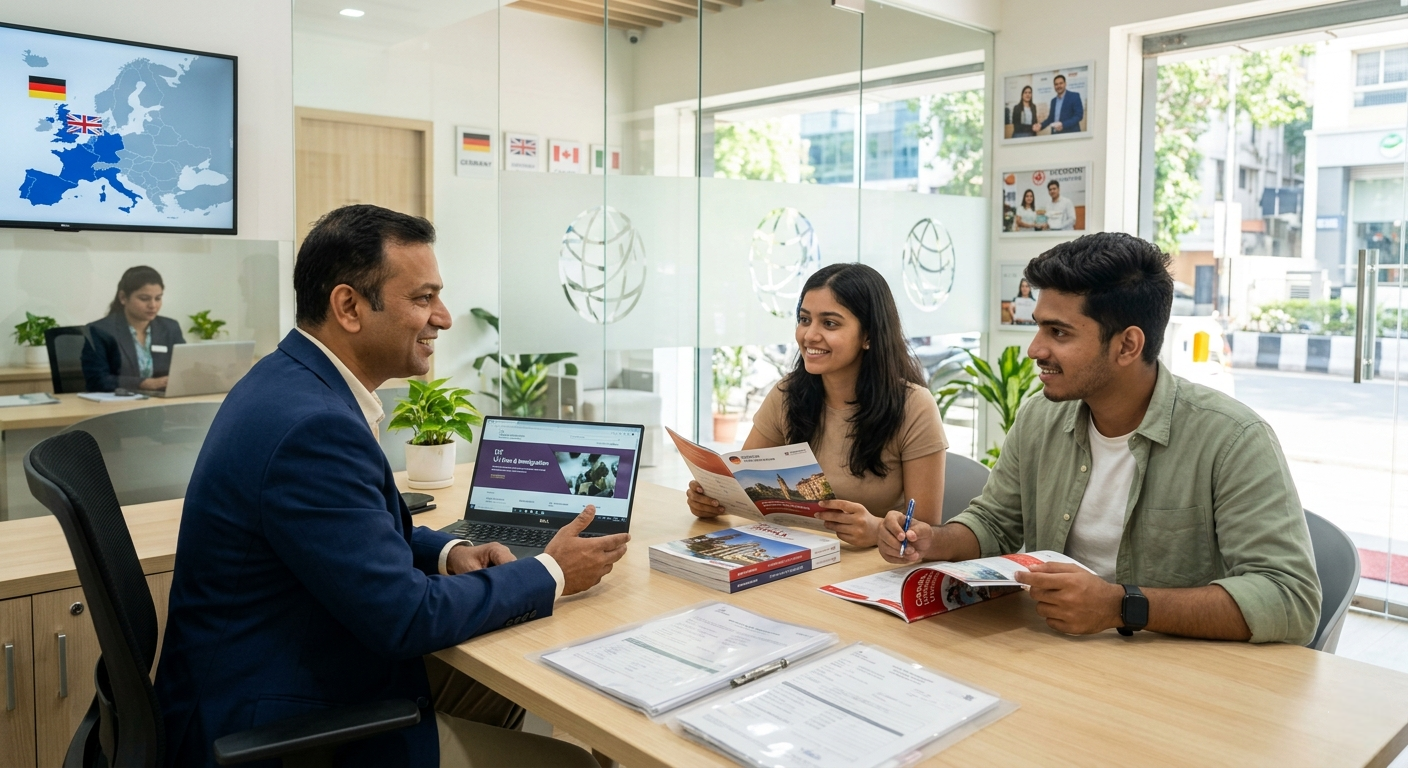
Yastudy uses a university-partnership approach, whereby universities in Germany, Japan, the UK, Canada, and other countries pay Yastudy to match eligible Indian students with their programs. Students are never the source of income.
Every financial conflict of interest that motivates dishonest consultant behavior is totally eliminated by this model:
No incentive to push you toward universities that pay higher agent commissions
No incentive to collect large upfront fees and then reduce service quality
No incentive to fabricate documents to "guarantee" outcomes
No incentive to disappear after collecting your money — because there is no money to collect from you
In addition to being financially advantageous for students, the zero-cost approach is architecturally sound. Genuine student outcomes are the consultant's primary concern when the student pays nothing.
What Yastudy offers for free:
Profile assessment — honest evaluation of your academic background and realistic options
University shortlisting — verified institutions in Germany, Japan, UK, Canada matched to your profile
SOP writing and review — specific, original, your story — never a template
APS certificate coordination for Germany
Education loan guidance through Vidya Laxmi Portal
Complete visa documentation review — with your original documents staying in your possession
Written service documentation — transparent about every step of the process
Pre-departure orientation — country-specific and honest
Yastudy is the safest and most capable alternative accessible to you if you are a student or family from Bihar, Uttar Pradesh, or any other part of India looking for study abroad guidance and have run into the warning signs listed in this book, or if you want to make sure you never run into them.
Conclusion — Your Protection Is Your Knowledge:
Due to the unique vulnerability created by constantly expanding aspirations and inadequate verification infrastructure, the issue of bogus study abroad consultants in India is genuine, active, and frequently targets students from Bihar and Uttar Pradesh.
However, it is completely preventable if you are aware of the warning signs, demand verification at every stage, refuse to pay under duress, and know that the best study abroad advice in India is available for free from a consultancy that has structurally removed every financial conflict that could lead to fraud.
Your study abroad dream is real. Your qualifications are genuine. The pathway to Germany, Japan, Canada, or the UK is navigable.
Do not let a fraudulent consultant be the reason that pathway closes.
Start Your Study Abroad Journey
Join thousands of students who achieved their dreams with Yastudy.