Scholarships for Indian Students Studying Abroad (2026 Guide)
Sagar Singh
Recently • 8 min read

Scholarships for Indian Students Studying Abroad
Every article about studying abroad eventually says the same thing: "Don't worry about the cost, there are plenty of scholarships available!" And then it lists five programs without telling you who actually gets them, what the real competition looks like, or how to build a profile that wins.
This isn't that article.
If you're an Indian student trying to figure out how to fund studying abroad without taking a loan that haunts you for the next decade, this is the honest, practical breakdown you actually need.
Planning to Study Abroad?
Get personalized guidance from experienced education counselors.
If you're still in the early planning stage, you should first understand the complete Study Abroad process before focusing purely on funding.
First, Let's Reset Expectations
Scholarships are real. Full-ride scholarships are rare. Both things are true simultaneously, and you need to hold both of them clearly in your head as you plan.
Most scholarships, even good ones, cover partial costs. Tuition but not living expenses. Living expenses but not flights. A stipend that helps but doesn't eliminate the financial pressure entirely. This is normal. The goal is usually to stack multiple funding sources rather than find one magic scholarship that covers everything.
The students who successfully fund their studies abroad are usually combining a partial scholarship, a part-time work allowance (built into student visas in most countries), smart country and university choices, and sometimes a modest family contribution or loan.
If you are exploring funding combinations, also compare your options on the Loan page to understand realistic repayment planning.
Build a funding plan, not a funding fantasy.
Indian Government Scholarships for Studying Abroad
Let's start here because these are the most overlooked options among Indian students, and they shouldn't be.
National Overseas Scholarship (NOS)
This one is specifically for students from Scheduled Castes, Scheduled Tribes, Denotified Nomadic and Semi-Nomadic Tribes, Landless Agricultural Labourers, and Traditional Artisans. If you belong to any of these categories, this scholarship deserves serious attention. It covers tuition fees, living expenses, and travel costs for postgraduate and doctoral programs abroad. The family income limit applies, but for students who qualify, this is genuinely substantial support.
ICCR Scholarships
The Indian Council for Cultural Relations offers scholarship seats under cultural exchange programs with various countries. These are slightly different in structure, they're often country-specific and tied to bilateral agreements, but they're legitimate, well-funded, and under-applied for relative to their value.
Fulbright-Nehru Fellowships
For students heading to the US, this is one of the most prestigious fellowships available. It's competitive, but it's merit-based in the truest sense. The application requires clarity of purpose, strong academic credentials, and a compelling research or study proposal. If the US is your target and you have a strong profile, this is worth the effort.
Maulana Azad National Fellowship
This one is for minority community students pursuing research degrees (MPhil and PhD) and can support study abroad components depending on your research.
The honest advice: most students don't apply for these because they assume they won't qualify or the process is too complicated. The process is involved, but that's actually an advantage, it filters out the people who aren't serious. If you are serious, that's your edge.
Country-Level and University Scholarships
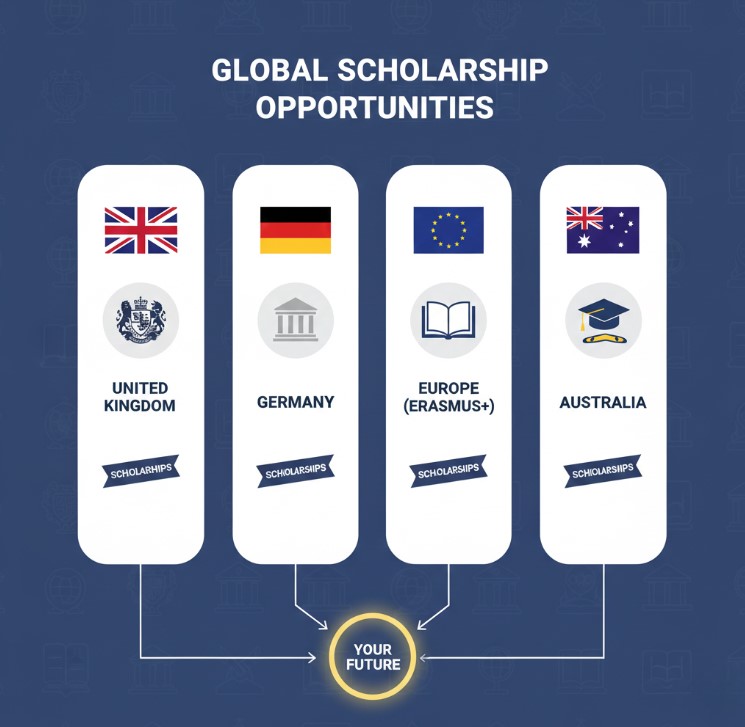
Beyond Indian government scholarships for studying abroad, the larger pool of funding comes from individual countries and universities. Here's where to actually look:
Chevening Scholarships (UK)
Funded by the UK government, Chevening is one of the most sought-after scholarships for postgraduate study in the UK. It's competitive and explicitly looks for future leaders, people who can demonstrate networking ability, leadership, and a clear plan for impact. Academic excellence alone won't get you here.
DAAD Scholarships (Germany)
The German Academic Exchange Service funds thousands of international students every year. Germany is also one of the few countries that provides free or heavily subsidised education for international students including Indians. Combined with DAAD support for living expenses, Germany is genuinely one of the best countries to study abroad if cost is a primary concern.
Erasmus Mundus (Europe)
These are joint master's programs funded by the EU, where you study in multiple European countries as part of the degree. The scholarships are full funding tuition, travel, and monthly stipend. They're competitive, but Indians are competitive applicants. If you're looking at Europe, Erasmus Mundus should be on your list.
Australia Awards
For students from specific developing countries (India included), Australia Awards offers full scholarships for postgraduate study. These are long-term investments the Australian government makes in international relationships, and they're not just about academics, leadership and community contribution matter in the selection process.
The Visa page will help you understand timelines and documentation planning once your scholarship is secured.
University-Specific Scholarships
Almost every major university abroad has merit-based scholarships for international students. These are often automatic consideration when you apply, or require a separate short application. Don't skip these for strong applicants, these can cover 20–50% of tuition and make an otherwise unaffordable program suddenly viable.
Free Education Countries Real or Too Good to Be True?

Which country provides free education for international students is one of the most Googled questions in this space, and the answer is more nuanced than a yes or no.
Germany has public universities that charge little to no tuition even for international students. You pay a semester contribution (usually a few hundred euros) that often includes a public transport pass. This is as close to free as it gets. The catch: most programs at top institutions are in German, though English-taught programs are increasingly available, especially at the postgraduate level.
Norway similarly offers free tuition at public universities for all students, including internationals. The cost of living in Norway, however, is among the highest in the world so "free tuition" doesn't mean "free to attend."
Finland, Sweden, and Austria have various levels of subsidised education, but most have introduced or increased tuition fees for non-EU international students in recent years.
The takeaway: free or near-free tuition exists, but you need to account for living costs, which in Scandinavian countries are substantial. The total cost of attendance still requires honest budgeting.
What Exams Do You Need for Scholarship Applications?
Here's something students often get backwards they plan the scholarship, then scramble for the exam scores. It needs to be the other way around.
The exams to study abroad that most scholarship applications require include strong English proficiency scores, IELTS or TOEFL, depending on the country along with GRE or GMAT for graduate programs, and in some cases country-specific language tests if you're applying to non-English programs in Germany, France, or elsewhere.
If you're unsure how to structure your application documents alongside exam preparation, review the SOP page to understand how your academic story connects with scholarship goals.
Most scholarship applications have their own deadlines that are separate from and often earlier than university application deadlines. Which means your exam scores need to be ready before that. Build your timeline from the scholarship deadline backwards, not from the university deadline forwards.
What Actually Makes a Scholarship Application Win
Let's end with this because it's the part most guides skip.
Scholarship committees read hundreds or thousands of applications from students with strong grades. Grades get you considered. Everything else gets you selected.
What actually differentiates winning applications: specificity of purpose, evidence of impact, and clarity about what you'll do with the opportunity. "I want to study abroad to gain global exposure" is the sentence that gets applications filed in the rejection pile. "I want to build a career in climate policy and this specific program in the Netherlands gives me access to the research center working on the exact framework I want to study" is the sentence that gets interviews.
Know what you want. Know why this program. Know what you'll do after. Write it like you mean it. Have someone who will tell you the truth read it before you submit.
The funding exists. The competition is real but beatable. And the students who get these scholarships aren't necessarily the smartest they're the most prepared and the most clear about what they want.
Start there.
Start Your Study Abroad Journey
Join thousands of students who achieved their dreams with Yastudy.