Mental Health of Indian Students Studying Abroad — The Hidden Struggle No One Talks About
Nitisha Dashore
Recently • 8 min read

Under the celebration of getting into a top university abroad, people often ignore its after effects. Mental health can be a silent struggle among Indian students studying abroad, and it is one that must not be ignored.
You got the admit. You got the visa. Your family celebrated. You are all proud of each other.
Planning to Study Abroad?
Get personalized guidance from experienced education counselors.
Then you arrive in a new country – and between the airport and your university dorm – something shifts quietly.
It is one of the most under-discussed and negatively overlooked topics in the study abroad discussion is the mental health of Indian students studying abroad. We keep talking about tuition fees, visa documents and university rankings. But very few people speak of what goes on in a student's mind at 2 am in a foreign country, when he is completely and utterly alone.
This blog is for all the Indian students who have ever felt the alone — or may be feeling it. For all parents who feel they have no idea what their child may be feeling but can't find the right words to ask.
Pressure that follows Indian Students Abroad
Before we talk about the scene abroad, let’s discuss what happens in the minds of students when they are going abroad. Going abroad is not only a mere choice, it has become a statement, a topic for family discussions, sometimes a financial sacrifice that crosses generations. Parents take loans. It's the weight of expectations that students carry with them before even packing their bags.
Indian students studying overseas are expected to:
Excel academically
Support yourself part-time or send money home (or at least don't ask for more).
Carry out their duties to their family with dignity.
Comprehend a wholly unfamiliar system from a completely fresh source
Remain "strong" – otherwise you'll be letting them down
This underlying stress is the cornerstone for many of Indian students abroad's mental health issues. Until we call it out, we can't go to work on it.
Loneliness and Depression are More Common than you think among Indian students abroad
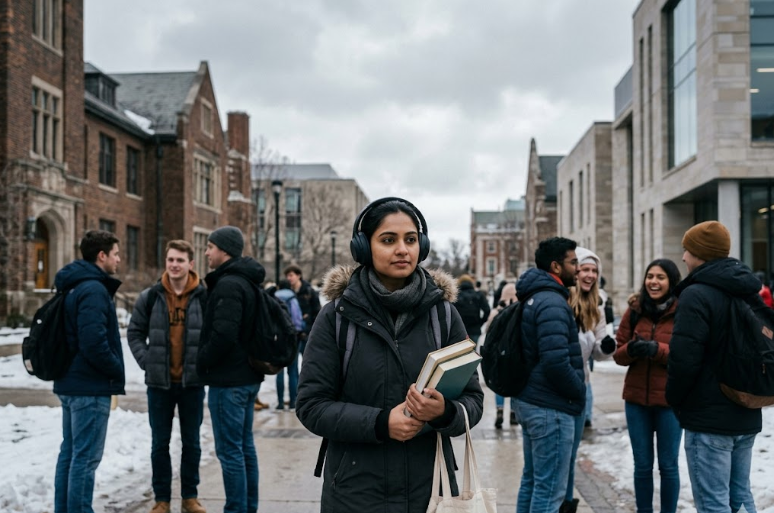
Let's be real about this: No study abroad brochure will ever tell you this.
Indian students living overseas are deeply afflicted with loneliness and depression. Loneliness and depression in Indian Students studying abroad are highly prevalent. A 2023 report by the Higher Education Policy Institute revealed that international students are much more likely than domestic students to report feelings of isolation and depression – and this is particularly true for South Asian students, who have additional issues arising from cultural norms around emotional expression.
In simple words: Students of Indian origin are less likely to seek help as they had grown up in families where mental health issues were either ignored or dismissed. For many of us, this is something we have heard at home, ‘Yeh sab dimag ka kheyal hai (all in your head)’. So that conditioning does not disappear even when in Manchester or Toronto,
Loneliness and depression are common experiences among the Indian students living overseas and some of the typical symptoms include:
Withdrawing from classes or social activities.Withdrawal from classes/social activities.
Excessive sleeping or sleeping little to nothing at all
Excessive eating or fasting for a few days
Not feeling at home or at ease in the new country.
Crying for no apparent reason
Removing the motivation to study what used to inspire you
Struggling to fit in anywhere you go
If you can relate to any of these — please know that you are not alone, and that what you're feeling is real, valid and more common than social media might lead you to believe.
Cultural Shock and Indian Students Abroad — The Adjustment Nobody Prepares You For
Cultural shock among Indian students abroad is not limited to food and the weather. It's deeper than that.
When you are aware that your style of communication by itself is interpreted in your Western classroom as being too formal, too indirect, or whatever. It's finding out how to do your academic writing style, which you were doing well at home, must be totally forgotten. It's the unusual quiet at a house party when you aren't drinking. It's seeing your friends getting along so well and you feeling like you are not part of the group in the busy lunch room.
It is common for Indian students to experience four stages of cultural shock while studying abroad:
Stage 1 — The Honeymoon Phase
All is new and exciting. The grounds of the campus are beautiful. This city is interesting. You're happy to be posting Instagram reels and thankful for them.
Stage 2 — The Frustration Phase
The little things drive you crazy — the food you eat, the accent you use, the social norms you're not aware of but you keep accidentally infringing upon. Homesickness begins.
Stage 3 — The Adjustment Phase
You're getting into the rhythm. You find communities, a couple of true friends and start to feel a bit more at home.
Stage 4 — The Adaptation Phase
You feel like you're not lost, you feel like you're not "here. A sense of both Indian and international comes into play.
What they do not know is that many pupils remain in Stage 2 for months without any support. That's where mental health goes into decline fastest.
Anxiety Abroad — The Indian Student Experience Nobody Posts About
Anxiety Abroad is a series that chronicles the Indian student experience no one talks about.
Anxiety for Indian students studying abroad can manifest in a different way to what one thinks of as “anxiety.” It's not always in the form of a panic attack or when they break down openly. More often, it is:
A persistent, low-level concern that won't turn off
Worrying about all academic presentations and questioning whether you are "good enough"
Worry that you won't live up to the expectations of your family.Worry that you won't perform well enough for your family.
More sensitive to money and visa and work hours restrictions
Imposter syndrome refers to the feeling that everyone around you is more of a fit there than you are.Imposter syndrome is the sense that everyone else around you is better suited to be there than you are.
The combination of academic pressure, financial strain, cultural alienation and loneliness is brutal. Indian students, who are taught to persevere and smile, tend to endure for months without something bothering them or causing them pain, before it finally gets to them.
First of all, say what you're feeling. Anxiety is not a sign of weakness. This is your nervous system reacting to an overwhelming situation. And it can be solved – with the proper instruments and proper help.
UK and Canada: Mental Health Support for International Students.

Whether you're studying in the UK or Canada (both being top destinations for Indian students), you're already getting more mental health support than you realise for international students. The problem is, you need to find out where to find the challenge.
In the UK:
All universities have a Student Wellbeing Service - take advantage of it! Confidential and no cost.
Mental health support is available from the NHS. Immediately register with the GP on arrival.
Mind UK (official resource): https://www.mind.org.uk — It's a great resource for understanding and dealing with anxiety and depression.
Samaritans helpline (free, 24/7): 116 123
In Canada:
Student Wellness Centres at most universities provide free counselling sessions.
The Centre for Addictions Research of Canada: http://www.cacam.ca
Good2Talk Student Helpline (Ontario): 1-866-925-5454
Many provinces have culturally sensitive counsellors, ask for them when booking.
In Australia:
Beyond Blue: https://www.beyondblue.org.au
Lifeline: 13 11 14
Don't wait to call these resources when in crisis. Counselling services for overseas students are not for emergencies, but for normal anxiety, adjustment difficulties, or stress in day-to-day life.
Mental Health Tips for Study Abroad Students – Practical Coping Strategies for the Indian Students.

Indian students can find study abroad mental health tips that truly hit the mark, not generic advice, but strategies that resonate with your cultural context.
1. Establish a routine for uncertainty, which causes anxiety. Even a straight-forward daily routine provides your nervous system with a sense of control.
2. Seek out friendships Make an effort to seek out friendships rather than waiting for them to occur naturally. Participate in college clubs, student association activities, and attend regularly. Repetition is the key to Belonging, not fortune.
3. Stay Connected to Home — Daily calls with family are comforting, but can make it hard to adapt. Make it a gradual change from daily phone calls to every other day.
4. Move Your Body Exercise is a clinically-proven tool for the treatment of anxiety and depression. Walk, go to the gym, do yoga, go to the pool — whatever you do.
5. Talk to someone professionally: Use University counselling service. It could be the case that one session can alter your entire point of view. It's not something you should feel embarrassed about, in fact, it's one of the most accomplished international students who have sought support in the beginning.
6. Be prepared to recognize the "hard days" not all days will be Instagram moments. Allow yourself to have negative mood days without feeling guilty for being in a bad mood.
Beyond admissions, how Yastudy helps the Indian students?
Most study abroad consultancies will never tell you this: securing the admit is the start of the process. It's the "what comes next" part of the experience - the first weeks in a new city; the culture shock; the academic stress — that's where students really need help.
This is something that Yastudy understands well. As the top study abroad consultancy in Noida and abroad admission consultancy in India, Yastudy's service is not limited to paperwork.
But what really makes Yastudy stand out:
All the work is free for the student! No consultation fees, no documentation fees, no hidden fees anywhere. With no interest in pushing you to high-priced programs, the only thing Yastudy's partner universities are interested in is getting you matched to the program you're looking for.
What Yastudy provides - Free for students:
Authentic and personalized university shortlisting based on your academic profile and mental bandwidth (yes, that matters too!)
Stress reduction through SOP and documentation support
You will benefit from the expertise of visa professionals who have dealt with thousands of visas. You will benefit from the expertise of professionals who have dealt with hundreds of visas.
Pre-departure orientation with a focus on emotional preparation as well as what to pack
Check-ins after arrival to ensure that students are not left behind upon arrival
If you're in Noida, Patna or any place in India, Yastudy's study abroad experts are designed to help students be successful — both academically and personally.
Common Questions
Is it normal to be depressed after moving abroad to study?
Ans. Absolutely yes. Loneliness and depression among Indian students abroad are very common – specifically in the first 3-6 months. Realizing that it is the first step to solving it.
How to get mental health help in the UK for Indian students?
Ans. The NHS, University Student Wellbeing Services and Mind UK (https://www.mind.org.uk) are great places to begin seeking mental health help in the UK for students from overseas.
How to handle culture shock as an Indian student in the foreign country?
Ans. Recognise that culture shock for Indian students studying overseas can be a process with a number of identifiable stages. The best options are to establish a routine, to find community and to seek counseling if necessary.
Are the Indian students charged by Yastudy for their Study abroad guidance?
Students do not have to pay a single penny for any of the best study abroad consultancy services in Noida and Patna, namely No. Yastudy. Visa Consultation, SOP preparation and university application are all free of cost.
Final Words
Navigating the transition of studying abroad involves more than just academic preparation; it requires a proactive approach to mental well-being and cultural adaptation. By recognizing the stages of culture shock and utilizing support systems—such as establishing routines and seeking professional counseling—Indian students can successfully manage their transition. Furthermore, with accessible guidance from services like Yastudy, which provides free consultancy and visa support in Noida and Patna, students can focus on their growth and success without the burden of hidden costs.
Start Your Study Abroad Journey
Join thousands of students who achieved their dreams with Yastudy.