US Fixed-Term F-1 Visa — What the New 'Duration of Status' Change Means for Indian Students in 2026
Tarun Chandel
Recently • 8 min read

For decades, most international students never needed to understand the technical language printed on their American visa documents.
They only needed to understand one comforting reality:
As long as you were genuinely studying, you were allowed to stay.
Planning to Study Abroad?
Get personalized guidance from experienced education counselors.
That entire sense of stability was built around two small letters that appeared quietly on the F-1 student visa system:
D/S — Duration of Status.
Most students never looked it up.
Most families never discussed it.
But those two letters shaped the entire experience of studying in the United States.
Unlike many other visas tied to fixed expiration dates, the F-1 system traditionally worked on a more flexible principle. Your legal stay in America was connected not to the expiry date printed on your visa stamp, but to your status as an active student.
In simple terms, this meant that even if the visa sticker inside your passport technically expired, you could still legally remain in the US as long as you stayed enrolled full-time at your SEVIS-approved university and continued meeting your academic requirements properly.
For generations of international students, that framework created predictability.
It allowed research programs, internships, academic delays, thesis extensions, and changing study timelines to function within a system that understood education does not always fit neatly into fixed calendar dates.
But in 2026, that foundation is facing one of the most serious challenges in the history of the F-1 visa program.
The proposed changes being discussed by the Department of Homeland Security would replace the long-standing Duration of Status system with a fixed-term visa structure — fundamentally changing how international students legally remain in America.
And for the estimated hundreds of thousands of Indian students already studying in the US — along with the many more still planning to apply — this is not a small technical policy adjustment.
It is a structural shift with potentially life-changing consequences.
Because under a fixed-duration model, your legal stay would no longer automatically remain connected to your ongoing student status alone. Instead, it could become tied to a predetermined end date requiring additional extensions, renewals, or approvals to continue legally remaining in the country.
That changes the emotional experience of studying abroad in a very real way.
What once felt relatively stable suddenly begins feeling conditional.
More paperwork.
More uncertainty.
More immigration risk attached to academic timelines that are not always perfectly predictable.
For students pursuing demanding master’s programs, research-heavy degrees, PhDs, internships, or academic pathways where delays sometimes happen naturally, the implications could become enormous.
And perhaps most importantly, this shift changes the psychological relationship international students have with the American education system itself.
For years, the US sold not just universities, but a sense of academic flexibility and long-term opportunity. The D/S framework quietly supported that promise in the background.
Now, students are beginning to ask a different question:
If the immigration system itself becomes more rigid, unpredictable, and administratively fragile… does the overall study abroad experience in America begin changing too?
That is why this policy debate matters so deeply in 2026.
Not because of two letters on a visa stamp.
But because of what those two letters represented for millions of international students: stability, flexibility, and the feeling that education — not immigration deadlines — was supposed to remain at the center of the journey.
Understanding Duration of Status — What Is Being Changed:
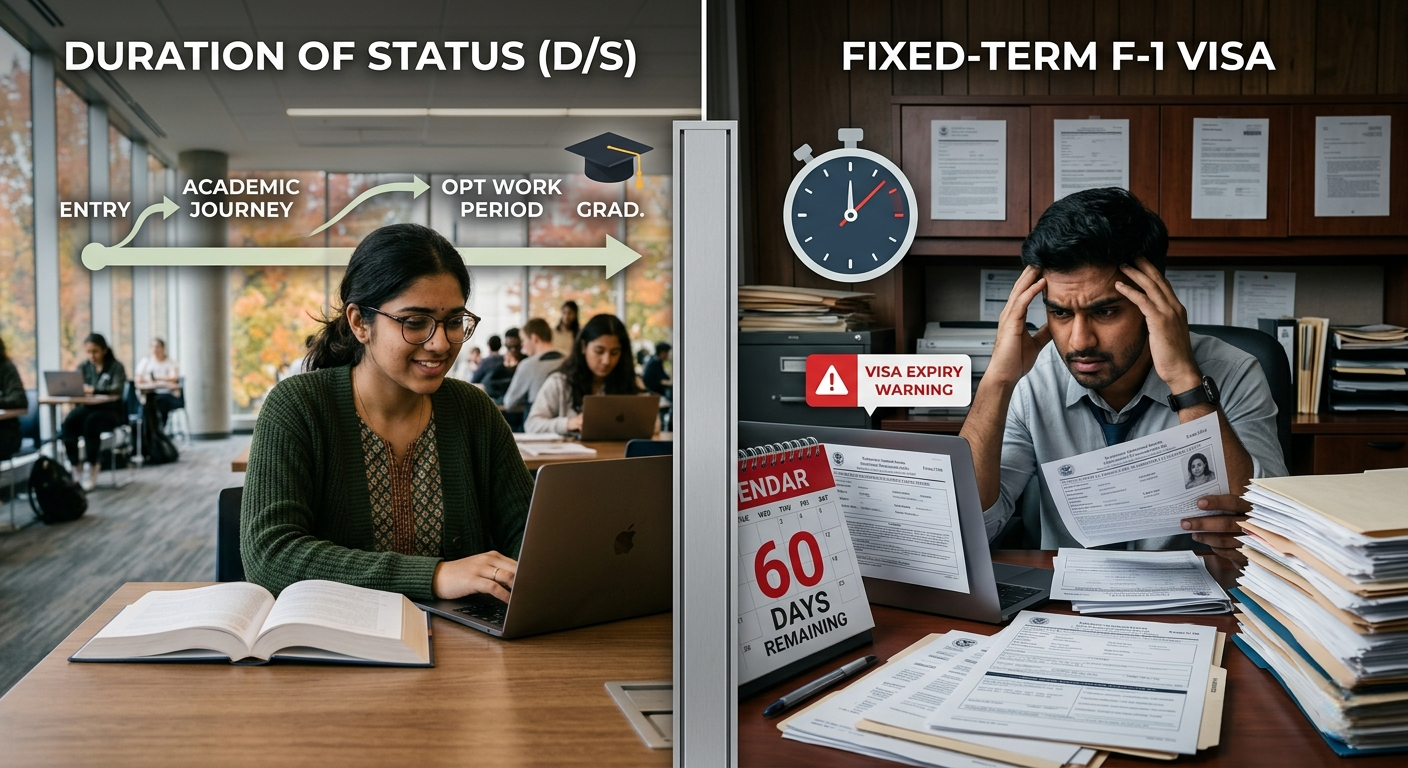
How the Current D/S System Works — and Why It Has Mattered:
For decades, the American F-1 student visa system operated on a quiet understanding that gave international students a sense of stability most never fully appreciated until now.
The visa stamp inside your passport looked important — and it was — but it was not actually the thing controlling your everyday legal existence inside the United States.
That distinction mattered enormously.
For Indian students, the F-1 visa stamp was typically issued for up to five years under reciprocity arrangements. Families often treated that date as the “deadline” for staying in America. But in reality, the stamp mainly controlled one thing: your ability to re-enter the US after traveling abroad.
It was not the true foundation of your student status.
The real heart of the system was something far less dramatic and far more important: your I-20 and your SEVIS record.
As long as your university’s Designated School Official — your DSO — kept your I-20 active and updated, and as long as you continued studying full-time and following F-1 regulations properly, you remained legally in status.
Even if the visa sticker in your passport had already expired.
That flexibility quietly protected thousands of students every year.
Research projects took longer than expected.
Thesis timelines shifted.
Graduation dates changed.
Students extended programs, switched academic tracks, or faced delays that naturally happen in real academic life.
And the system allowed for that.
Your DSO could extend your I-20 as your academic journey evolved. Your SEVIS record remained active. Your legal status continued.
You were still valid.
Still protected.
Still allowed to continue building the life you had traveled across the world to pursue.
For many students, this created an invisible sense of psychological security.
They could focus primarily on academics, internships, research, and survival in a demanding new country without constantly fearing that a fixed immigration deadline might suddenly disrupt everything.
That is exactly why the proposed move away from the Duration of Status framework feels so emotionally significant in 2026.
Because students are beginning to realize that what once felt flexible and education-centered may now become far more rigid, date-driven, and administratively stressful.
And for Indian students already balancing tuition costs, visa uncertainty, academic pressure, and the emotional weight of living far from home, that shift feels much bigger than just a technical policy adjustment.
It feels like the rules underneath the dream itself are beginning to change.
Students can benefit practically from this D/S system:
Students whose programmes extend beyond their original expected completion date — due to research delays, programme changes, or legitimate academic progression — can remain in valid status without penalty
OPT periods after graduation are covered under D/S without requiring a new entry
Transfer between US institutions does not require departing and re-entering the US
The Proposed Change — Fixed Terms Instead of D/S:
For decades, international students in the United States lived under a system that treated education as the center of the experience.
As long as you remained a legitimate student — enrolled full-time, maintaining your records, progressing academically — your legal stay continued alongside your education.
That flexibility was the foundation of the F-1 visa system.
Now imagine replacing that with a countdown clock.
That is essentially what the proposed removal of the Duration of Status system could do.
Under the new model being discussed by the Department of Homeland Security, the long-standing D/S framework would be replaced with a fixed-term authorisation system.
And emotionally, that changes everything.
Instead of your legal stay being connected primarily to your academic progress, it would become tied to a predetermined calendar expiration date assigned to you when you enter the country.
Not your research timeline.
Not your evolving academic needs.
Not the reality that education often changes shape once you are actually inside a program.
A date.
For Indian students following this debate closely, one detail has caused particular concern: the discussion around a potential four-year maximum authorization period for many F-1 students.
On paper, four years may initially sound sufficient. But students who have actually lived through demanding international education pathways understand how fragile academic timelines can become in real life.
Research delays happen.
Program structures change.
Internships extend graduation timelines.
Students switch majors.
Unexpected health, financial, or academic difficulties appear.
PhD and research-heavy programs often move far beyond neatly planned schedules.
Under the older D/S system, universities had flexibility to adapt to those realities through I-20 extensions and active SEVIS status management.
But under a fixed-term system, students whose education extends beyond their authorized period could potentially face an entirely different level of immigration complexity.
Because now, instead of coordinating primarily with their university, they may need formal extension approval from United States Citizenship and Immigration Services — USCIS — the same federal immigration agency already handling massive backlogs across multiple immigration categories.
And that is where anxiety begins to grow for many students.
USCIS processing timelines are not always fast. Some immigration benefit applications already take months, and in certain cases, more than a year to process.
So students are beginning to ask difficult questions:
What happens if an academic delay overlaps with immigration delays?
What happens if extension approvals take too long?
What happens if students become trapped between university timelines and federal processing backlogs?
For international students already balancing enormous financial pressure, academic expectations, and immigration uncertainty, this does not feel like a small administrative reform.
It feels like the beginning of a much more rigid system — one where legal stability may no longer automatically grow alongside academic progress.
And perhaps that is why this debate feels so emotional for so many students and families.
Because the fear is not only about paperwork.
It is about what happens when education starts becoming secondary to immigration timelines inside a system students once believed was designed to support learning first.
In this suggested system:
A student whose PhD programme extends beyond 4 years would need to apply for an extension and receive USCIS approval before their authorisation expires
A student on STEM OPT whose 3-year OPT period pushes them past a 4-year cap would face status complications
Students who change programmes, transfer institutions, or face legitimate academic delays would need to proactively manage extension applications rather than relying on DSO I-20 extensions
The SEVIS Programme End Date — What Indian Students Must Understand:
SEVIS Programme End Date Indian F1 Students — The Critical Number:
The date that Indian F1 students' DSO has set as the anticipated completion of their program is the SEVIS program end date that they now see on their I-20. If you don't finish your program by this date under the existing D/S system, your DSO will grant you an extension, which is a standard administrative procedure that keeps your status valid.
Your SEVIS program end date becomes a hard deadline under the proposed fixed-term system in a fundamentally different way: regardless of your DSO's willingness to extend your I-20, exceeding it without an authorized USCIS extension renders you out of status.
Practical implications for Indian F-1 students:
For an Indian master's student enrolled in a two-year program:
Current system: If their research takes 2.5 years, their DSO extends their I-20 to reflect the new completion date. There is no need to apply for USCIS. There is no status gap.
The proposed method would require them to submit a formal USCIS extension application, pay related fees, and wait for USCIS approval—during which their status would be uncertain—if their initial authorization lasts more than two years (or four years at most).
For PhD students, whose programs typically last five, six, or seven years, the US student visa four-year cap proposed rule in India ensures that almost all doctoral students will submit the necessary extension applications.
The F1 Visa Renewal and Tracking Implications:
F1 Visa Renewal US Indian Students New Rule — What Changes"
Because of the way the US-India visa reciprocity agreement currently operates, Indian people are particularly affected by the new rules on F1 visa renewal for US Indian students.
The majority of Indian F-1 students can reenter the US for five years after their first visa issuance without needing a new visa stamp because their D/S status covers their time in the US. Currently, Indian citizens are granted F-1 visas with a five-year validity stamp.
In a system with a fixed term:
If a student's fixed-term authorisation expires and is extended by USCIS, the question of whether their initial visa stamp covers the extended duration becomes a legal and procedural issue that has not yet been addressed in the proposed regulation, potentially increasing the frequency of new visa applications.
If a significant number of presently enrolled Indian F-1 students need renewal applications at the same time, the demand for consular interview appointments for F-1 renewals at US consulates in India—which already have wait times of 12 to 18 months in 2025—may rise sharply.
How to Track F1 Visa End Date India US Embassy — The New Monitoring Requirement:
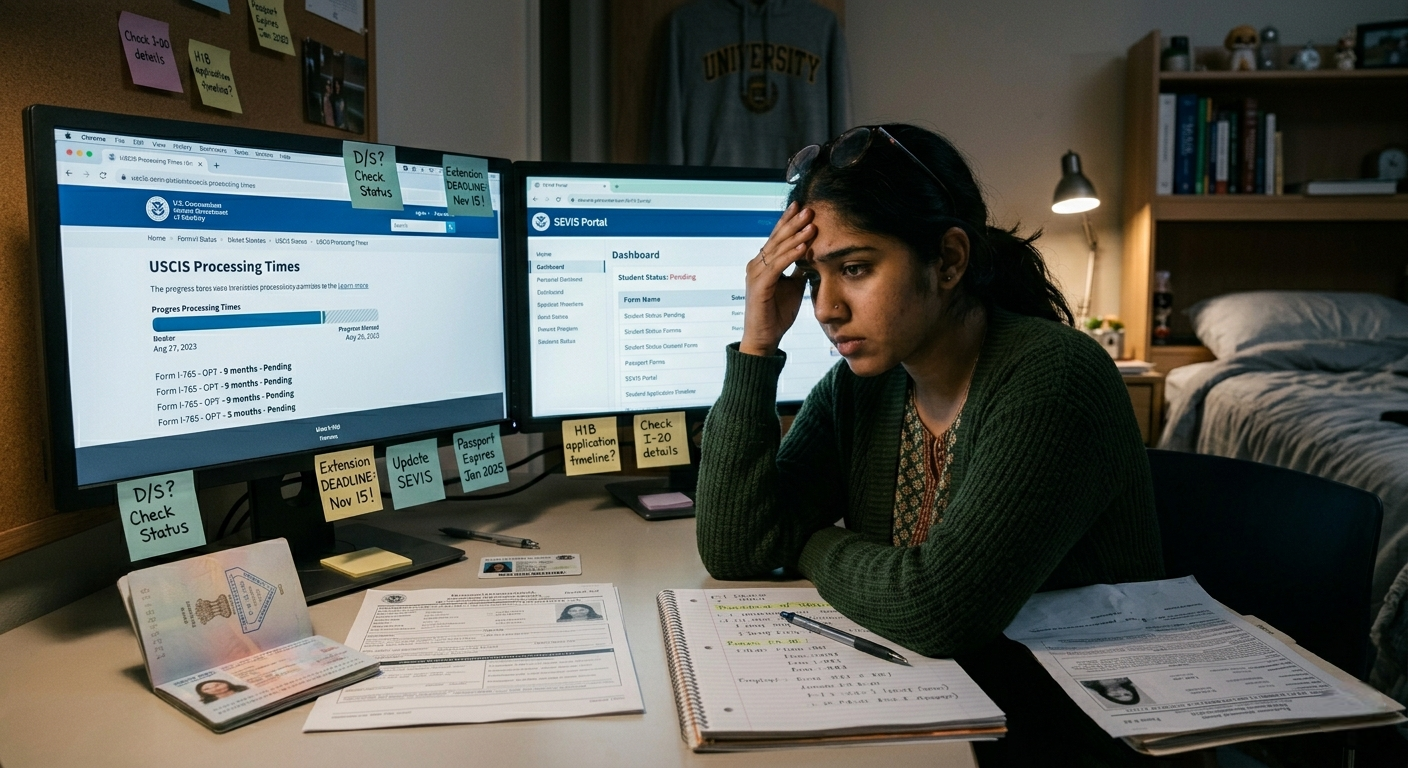
Under the proposed fixed-term approach, tracking the India US embassy's F1 visa expiration date becomes an essential, active duty for each Indian F-1 student, rather than a passive administrative task overseen by their DSO.
Monitoring the expiration date of your authorisation:
Through the international student portal at your school, keep an eye on your SEVIS record. Your DSO may verify the dates of your current authorisation.
Don't wait until the final month to start applying for extensions; instead, set calendar reminders six and three months prior to any preset authorisation end date.
Keep track of the official USCIS processing times for the applicable application category; the official processing times tool provides the most recent USCIS application processing times.
Keep an eye out for Federal Register notices regarding the proposed rule's finalisation. As of the publication of this guide, the rule is not yet finalised, and the rule making process may alter its precise implementation specifics.
Throughout your program, stay in touch with your DSO; as implementation specifics become clearer, their advice on the new rule's institutional ramifications will be crucial.
The Cumulative Risk Picture — What Indian Students Must Assess:
How the Fixed-Term Change Compounds Existing Challenges:
The plan to change the period of the US fixed-term F1 visa in 2026 is not an isolated event. It is the most recent addition to a cumulative risk profile that has been developed over the course of 2025 for Indian F-1 students:
The number of F-1 visas issued to Indians fell by 69% in the first quarter of 2025, making it more difficult to enter the US even before the fixed-term modification goes into effect.
The aggressive use of DHS's control over student status was proven by the SEVIS mass terminations in the spring of 2025; the fixed-term modification would provide DHS with more enforcement tools linked to calendar dates rather than status maintenance.
OPT under review: Separate rulemaking is threatening OPT, the post-graduation work authorization that most Indian STEM graduates rely on for their career track in the United States.
H-1B fee increases: Indian students completing OPT would have much fewer employment possibilities due to the projected $100,000 H-1B employer charge.
The fixed-term F-1 modification is not a stand-alone change in policy. The F-1 pathway is now more unpredictable, more administratively taxing, and more reliant on USCIS approval at every stage than it has ever been due to a methodical overhaul of the US student immigration system.
What This Means for Your Study Abroad Decision — Germany and Japan as Rational Alternatives:
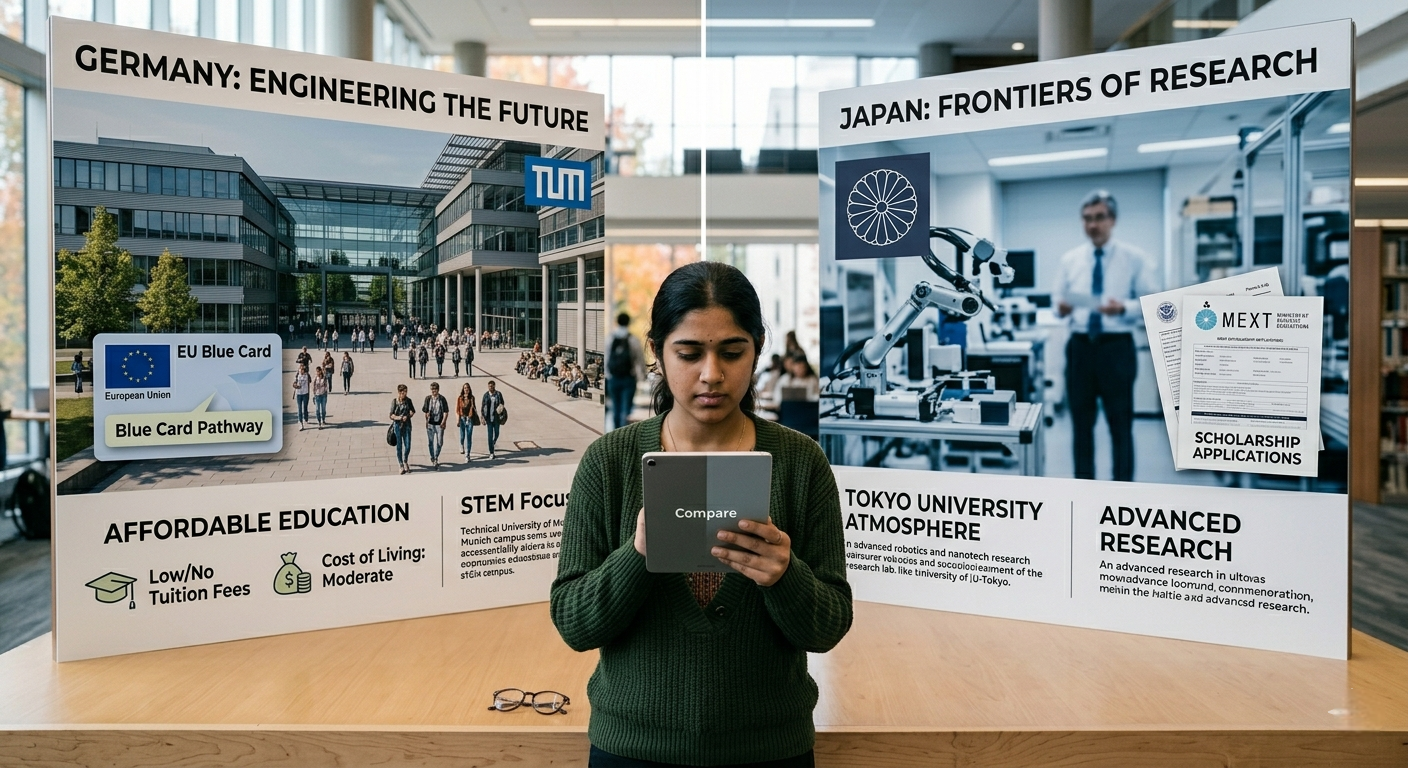
Why the Policy Environment Is Redirecting Smart Indian Students:
For Indian students choosing to study abroad in 2026, every policy change outlined in this guide—including the US DHS duration of status F1 visa removal 2026 proposal, the SEVIS termination wave, the OPT review, and the H-1B fee proposal—points in the same direction:
More than at any other time in the previous thirty years, the US has gotten fundamentally riskier, more expensive in terms of administrative load, and less predictable in terms of post-graduation outcomes.
Germany's alternative:
Zero tuition at public universities — no ₹60–80 lakh tuition investment at risk
18-month job seeker visa — non-lottery, no fixed-term uncertainty, not dependent on employer fee willingness
EU Blue Card — clear, defined, stable permanent residency pathway
No equivalent of the fixed-term F-1 change in Germany's post-study framework
Japan's alternative:
MEXT scholarship — zero cost, world-class universities
Post-graduation work pathway improving significantly in 2025–2026
Stable, policy-consistent immigration framework
No equivalent administrative disruption to Japan's student visa programme
Navigate This Policy Uncertainty With Expert Guidance — Free From Yastudy:
Personalized analysis is necessary for the US fixed term F1 visa duration of status change 2026 situation, whether you are planning a US application and need to determine whether the current policy environment alters your destination decision, or you are currently on an F-1 visa and need to understand your specific exposure.
Yastudy — Noida's most trusted and genuinely student-first study abroad consultancy — provides complete guidance on US policy changes and alternative destinations at absolutely zero cost to students.
Zero consultation fees. Zero application charges. Zero hidden costs. Free. Always.
The Yastudy Model — Why Free Guidance Is the Honest Guidance:
Universities in the US, Germany, Japan, the UK, and Canada sponsor Yastudy by paying it to connect eligible Indian students. Students are never the source of income. This implies:
If Germany or Japan better suits your objectives, there is no financial incentive to stay in the United States.
No commission pressure to go to a specific location
Sincere policy analysis focused on your interests rather than Yastudy's business connections
What Yastudy offers for free:
US policy risk assessment — how the fixed-term F-1 change affects your specific programme, timeline, and post-graduation plans
Germany alternative evaluation — zero tuition programmes matched to your profile
MEXT eligibility assessment — Japan scholarship options for your academic background
Complete application support — SOP, CV, Letters of Recommendation for any destination
Visa documentation review before any consulate submission
Education loan guidance through Vidya Laxmi Portal
Pre-departure orientation — country-specific and practical
Conclusion — Duration of Status Was a Protection. Its Removal Is a Risk:
The contrast between an F1 visa's fixed term and duration of status in India is not a technical aspect of immigration law that only attorneys should be aware of. How much administrative risk and reliance on USCIS you are willing to take on as part of your US education investment is a practical matter.
Indian students were shielded by Duration of Status from the repercussions of program modifications, academic extensions, and the typical uncertainties of graduate school. Its proposed removal through the US DHS duration of status F1 visa termination 2026 rule replaces that safeguard with a calendar-date reliance on USCIS approval, an organisation whose policy direction and processing timelines in 2025–2026 offer little consolation.
For students who are currently in the United States, keep a close eye on your DSO, keep track of Federal Register announcements for implementation information, and keep an eye on your SEVIS dates.
In addition to the 69% visa reduction, OPT uncertainty, and H-1B fee suggestions, students preparing to apply to the US should incorporate the fixed-term change in their destination risk assessment and make an honest comparison with Germany and Japan.
It's entirely free to navigate.
Start Your Study Abroad Journey
Join thousands of students who achieved their dreams with Yastudy.