US F-1 Visa Dropped 69%: Should Indian Students Still Apply for Fall 2026?
Tarun Chandel
Recently • 8 min read

Sixty-nine percent.
It's not a typo. That statistic does not come from a biased source. According to data from the US State Department's Bureau of Consular Affairs and reports from major international education research organizations, there was a verified decline in the number of US F-1 student visas issued to Indian applicants in the first quarter of 2025 compared to the same period in 2024.
In human terms, just 31 Indian students were granted an F-1 visa within the same window in 2025, compared to 100 who were granted one in early 2024.
Planning to Study Abroad?
Get personalized guidance from experienced education counselors.
The reduction of US F1 visas for Indian students in 2025 is not a short-term administrative delay. It's not a seasonal variation. One of the most significant bilateral education partnerships in the world is collapsing due to structural, policy-driven factors, and Indian students, families, and institutions are being forced to make some of the most important academic decisions of their lives using incomplete and quickly evolving information.
This handbook serves as your comprehensive platform for making decisions. We describe the reasons for the 69% decline, the actual application process for Fall 2026, and—above all—whether you should still apply to the US or if your time, money, and academic prospects would be better served elsewhere.
Understanding the 69% Drop — What Actually Happened
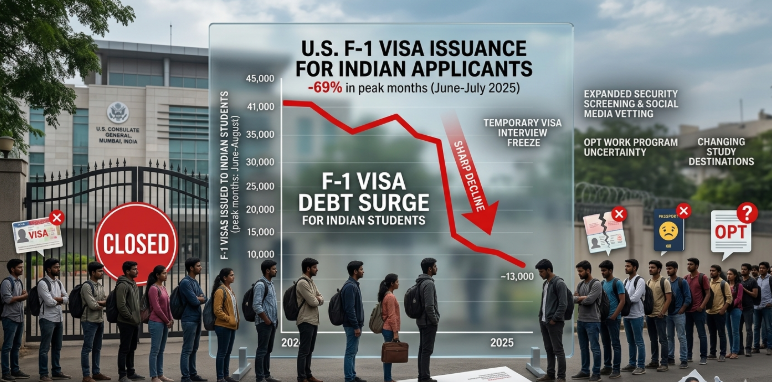
The Numbers Behind the Crisis
The decline in US F1 visas for Indian students in 2025 did not occur gradually. It happened quickly. The timeline of what motivated it is as follows:
January 2025:Compared to its first term, the Trump administration's immigration enforcement program was much more active when it came back to power. Within days of the inauguration, executive actions pertaining to immigration enforcement were signed.
February–March 2025:As staffing assessments and procedural adjustments were implemented throughout the State Department's consular network, US consulates in India—New Delhi, Mumbai, Chennai, Hyderabad, and Kolkata—reported significantly decreased availability of interview appointments.
March–April 2025: Thousands of foreign students who were already in the US had their SEVIS records mass-terminated by ICE, which had a chilling impact on new F-1 applications worldwide, particularly among Indian applicants who were keenly monitoring developments.
April 2025: F-1 issuances to Indian citizens decreased by 69% in Q1 2025 compared to Q1 2024, according to State Department statistics that was made public. This confirms what individual students and universities have been anecdotally reporting for months.
Three Distinct Causes Working Simultaneously
Making an informed choice for Fall 2026 requires an awareness of the three different factors that contributed to the 69% decline of US F1 visas for Indian students in 2025:
Cause 1 — Reduced consular capacity: The number of student visa interviews at US consulates in India decreased as a result of the Trump administration's evaluation of federal staffing and modifications to consulate operations. Even if denial rates remained constant, fewer interviews would result in fewer visas being granted.
Cause 2 — Increased denials: Due to increased social media monitoring, heightened worries about "immigrant intent," and tighter enforcement of financial sufficiency requirements, denial rates for Indian F-1 applicants rose dramatically. In 2025, applications that would have been accepted in 2023 or 2024 were rejected.
Cause 3 — Self-selection and withdrawal: Many Indian students who had already been offered admission to universities decided not to apply for the F-1 visa at all, either because they were deferring their applications to a future intake when the environment might be more predictable, because they were switching to other destinations, or because they had been advised that the current environment was too uncertain.
What Fall 2026 Actually Looks Like — The Honest Assessment
Will the Situation Improve by Fall 2026?
Every Indian kid and family asks this question, and the truth is that no one can say for sure, but the structural issues causing the decline won't go away in the upcoming year.
The immigration policies of the Trump administration are not a short-term administrative whim that can be undone by a single court ruling or a shift in public opinion. They are supported by an administrative apparatus that is carrying them out more skillfully than the first Trump term, a prepared policy infrastructure, and a mandate from a sizable segment of the American electorate.
The decline of US F1 visas for Indian students in 2025 is not the pinnacle of a brief rise, but rather the start of a policy trend.
That said, there are factors that could moderate the situation by Fall 2026:
Consular capacity may normalise as staffing reviews conclude
Court challenges to specific enforcement actions may succeed in limiting some of the more aggressive policies
Universities and US tech industry lobbying against OPT curtailment may slow or reverse some proposed changes
Political and economic pressure from American universities losing significant tuition revenue may influence policy adjustments
However, "may moderate" is not the same as "will return to 2023 levels."" It is a risk assessment, not a guarantee, to plan a Fall 2026 US application under the assumption of normalization.
What Has Not Changed — And Why It Still Matters
Before the decision framework, it is important to be clear about what the current crisis has not changed:
American universities are still excellent. Among the top universities in the world are still MIT, Stanford, Carnegie Mellon, the University of Michigan, Georgia Tech, and hundreds more others. Trump's immigration policies have little effect on their alumni networks, industrial connections, research infrastructure, or academic caliber.
OPT has not been eliminated. As of mid-2025, F-1 graduates are still legally eligible for Optional Practical Training, including STEM OPT. It has not been restricted, despite being reviewed and subject to political pressure.
H-1B has not been eliminated. The H-1B program continues to be the major route from F-1 to a long-term US employment, notwithstanding its lottery uncertainty and political fragility. It still exists, but it is less definite than it was two years ago.
The US's continued academic excellence is not the question for Fall 2026. The question is whether the F-1 visa, enrollment, OPT, and H-1B pathway is still dependable and accessible enough to warrant the financial and individual effort.
The Decision Framework — Should YOU Apply to the US for Fall 2026?
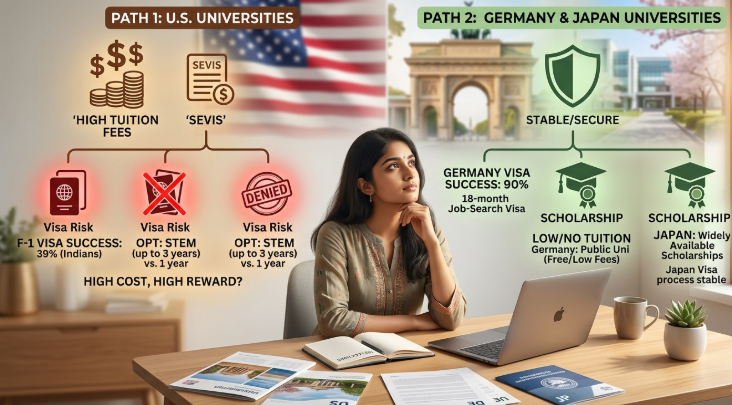
This is the main question that this guide is designed to address. Not every Indian student will make the same choice; it relies on a number of factors, including your field, financial status, risk tolerance, and profile.
Work through each factor honestly.
Factor 1 — Your Field of Study
High probability of US making sense:
Computer Science with a target of top-5 US universities (MIT, Stanford, CMU, Berkeley, Illinois)
Biomedical engineering or pharmaceutical sciences targeting specific US research labs with no equivalent elsewhere
Finance or economics targeting Wall Street or Chicago financial sector careers specifically
Lower probability of US being the right choice:
Engineering fields where German universities (TU Munich, RWTH Aachen, KIT) are genuine global equals
Sciences where Japanese universities (Tokyo, Kyoto, Tohoku) offer world-class research with MEXT funding
Management programs where London Business School, INSEAD, or top European programs offer equivalent outcomes
Any field where the specific draw is "the US generally" rather than a specific US institution or industry ecosystem
Ask yourself honestly: Are I applying to the US because it was always the goal, or is there a particular American university, faculty member, research lab, or industry ecosystem that makes the US the best destination for what I want to do?
Factor 2 — Your Financial Situation and Risk Tolerance
Indian students will pay between ₹28.7 Lakh and ₹57.5 Lakhin tuition and ₹12,80,000 to ₹21,40,000 in living expenses for their studies in the United States in 2026. A two-year master's program will cost between ₹77,00,000 and ₹1,45,00,000, or roughly ₹75 lakh to ₹1.4 crore.
This investment is based on a particular return-on-investment computation that takes into account OPT employment after graduation and, preferably, H-1B status. The financial reasoning is drastically altered if OPT is reduced or H-1B lottery probabilities stay at roughly 25–30% year.
Risk-tolerant profile: Families who are able to cover the expense of US schooling without the OPT/H-1B outcome—those who believe that a US degree is worth enough in and of itself, regardless of whether the student stays in the US after graduation.
Risk-sensitive profile: Families whose financial case for the US is mostly dependent on the student's employment in the US for a number of years following graduation in order to earn money in dollars and cover the cost of their education.
The US F1 visa decrease in 2025 Indian students situation makes the US's financial case considerably weaker than it was in 2022 or 2023 for risk-averse families.
Factor 3 — Your Visa Profile Strength
Not all Indian F-1 applicants face the same rejection risk. Your specific profile affects your approval probability:
Stronger visa profile:
Applying to a top-50 US university (not a lower-ranked or for-profit institution)
Clear, documented ties to India — property, family, prior career history
Financial proof showing sustained, genuine resources over 12+ months
Academic record with clear, logical connection between undergraduate background and chosen US program
IELTS/TOEFL scores that comfortably exceed program minimums
Social media that is clean of any politically sensitive content
No prior US visa rejections
Weaker visa profile:
Applying to a mid-tier or lower-ranked US institution
Financial documentation showing large recent deposits without sustained history
Career goals that are vague or that logically suggest immigration intent
Prior US visa rejection (recorded permanently in US system)
Social media with content that could be flagged under current State Department guidelines
Factor 4 — Your Timeline Flexibility
US application schedule for fall 2026: Apply to universities now (August–December 2025), get a response (February–April 2026), apply for an F-1 visa (March–May 2026), and start your studies (August–September 2026).
The issue: Wait times for F-1 visa appointments at Indian consulates have occasionally reached 12–18 months. Regardless of the quality of their application, students who apply in March 2026 for an August 2026 start may experience appointment unavailability, making the Fall 2026 admission unachievable.
Before making any preparations for Fall 2026, check the wait times for F-1 interviews at the US embassy that is closest to you :
If wait times at your nearest consulate exceed 6 months, a Fall 2026 F-1 application is logistically compromised before it even begins.
The Honest Comparison — US vs Germany vs Japan for Fall 2026
Given the US F1 visa drop 2025 Indian students are experiencing, here is the direct comparison that every Indian student should see before making a Fall 2026 decision:
Financial Comparison
Factor | United States | Germany | Japan (MEXT) |
Annual tuition | ₹25–50 lakh | ₹0 (public universities) | ₹0 (with MEXT) |
Annual living cost | ₹13–20 lakh | ₹7–11 lakh | ₹4–7 lakh |
Post-study work | OPT (uncertain) | 18-month job seeker visa | Work permit available |
Visa certainty | Low (2025) | Moderate-High | Moderate-High |
Long-term residency | H-1B lottery | EU Blue Card (clear pathway) | Available (improving) |
Academic Comparison
In some areas, especially at prestigious universities, the US continues to have an advantage. However, Japan's University of Tokyo and Kyoto University, as well as Germany's TU Munich, RWTH Aachen, and KIT, are true worldwide peers to mid-tier and upper-mid-tier American universities for engineering, IT, natural sciences, and research-focused programs.
Despite the hazards, the US might still be the best option if your aim is MIT, Stanford, or CMU in particular. If you want to attend a reputable American state institution because "the US is better," you should seriously consider a German or Japanese counterpart.
Make the Right Decision With Free Expert Guidance — YaStudy
Further internet study won't solve the issue of Indian students' US F1 visa drop in 2025. Making this choice necessitates a customized, truthful, and professional evaluation of your unique profile, including your field, your academic goals, your financial status, your family situation, and your long-term career goals.
This is exactly what YaStudy provides — and they do it at absolutely zero cost to every student.
Not a reduced fee. Not a free first consultation that leads to charges. Zero. Free. Always.
Why YaStudy Is the Right Call Right Now
YaStudy provides simultaneous counseling to Indian students in the US, Germany, Japan, the UK, Canada, and other countries. They have no financial motivation to drive you toward the US if Germany or Japan better suits your objectives because they are supported by university partnerships in all of these locations.
This is the main distinction between YaStudy and the majority of study abroad advisors you will come across. A US-focused consultant has every financial incentive to advise you to move forward with your application because the US is still doing well. YaStudy's recommendations are based on your interests rather than their commission schedule.
There are no costs associated with consulting. No fees for document reviews. There are no SOP drafting costs. There are no fees for visa advice. No additional expenses. The service is all-inclusive. The advice is professional. There is no expense to you.
What YaStudy provides at zero cost for Fall 2026 decision-makers:
Personalised US vs alternative destination assessment — sincere evaluation of whether your particular profile makes the US logical in the given context
F-1 visa strategy — consulate appointment timing, document preparation, social media audit, interview preparation
OPT and post-graduation analysis — realistic evaluation of your post-US graduation options under current policy
Germany application support — university shortlisting, SOP writing, APS guidance, blocked account support, DAAD scholarship identification
Japan application support — MEXT scholarship application, professor outreach, university shortlisting, CoE coordination
UK and Canada options — assessed honestly against your profile where relevant
Complete visa documentation review — for any destination, before consulate submission
Pre-departure orientation — country-specific, so you arrive prepared and confident
YaStudy's entirely free platform has helped hundreds of Indian students navigate the US F1 visa drop 2025 Indian students crisis and make the best choice for Fall 2026. Some have strategically strengthened their US applications, while others have turned to Germany or Japan and found truly better options.
Conclusion — 69% Is a Number. Your Decision Is Personal.
Every Indian student and family thinking about studying in the US in the fall of 2026 should take seriously the genuine, significant, and structurally driven phenomenon of the US F1 visa drop experienced by Indian students in 2025.
However, 69% is an aggregate figure that describes the general trend rather than your particular application. Some Indian students will apply in the fall of 2026, be granted an F-1 visa, and go on to have exceptional experiences at prestigious American universities. Others will apply, losing thousands of rupees in application fees and months of preparation time due to rejection or logistical difficulties.
The quality of the decision-making and preparation that goes into the application—as well as whether the applicant had access to frank, knowledgeable advice that assisted them in making the best choice for their particular circumstance—determines the difference between these two outcomes almost entirely.
That advice is accessible. It is proficient. It's free. And it is currently waiting for you.
Start Your Study Abroad Journey
Join thousands of students who achieved their dreams with Yastudy.