How to Write an SOP for Germany
Aastha Sharma
Recently • 8 min read

Germany has quietly become one of the most sought-after destinations for Indian students, and honestly, it makes sense. Public universities with near-zero tuition, world-class engineering and research programs, and a post-study work environment that genuinely welcomes international talent. If you're reading this, you've probably already figured out the "why Germany" part.
Now comes the part that trips everyone up: the SOP.
The Statement of Purpose for Germany is not the same document as a personal statement for a UK university or an application essay for a US school. It has its own expectations, its own tone, and its own very specific way of going wrong. And because German universities, particularly those offering English-taught programs, receive thousands of applications from Indian students every year, a generic, templated SOP is the fastest way to get filtered out.
Planning to Study Abroad?
Get personalized guidance from experienced education counselors.
Let's build this properly.
What Is an SOP and Why Does Germany Take It So Seriously?
Before we get into structure, let's clear something up that confuses a lot of students: SOP, statement of purpose, and motivation letter are terms that get used interchangeably in the German university context, but they're not always the same thing.
Some German universities ask for a "Statement of Purpose." Others ask for a "Motivation Letter for a Master's degree" or simply a "Letter of Motivation." The names differ but the fundamental question is the same: why you, why this program, why now, and what do you plan to do with it?
German academic culture values precision, logical reasoning, and clarity of purpose. Vague statements about "passion for the subject" land flat. What German admissions committees want to see is a student who has thought seriously about their academic and professional trajectory, and can articulate, specifically, how this program fits into that trajectory.
This is a document that requires genuine self-reflection. You can't fake it well, and they can tell when you're trying.
The Structure That Works, Section by Section
Opening Paragraph, Don't Start With "I"
The single most common SOP mistake, not just for Germany, the best SOP writing services in India will tell you this across the board, is opening with "I have always been passionate about..." It's the academic equivalent of a cover letter that begins with "I am writing to apply for..."
Start with context. A specific problem, a moment of realisation, a gap you identified in your field. Something that makes the reader immediately understand what lens you see your subject through. This opening paragraph should make them want to read the next one.
Academic Background, Connect It, Don't Just List It
Your undergraduate degree, relevant coursework, thesis or final year project, research experience, these go here. But the mistake students make is treating this as a resume summary. It's not. Every piece of academic experience you mention should be connected to why it's relevant to what you want to study in Germany.
If you did a project on renewable energy systems during your engineering degree and you're applying to a sustainable energy program in Germany, don't just mention the project, explain what it taught you, what questions it left unanswered, and how the German program addresses those questions.
Professional Experience, If You Have It
For students with work experience between their bachelor's and master's applications, this section matters significantly. What did you work on? What did you observe professionally that deepened your interest in this field? What limitations did you encounter in your work that further study would address?
If you're applying straight from undergraduate, don't pad this section with irrelevant internships. A brief, honest paragraph about what practical exposure you've had is better than inflating things that don't connect to your application.
Why This Program, Why This University
This is the section that most students write generically, and it's the section that does the most damage when it's generic.
TU Munich is a world-renowned institution with excellent faculty tells the admissions team absolutely nothing they don't already know. What they want to know is: have you actually looked at our program? Do you know which professors work in your area of interest? Do you understand what makes our curriculum different from similar programs elsewhere?
Name specific courses that align with your goals. If there's a research group working on something directly relevant to your interests, mention it. If the university has industry partnerships in your field that matter to your career plans, reference them. Show that you chose this university specifically, not just Germany in general.
Career Goals, Be Specific, Not Ambitious

Saying you want to "contribute to the field and make a global impact" is not a career goal. It's a placeholder.
What do you actually want to do after this degree? Work in industry in Germany using the job seeker visa? Return to India and work in a specific sector? Pursue a PhD? The more specific you are, the more credible you become. Admissions committees have seen thousands of statements, they can tell the difference between someone who has a plan and someone who is saying what they think sounds good.
SOP for Germany vs SOP for Student Visa, They're Not the Same Document
This is a distinction that catches a lot of students off guard, especially those applying for a German student visa alongside their university application.
Your SOP for the university is about academic and professional fit, why you and why this program.
Your SOP for the student visa, sometimes called the SOP for student visa or visa motivation letter, is a different document with a different purpose. It's addressed to the German consulate and needs to address: what you plan to study, why in Germany specifically, how you will fund your studies, and your intention to return to your home country after completing your degree (or your plans if you intend to stay, depending on your circumstances).
Conflating these two documents, or worse, submitting the same document for both, is a mistake. Write them separately, with their respective audiences clearly in mind.
Common Mistakes That Get SOPs Rejected
Beyond the generic opening and the vague career goals, here are the patterns that regularly sink SOP for Germany applications:
Translating directly from Hindi or another Indian language into English without adjusting for the structural differences in how German academic culture expects arguments to be presented. The logic should flow in a way that feels natural to a European academic reader, linear, evidence-based, conclusion-supported.
Mentioning Germany's free education or low tuition as a motivation. Genuinely, don't do this. It's true, it's a factor for almost every Indian student, but stating it explicitly in your SOP signals that your primary interest is financial rather than academic. Even if cost is a real factor in your decision, it doesn't belong in this document.
Padding length without adding substance. German universities are not impressed by length. A tight, well-argued 800-word SOP will outperform a rambling 1,200-word one every time. Say what needs to be said and stop.
Using a template from a sample SOP for MBA or a statement of purpose sample PDF found online without substantially rewriting it for your specific situation. Admissions teams recognise templates. If your SOP reads like a fill-in-the-blank document, that's exactly what it looks like.
A Note on Getting Help, SOP Writing Services in India
There's a real market for SOP writing services in India, and if you're considering using one, here's the honest take: a good service helps you structure your story, sharpens your language, and pushes back on weak sections. A bad service writes a generic document that sounds polished but has nothing uniquely you in it.
The best SOP writing services work with you through multiple drafts, they're extracting your story from you, not inventing one. If a service is producing your SOP without extensive back-and-forth conversation about your actual experiences and goals, be cautious about what you're getting.
At the end of the day, the SOP needs to sound like you, a more articulate, more focused version of you, but still you. An admissions committee that interviews you and finds someone completely different from the person in the SOP has a problem with your application.
SOP for Germany, Quick Reference Checklist
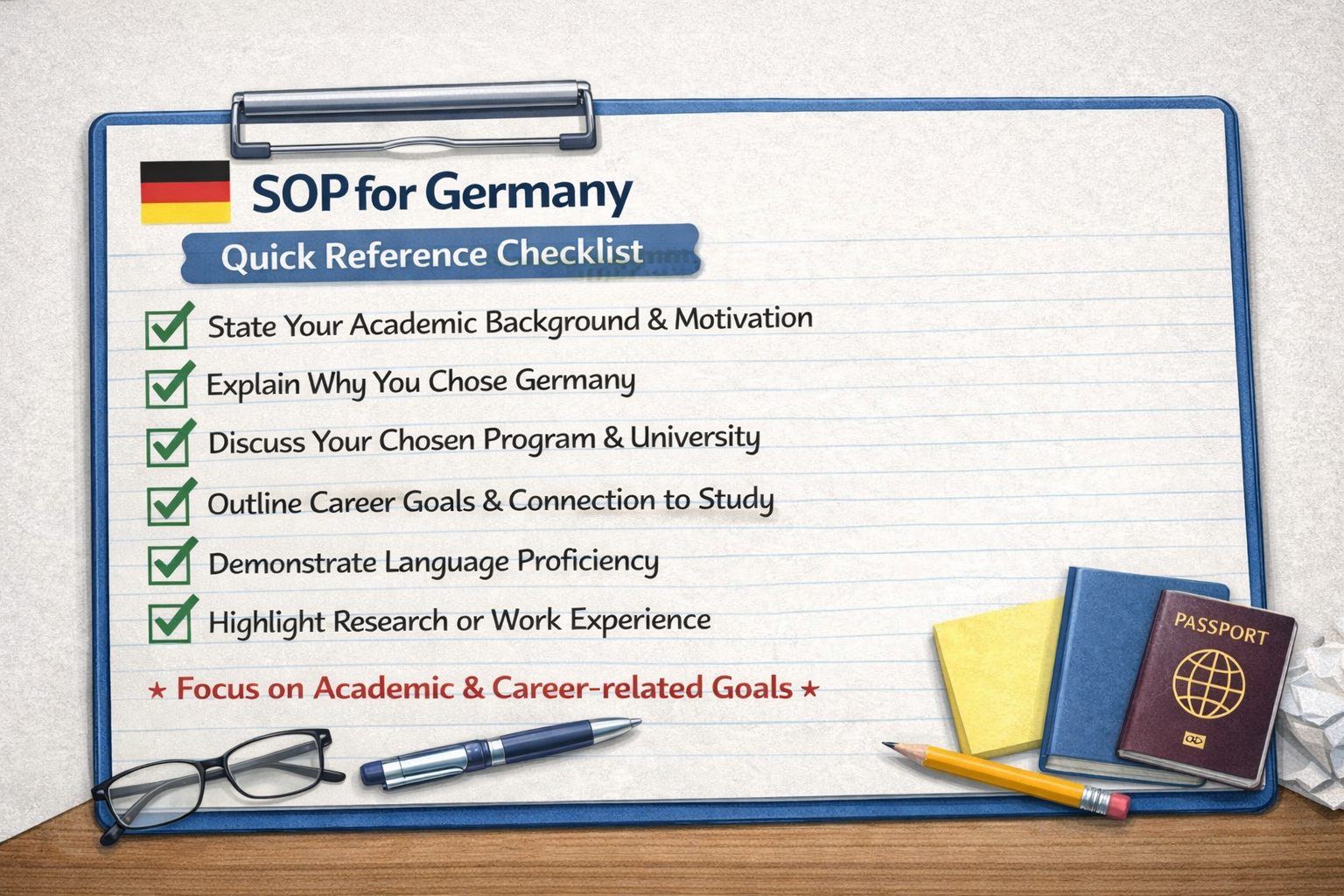
Before you submit, run through this:
Does your opening paragraph avoid starting with "I" and immediately establish something specific and interesting? Does every section connect to why this program in Germany is the right next step? Have you named specific courses, professors, or research areas at the university? Are your career goals concrete enough to be believable? Have you had someone whose English you trust read it for clarity and flow? Is it within the word limit specified by the university, and if no limit was given, is it under 1,000 words?
If yes to all of the above, you're in much better shape than most.
FAQs, SOP for Germany
What is the ideal length for an SOP for Germany?
Most German universities don't specify a word limit, but 700 to 1,000 words is the sweet spot. Tight, purposeful writing is valued in German academic culture. If you're going over 1,000 words, look for what you can cut, not what you can add.
Is a motivation letter for a master's degree the same as an SOP for Germany?
They're used interchangeably in most contexts. Both ask why you want to pursue this specific program and what you plan to do afterward. If a university specifies a "letter of motivation," treat it structurally the same as an SOP but with a slightly more personal, letter-like tone.
Can I use the same SOP for multiple German universities?
The core narrative can be similar, but the "why this university" section must be rewritten for every application. Submitting an identical document to multiple universities, especially if you accidentally leave in a reference to a different university, is a serious mistake.
Should I mention that Germany has free education in my SOP?
No. The low or zero tuition at German public universities is a practical benefit, but it should never appear in your SOP as a motivation. Your stated reasons should be entirely academic and professional.
Do I need SOP writing services in India or can I write it myself?
You can absolutely write it yourself, and many successful applicants do. Professional help is useful if you're struggling with structure, if English isn't your strongest language, or if you want rigorous external feedback. The key is that the content, your experiences, your goals, your reasoning, must come from you regardless.
Start Your Study Abroad Journey
Join thousands of students who achieved their dreams with Yastudy.