Plagiarism, AI Tools & Academic Misconduct Abroad What Every Indian Student Must Know in 2026
Divyanshi Singh
Recently • 8 min read
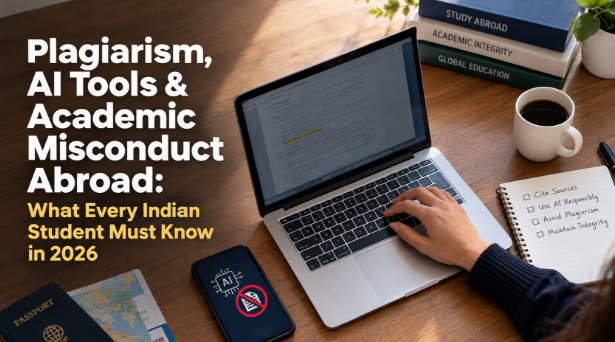
Plagiarism, AI Tools & Academic Misconduct Abroad: What Every Indian Student Must Know in 2026
You cleared IELTS or PTE, secured your offer letter, got your visa and landed abroad. The hardest part is over, right?
Planning to Study Abroad?
Get personalized guidance from experienced education counselors.
Not quite. Every year, international students, including many Indians, are called into academic misconduct meetings for things they did not realise were against the rules: reusing their own old work, studying together and submitting similar answers, or using an AI tool the way they would use a calculator.
Most study abroad blogs explain how to get in. Very few explain how to stay in good standing once you arrive. This guide covers what academic integrity means at universities in the UK, Canada, Australia, Germany and the US, why Indian students are often caught off guard, and how to protect your degree, scholarship and visa.
What Is Academic Integrity (and Academic Misconduct)?
Academic integrity means producing your own honest work and giving credit to the ideas, words and data of others. Academic misconduct is any breach of that principle. Universities abroad usually group it into these categories:
• Plagiarism: presenting someone else's words, ideas or work as your own, even without intending to.
• Self-plagiarism: reusing your own earlier assignment, or work from a previous degree, without permission.
• Collusion: working with others on an individual assignment in a way that is not allowed.
• Contract cheating: paying a person or website to write or complete your work.
• Fabrication or falsification: inventing data, sources or results.
• Unauthorised use of AI tools: using generative AI where the course rules do not allow it, or without disclosing it.
• Exam misconduct: unauthorised notes, devices or impersonation.
The key point is that intent often does not matter. "I did not know" is rarely accepted as a full defence, which is why learning the rules early is essential.
Why Indian Students Are Often Caught Off Guard
This is not about honesty. It is about a difference in academic culture. Many Indian students come from systems where:
1. Memorisation and reproduction of textbook content is rewarded, while universities abroad reward original analysis and your own argument.
2. Group study is a normal way to prepare, whereas abroad the line between studying together and submitting similar work is strict.
3. Referencing was rarely taught in detail, so styles like APA, Harvard, MLA or Chicago feel unfamiliar.
4. Copying definitions from a textbook or website is common practice, while abroad even a few unreferenced sentences can be flagged.
5. Asking teachers for help can feel awkward, so students struggle silently and sometimes take risky shortcuts.
Understanding this gap is the first step to closing it.
AI Tools in University Assignments: The 2026 Grey Area
Generative AI is the biggest source of confusion for students right now. Universities have responded very differently, and policies can even change from one module to another at the same university.
In general, you will see three approaches:
• Not allowed: any AI-generated text or ideas in assessed work are treated as misconduct.
• Allowed with disclosure: you may use AI for limited purposes (such as brainstorming or grammar checks) but must state exactly how you used it.
• Allowed and encouraged: some courses build AI use into the assignment itself.
How to stay safe with AI
• Read the assessment brief and module handbook every time. Do not assume last term's rules still apply.
• When in doubt, ask your lecturer in writing (email) and keep the reply.
• Never submit AI output as your own writing unless the rules clearly allow it.
• Keep drafts, notes and version history. Evidence of your process is your best protection if your work is questioned.
• Do not rely on "humaniser" tools. They do not make misconduct acceptable, and they can make your work look suspicious.
• Know that AI detectors are imperfect. Universities usually combine them with other evidence, and some do not use them at all, but your writing style, drafts and ability to explain your work can all be reviewed.
Plagiarism Software: How Turnitin and Similar Tools Work
Most universities in the UK, Canada, Australia and the US run submissions through similarity-checking software such as Turnitin. It compares your work against web pages, journals, books and previously submitted student papers.
A few things many students do not know:
• A high similarity score is not automatically plagiarism, and a low one is not automatically safe. A human marker reviews the report.
• Your own earlier submissions may be stored in the database, which is why self-plagiarism gets caught.
• Paraphrasing without a citation is still plagiarism. Changing a few words does not make it your idea.
Collusion vs Collaboration: Where Is the Line?
This is one of the most common causes of misconduct cases among international students.
Usually acceptable | Usually NOT acceptable |
Discussing concepts and lecture material | Sharing your written answers or code |
Studying together for an exam | Writing an individual assignment together |
Asking a friend to explain a topic | Letting someone copy or lightly edit your work |
Peer feedback if the course allows it | Using a friend's old assignment as a template |
If an assignment is marked individual, the final work must be yours alone. For group projects, check how individual contributions will be assessed.
Country-by-Country Overview
Rules vary by university, so always follow your own institution's policy. Here are the general patterns:
• United Kingdom: Misconduct is handled through formal university procedures, often with a panel meeting. Outcomes can range from a warning or mark reduction to module failure or, in serious cases, expulsion. Because UK student visas depend on your enrolment, a serious outcome can affect your immigration status.
• Canada: Universities have detailed academic integrity policies, and penalties can include a zero on the assignment, course failure, suspension or expulsion. Your study permit depends on remaining enrolled.
• Australia: Universities and the national regulator treat academic integrity seriously, and contract cheating is a particular focus. Serious cases can lead to exclusion and affect visa conditions.
• Germany: Plagiarism in theses and coursework is taken very seriously, and consequences can include failing the work, exclusion from the exam, or even degree revocation if discovered later.
• United States: Most universities operate an honor code system. Penalties range from a failing grade to suspension or dismissal, and F-1 status depends on maintaining full-time enrolment.
How a Misconduct Case Can Affect Your Visa, Scholarship and Future
An integrity case is not just an academic problem. Depending on the severity, it can lead to:
• Loss of credits or a failed module, which may delay graduation
• Withdrawal of a scholarship or funding
• Suspension or expulsion, which can end your student visa
• A note on your academic record or transcript
• Difficulty with future admissions, internships or job background checks
This is why prevention matters far more than defence.
10 Practical Tips to Protect Your Academic Record
1. Attend the integrity workshop during orientation. Many students skip it.
2. Learn your referencing style (APA, Harvard, MLA, Chicago) in your first month.
3. Use a reference manager such as Zotero or Mendeley from day one.
4. Take notes in your own words and record the source immediately.
5. Use quotation marks for exact words, with a citation.
6. Start assignments early. Panic and last-minute deadlines are when students take risky shortcuts.
7. Use the writing centre. Most universities offer free academic writing support for international students.
8. Ask for an extension or extenuating circumstances support rather than cutting corners if you are struggling.
9. Never buy or sell assignments or share your work with classmates, even as a favour.
10. Save your drafts and research notes until your results are final.
What to Do If You Are Accused of Academic Misconduct
Stay calm, and do not ignore the notice.
1. Read the allegation letter carefully and note the deadline to respond.
2. Do not delete drafts or messages. Preserve all evidence of your work.
3. Contact the student union or student advice service. Most universities have independent advisers who can support you for free.
4. Be honest and factual in your response. Explain your process and any misunderstanding.
5. Attend the meeting and consider bringing a support person if allowed.
6. Learn from the outcome. If it was an honest mistake, many universities treat a first offence educationally.
7. Check how the outcome could affect your visa and seek advice early if suspension or expulsion is possible.
Why This Matters for Your Mental Health Too
Fear of failing, language pressure and isolation push many students toward shortcuts, and misconduct cases themselves are deeply stressful. If you feel overwhelmed, talk to your university's wellbeing team or academic adviser early. Asking for help is always safer than hiding a struggle.
Frequently Asked Questions
1. Is using ChatGPT considered cheating at foreign universities?
It depends on the university and the specific module. Some ban it, some allow it with disclosure, and some encourage it for certain tasks. Always check your assessment brief and ask your lecturer if unsure.
2. What is the difference between plagiarism and collusion?
Plagiarism is using someone else's work or ideas without credit. Collusion is working with others on an assignment that should be individual.
3. Can I reuse my own previous assignment?
Not without permission. Reusing earlier work is called self-plagiarism and can be flagged by software like Turnitin.
4. Can plagiarism affect my student visa?
A serious misconduct finding can lead to suspension or expulsion, and since your visa depends on being enrolled, it can create immigration problems. Seek advice if you face a serious case.
5. What is a safe Turnitin similarity score?
There is no universal safe number. Markers review the report and look at the context, so focus on correct citation rather than a target percentage.
6. Are paraphrased sentences safe without a citation?
No. Paraphrased ideas still need a citation to the original source.
7. What should I do if I accidentally plagiarised?
If you realise before submission, fix and cite properly. If you are contacted afterwards, respond honestly and promptly, and use student advice services.
8. Are group study sessions allowed?
Yes, for learning and revision. The problem begins when individual assignments end up with shared or very similar wording, code or structure.
9. Where can I get help with referencing and academic writing?
Most universities offer free writing centres, library workshops and online guides for international students.
10. Do these rules apply to postgraduate and PhD students too?
Yes, and the standards are often stricter, especially for dissertations and theses.
Conclusion
Studying abroad is not only about getting admission and a visa. It is also about adapting to a new academic culture where originality, referencing and honesty are non-negotiable. The good news is that nearly every integrity problem is preventable with early awareness, good habits and a willingness to ask questions.
Learn the rules in your first week, keep proof of your own work, and reach out for support when you need it. Your degree, your scholarship and your future career are worth protecting.
Need Help Planning Your Study Abroad Journey?
At YaStudy, our counsellors in Noida, and Bengaluru guide students through university selection, SOP writing, visa support and pre-departure preparation, so you start your journey informed and confident. Book your free counselling session today and get a personalised roadmap for the UK, Canada, Germany, Australia, the US and more.
Disclaimer: Academic integrity policies and visa conditions vary by university and country and change over time. Always check your institution's official policy and the latest immigration rules.
Start Your Study Abroad Journey
Join thousands of students who achieved their dreams with Yastudy.