Eligibility After 12th for Bachelor's in Germany
Divyanshi Singh
Recently • 8 min read

Eligibility After 12th for Bachelor's in Germany: Complete 2026-27 Guide for Indian Students

Germany is one of the most popular destinations for Indian students. It offers low or no tuition at public universities, strong engineering and technology programmes, and a post-study work option. But the eligibility for a Bachelor's in Germany after 12th has changed. Under APS India's updated criteria, applying for Winter Semester 2026/27 and later intakes requires a minimum Class 12 score. This guide covers who is eligible, which routes are open and what to do if your marks are lower.
Planning to Study Abroad?
Get personalized guidance from experienced education counselors.
Can You Study in Germany Directly After 12th?
Most Indian students can't enter a German Bachelor's directly with a Class 12 certificate alone. German universities treat the Indian Class 12 certificate as not equivalent to the German school-leaving qualification (Abitur), so you need one of these:
1. Studienkolleg (foundation year), followed by the entrance exam (Feststellungsprüfung)
2. One successful year of a Bachelor's in India, for subject-restricted direct admission
3. A valid JEE Advanced result, which DAAD India lists as a direct route (check each university)
Every route starts with the APS certificate, which is mandatory for Indian applicants.
New Rule: 70% in Class 12 Is Now the Minimum
From Winter Semester 2026/27 onwards, APS India requires a minimum of 70% of the maximum achievable marks in Class 12 for undergraduate admission. It applies to every board (CBSE, ICSE/ISC, state boards, etc.). APS announced the change in February 2026, and it was reflected in the anabin database from 15 March 2026.
This 70% threshold applies to both standard undergraduate routes:
• Route 1: Class 12 (70%+) + APS certificate → Studienkolleg (subject-restricted admission)
• Route 2: Class 12 (70%+) + APS certificate + one successful academic year of a Bachelor's in India → direct subject-restricted admission to the same or closely related field
Meeting 70% makes you eligible to apply, but it does not guarantee a seat. Many universities set their own, often higher, selection criteria.
Eligibility Criteria at a Glance
Requirement | Details |
Minimum Class 12 marks | 70% of maximum achievable marks (from WS 2026/27), on every board |
School education | 12 years completed (Class 12 passed) |
APS certificate | Mandatory for Indian applicants |
Subjects | Must match the course applied for (e.g., Maths/Physics for engineering) |
Language (German-taught) | Usually B1/B2 for Studienkolleg entry; C1 (TestDaF/DSH/Goethe) for the degree |
Language (English-taught) | IELTS/TOEFL; required score set by each university |
Financial proof | Blocked account (about €11,904/year in 2026, i.e. €992/month) |
Language scores and financial requirements vary by university and can change, so always confirm on the official university and Federal Foreign Office pages.
Route 1: Studienkolleg Pathway
Studienkolleg is a one-year preparatory course that bridges the gap between the Indian Class 12 and German university entry. It is taught in German, ends with the Feststellungsprüfung, and is subject-specific (for example, the T-course for engineering, maths and natural sciences). Passing it qualifies you for subject-restricted admission to Bachelor's programmes.
Steps
1. Get 70%+ in Class 12
2. Apply for and receive your APS certificate
3. Learn German (typically B1/B2 for Studienkolleg entry)
4. Apply to a Studienkolleg (often via uni-assist) and clear the entrance test
5. Complete the year and pass the Feststellungsprüfung
6. Apply to your university programme
Route 2: One Year of a Bachelor's in India
If you complete one successful academic year of a Bachelor's in India, you may qualify for direct, subject-restricted admission to the same or a closely related field in Germany. Note that the 70% Class 12 requirement still applies, so a strong first year doesn't compensate for lower Class 12 marks.
Route 3: JEE Advanced
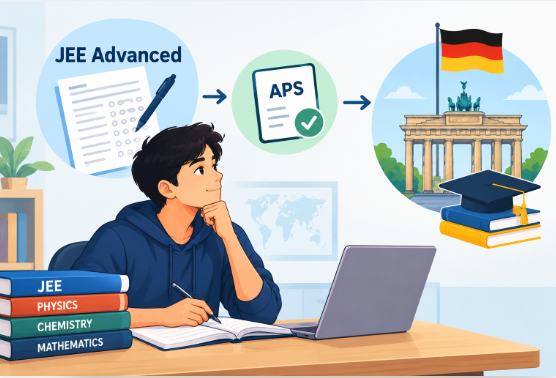
DAAD India still lists a valid JEE Advanced result as a direct route for certain programmes. Acceptance depends on the university, so check with each one, especially under the new criteria.
What If You Scored Below 70% in Class 12?
If your Class 12 score is below 70%, both standard undergraduate routes are closed from Winter Semester 2026/27. APS India's notice sets 70% as the minimum for each and lists no workaround. Your realistic options are:
• Ask about JEE Advanced. If you have a valid result, check with each target university whether it accepts it under the new criteria.
• Study a Bachelor's in India first, then apply for a Master's in Germany. The 70% rule concerns undergraduate admission, so your Bachelor's grades become the deciding factor for a Master's.
• Choose a Bachelor's in another country and keep Germany for your postgraduate studies.
Documents Required
• Class 10 and Class 12 mark sheets and certificates
• APS certificate
• Passport
• Language test certificate (German or English, as required)
• CV and statement of purpose (for some programmes)
• Proof of finances (blocked account)
• Passport-size photographs
Application Timeline
Start 9 to 12 months before your intake, because APS processing and visa appointments can take weeks.
• Winter Semester (starts October): applications are typically due by around 15 July
• Summer Semester (starts April): applications are typically due by around 15 January
The Winter 2026/27 window has now closed, so the realistic targets are the Summer 2027 or Winter 2027/28 intakes. Deadlines differ by university, so check each one.
Costs
• Tuition: Most public universities charge no tuition. Baden-Württemberg charges non-EU students about €1,500 per semester, and some programmes carry fees.
• Semester contribution: a few hundred euros per semester, which usually includes a transport pass
• Student visa fee: €75
• Living costs: covered by the blocked account requirement
Frequently Asked Questions
What is the minimum percentage required for Germany after 12th?
70% of the maximum achievable marks in Class 12 on any board, for admissions from Winter Semester 2026/27 onwards.
Is the APS certificate compulsory?
Yes, for Indian students applying to German universities. Without it, universities may not process your application.
Does the 70% rule apply to Master's applicants?
No. It concerns undergraduate admission. For a Master's, your Bachelor's grades carry the weight.
Can I study in Germany in English after 12th?
Yes, some Bachelor's programmes are taught in English, but they are fewer and more competitive. Most Studienkolleg and Bachelor's routes involve German.
Is a Bachelor's in Germany free?
Mostly, at public universities, apart from semester contributions and exceptions like Baden-Württemberg.
Final Thoughts
Eligibility for a Bachelor's in Germany after 12th now starts with the 70% Class 12 benchmark and an APS certificate. If you meet it, plan early, build your German skills and shortlist universities that match your subject combination. If you're below 70%, a Bachelor's in India or another country followed by a German Master's is a realistic path. Talk to the YaStudy counsellors to map the route that fits your profile.
Not sure if you're eligible? Book a free counselling session with YaStudy.
Start Your Study Abroad Journey
Join thousands of students who achieved their dreams with Yastudy.