Canada Student Visa Rejected? Here's Exactly What Indian Students Should Do in 2026–27
Tarun Chandel
Recently • 8 min read

You did everything right.
You got your IELTS score. You applied to a legitimate Canadian college. You gathered your documents, paid the application fee, submitted everything on time — and then the email arrived.
Canada student visa rejected.
Planning to Study Abroad?
Get personalized guidance from experienced education counselors.
Three words that make you feel as though everything is falling apart. A single IRCC decision letter that provides virtually no explanation for your application's failure suspends months of preparation, thousands of rupees in fees, family expectations, and future plans.
If this is where you are right now, this guide was made specifically for you.
Rejected Indian student visas for Canada in 2026 are not a special issue. It's a crisis-level phenomenon. Approximately 35–40% of Indian student visa applications were denied by Canada's Immigration, Refugees and Citizenship Canada (IRCC) in recent cycles, which is one of the highest rejection rates among popular study abroad locations. Rejection rates for Indian candidates above 60% in certain months and academic categories.
This book explains the true causes of rejections, what to do in the event of a rejection, how to submit a stronger application again, and why some Indian students are switching to better options and succeeding greatly.
Why Is Canada Rejecting So Many Indian Student Visas in 2026?
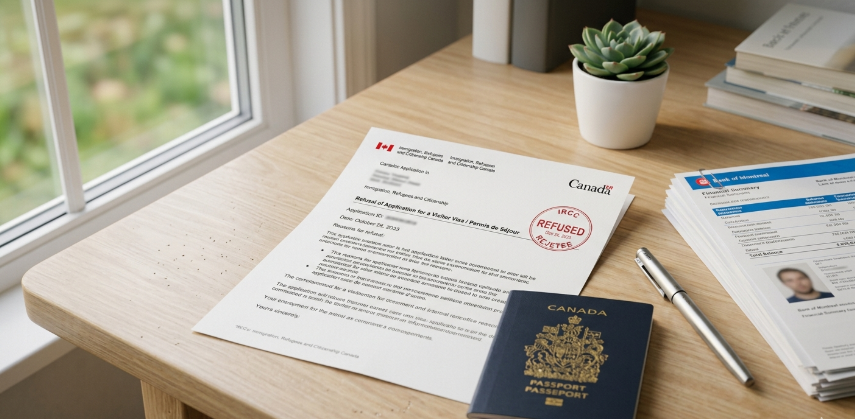
You must comprehend the true causes before you can find solutions. The IRCC's official rejection letters are incredibly ambiguous; they simply tick a few boxes without outlining the precise flaw in your application. The following is the real cause of the surge in Indian student visa rejections for Canada in 2026:
Reason 1 — The CAP on Study Permits
The Canadian government imposed a two-year cap on study permits for foreign students in January 2024, which resulted in a roughly 35% decrease in the total number of licenses awarded nationwide. Even for eligible applicants, there is now a substantially lower pool of permits available due to the extension and adjustment of this cap until 2026.
Indian students were disproportionately impacted by the cap since, at its peak, India sent more than 300,000 students annually to Canada, making Indian applicants statistically more likely to exceed the lowered quota.
Reason 2 — Failure to Demonstrate Ties to Home Country
According to IRCC letters from 2026, this is the most frequently stated reason why Indian students' visas to Canada are denied. Canadian visa officers need to be confident that you will return to India after your studies are over. The officer may believe that you plan to immigrate rather than study if your application does not clearly show strong ties to India, such as family responsibilities, property ownership, employment history, or financial dependency.
Reason 3 — Insufficient Proof of Financial Ability
Proof of your ability to pay for living expenses, tuition, and return travel is required by IRCC. Students must now show that they have available cash beyond the first year's tuition of about CAD 20,000–25,000 (about ₹12–15 lakh). Instead of being comforting, bank statements that show recent substantial deposits without sufficient transaction history are marked as suspicious.
Reason 4 — Weak SOP — Statement of Purpose
The Study Plan or SOP that you submit with your application for a Canadian student visa must persuade a visa officer that your selection of Canada, the program, and the school is actually sensible for your academic and professional objectives. SOPs that are general, vague, and template-copied are quickly recognized and have a negative impact on the application.
Reason 5 — DLI (Designated Learning Institution) Quality Concerns
Applications to private schools, smaller DLIs, and institutions in British Columbia and Ontario, which had turned into entrance routes for immigration-focused rather than education-focused applicants, are now subject to far stricter scrutiny in Canada. Regardless of an applicant's strength, applications to these institutions have much greater rejection percentages.
Reason 6 — IELTS Score Below Program Requirements
Some rejections happen just because the submitted IELTS score doesn't match the program's specified language requirement. If the school demands 6.5 in each component, even an overall band of 6.0 may result in rejection.
Reason 7 — Inconsistencies in Documentation
The officer becomes skeptical of any discrepancy between the SOP, financial records, academic records, and IELTS results. Rejection may result from seemingly little differences, such as a name spelled differently in several documents or an inexplicable balance fluctuation on a bank account.
What to Do Immediately After Canada Student Visa Rejection
The most crucial time frame is within 48 hours of receiving your letter of rejection for a student visa to Canada. This is what you should and shouldn't do.
Step 1 — Read the Rejection Letter Carefully and Note the Reason Code
Certain provisions of the Immigration and Refugee Protection Act (IRPA) and Immigration and Refugee Protection Regulations (IRPR) are cited in IRCC denial letters. The mentioned section identifies the particular issue that led to the rejection:
Section R216(1) — failure to satisfy officer you will leave Canada at end of authorised stay (ties to home country issue)
Section R220(a) — insufficient financial resources
Section R216(1) + R219(1) — combination of concerns about temporary resident intent and purpose of study
General refusal — multiple factors combined
Understanding the exact reason is essential before you decide on next steps.
Step 2 — Do Not Panic and Do Not Reapply Immediately
The instinct after Canada student visa rejected Indians 2026 is to reapply immediately. This is almost always the wrong move. Reapplying with the same application — or only minor changes — results in the same rejection for the same reasons. IRCC officers can see your application history.
Before reapplying, you need to understand and genuinely address the specific concern that caused the rejection.
Step 3 — Request Your GCMS Notes
The internal notes created by the visa officer who examined your application are called Global Case Management System (GCMS) notes. Compared to the official letter, they provide a lot more information about the reasons your application was denied.
How to request GCMS notes:
File an Access to Information and Privacy (ATIP) request through the Government of Canada portal
Cost: Free
Timeline: 30 days (though often longer in practice)
The most important resource for comprehending your particular rejection and strengthening your reapplication is the GCMS notes. Don't reapply without them.
Step 4 — Assess Your Three Options
After understanding the rejection reason, you have three paths:
Option A — Reapply for Canada with a strengthened application Option B — Appeal or seek judicial review Option C — Pivot to an alternative study abroad destination
Each has merit depending on your specific situation, timeline, and goals. We will cover all three.
Option A — Reapplying for Canada Student Visa After Rejection

If you decide to reapply, here is exactly what needs to change:
Strengthen Your Ties to India
This is the most common fix required. Your reapplication must explicitly and evidentially demonstrate your ties to India:
Family ties — parents, siblings, dependents in India; affidavits from family members confirming your planned return
Property and assets — ownership documents for property, vehicles, fixed deposits in your name or family's name
Employment history — if you were working before applying, a letter from your employer confirming you have a position to return to
Future employment plan — a credible, specific explanation of what career opportunity in India your Canadian degree will help you access
The SOP rewrite must address this directly and convincingly — not as an afterthought paragraph but as a central argument in your study plan.
Rebuild Your Financial Documentation
If financial proof was the rejection reason:
Make sure the balance in your bank account is real and consistent over a period of six to twelve months, rather than a newly inflated amount.
Add fixed deposit certificates, property valuations, mutual fund statements as supplementary financial evidence
If parents are sponsors, include their income tax returns for 3 years, salary slips, and a formal sponsorship letter
Avoid cash deposits immediately before the application — these are flagged universally
Rewrite the SOP Completely
Your Statement of Purpose must answer three questions so convincingly that rejection becomes illogical:
Why this specific program? — connect directly to your academic background and career goals
Why Canada and this specific institution? — name faculty, research, infrastructure; avoid generic Canada praise
Why will you return to India? — your post-study plan in India must be specific, credible, and tied to your Indian circumstances
A reapplication SOP cannot read like your first one. It must address the rejection reason directly — without mentioning the rejection — by providing stronger evidence across every dimension.
Consider Changing the Institution
Consider upgrading to a larger, more reputable public university for your reapplication if your rejection was related to the kind of institution you applied to—a smaller private college in Ontario, for instance. Compared to lesser DLIs, the University of Toronto, University of British Columbia, McGill, McMaster, and University of Waterloo are subject to much less scrutiny from visa authorities.
Option B — Judicial Review After Canada Visa Rejection
You have the right to request judicial review in the Federal Court of Canada if you feel that the visa officer made an unreasonable judgment based on the evidence presented in your application.
What Is Judicial Review?
Presenting fresh evidence in an appeal is not the same as judicial review. It is a legal challenge that claims the visa officer committed a legal error, violated procedural justice, or made an irrational decision based on the information at hand.
Timeline: Applications for leave for judicial review must be filed within 15 days of receiving the rejection decision for applicants outside Canada.
Cost: Requires a Canadian immigration lawyer — fees typically range from CAD 3,000–6,000 (approximately ₹1.8–₹3.6 lakh).
Success rate: Low — the Federal Court grants leave in approximately 20–30% of cases, and full judicial review results in a positive outcome in a smaller fraction of those.
Presenting fresh evidence in an appeal is not the same as judicial review. It is a legal challenge that claims the visa officer committed a legal error, violated procedural justice, or made an irrational decision based on the information at hand.
Option C — Pivot to Germany or Japan — Why Many Indian Students Are Winning Bigger

The majority of Canadian visa denial blogs never have this discussion since it is not in the best interests of consultants who specialize in Canada.
Many Indian students who were denied a Canada student visa in 2026 and chose to go to Germany or Japan have found themselves in considerably better academic, financial, and professional positions than they would have in Canada.
This is not comfort. It is a known fact.
Germany offers:
Zero tuition fees at public universities — compared to CAD 20,000–40,000 per year in Canada
No blocked account equivalent — the APS and blocked account process is complex but the educational cost is unmatched
18-month post-study work visa and EU Blue Card pathway — comparable to Canada's PGWP
Massive documented skill shortage — 400,000+ vacancies annually across engineering, IT, and healthcare
Japan offers:
MEXT scholarship — fully funded, covering tuition, ¥143,000 monthly stipend, airfare, and health insurance
World-class universities — University of Tokyo, Kyoto University, Osaka University rank among global top 50
Active immigration reforms in 2026 making it easier for international graduates to stay and work
Why YaStudy Is the Best Decision After a Canada Rejection
Whether you are reapplying for Canada, pivoting to Germany or Japan, or still deciding what to do next — this is the moment where having the right guidance changes everything.
YaStudy — Noida's most trusted and genuinely student-first study abroad consultancy — specialises in exactly this situation: helping Indian students who have faced setbacks rebuild their international education plan with clarity, expertise, and zero cost.
Yes — zero cost to you. Always.
How YaStudy's Free Model Works — and Why It Matters Here
University partnerships in Germany, Japan, the UK, Canada, Australia, and other countries provide funding for YaStudy. YaStudy is compensated by universities for matching eligible Indian students with their courses. Every recommendation is genuinely in your best interest because students are never the source of income.
If you find a better place to go, there is no reason to push you back toward Canada. There isn't a commission structure that distinguishes one nation from another. The guidance is clear, strategic, and entirely outcome-oriented.
There are no consultation costs. No fees for document reviews. There are no SOP drafting costs. There are no fees for visa advice. There are never any unstated expenses.
What YaStudy provides for students after Canada visa rejection:
Rejection analysis — detailed review of your IRCC letter and GCMS notes to identify the exact cause
Reapplication strategy — if Canada is still the right choice, a complete rebuild of your SOP, financial documentation, and institution selection
Alternative destination assessment — honest comparison of Germany, Japan, UK, and other options against your specific profile
University shortlisting — across multiple destinations matched to your academic record and career goals
Complete application support — SOP, CV, Letters of Recommendation, transcripts, and all documentation
Scholarship identification — DAAD for Germany, MEXT for Japan, and other funded options
Visa documentation review — complete checklist reviewed before submission to whichever country you choose
Pre-departure preparation — so you arrive at your destination confident and ready
Hundreds of Indian students have used YaStudy's totally free platform to rebuild their plans and get into prestigious universities in Germany, Japan, and other locations without paying a single rupee in consultant fees. Many of these students faced Canada student visa rejections in 2026.
Frequently Asked Questions — Canada Student Visa Rejected Indians 2026
Can I Reapply Immediately After Rejection?
In a technical sense, there isn't a required waiting period. However, it is nearly a given that you will fail again if you reapply without addressing the precise reason for rejection. Hold off until you get the GCMS comments, comprehend the reason for the rejection, and have made sincere adjustments to your application.
How Many Times Can I Reapply?
The number of times you can apply is unlimited by law. Nonetheless, every denial is noted and accessible to upcoming visa officers. Your reputation with the IRCC is harmed by repeated rejections if your application has not significantly improved.
Does a Canada Visa Rejection Affect Applications to Other Countries?
The systems in Germany, Japan, the UK, and Australia do not immediately raise alarms when a visa is denied in Canada. However, a lot of foreign visa applications inquire about prior visa rejections. Answer truthfully: A prior rejection is not nearly as serious as misrepresentation.
Should I Use an Immigration Consultant for Reapplication?
Use caution. Regulated Canadian Immigration Consultants (RCICs) hold licenses; check the credentials of any consultant on the ICCRC website.
Unregulated advisors that guarantee visa clearance are in violation of Canadian law and therefore to be completely avoided.
Conclusion — A Canada Rejection Is a Redirection, Not a Dead End
Rejecting an Indian student visa for Canada in 2026 is a difficult experience, but your path to pursue an international education does not end there. There are specific, workable answers for this particular situation.
The steps to a successful reapplication are straightforward if Canada is truly the ideal place for you: comprehend your GCMS remarks, address the particular reason for denial, thoroughly rebuild your SOP, bolster your financial evidence, and carefully select your institution.
Germany and Japan provide top-notch education with more certainty, lower costs, and, in many cases, better career outcomes if the pattern of Canada's policy changes toward Indian students—the caps, the increased scrutiny, the high rejection rates—makes you wonder if Canada is the right investment of your time and family's money.
In any case, you should get professional advice from someone who has no financial stake in the nation you select.
That advice is accessible. It is proficient. It's totally free.
Start Your Study Abroad Journey
Join thousands of students who achieved their dreams with Yastudy.