Collateral vs Non-Collateral Education Loan: The Complete 2026 Guide for Study Abroad Students
Charu Singh
Recently • 8 min read

"Do I really need to mortgage my house to study abroad... or is there another way?"
If this question has ever crossed your mind, then know that you are not alone in this dilemma. Every year, thousands of students from India who are planning to go abroad for their higher studies face this same confusion in their minds. With the fees in countries like the US, UK, and Canada ranging from 20 lakhs to 80 lakhs, one of the biggest challenges for students is to arrange for funds for their education.
In today’s economic scenario, i.e., 2026, the cost of living in global economies is increasing at a steady rate. For some students, their dream to study in prestigious institutions like Ivy League or Russell Group is entirely based on financial support. In this context, knowing everything about collateral vs non-collateral education loan is extremely important for students.
Planning to Study Abroad?
Get personalized guidance from experienced education counselors.
In this comprehensive guide, we will cover everything from “how does education loan work,” “what are the types of loans,” “actual interest rate data,” “government schemes,” etc., so that you can take an informed decision.
What is an Education Loan & How Does It Work?
Before making a comparison between loan types, it would be best to first understand how does education loan work.
An education loan is a financial product provided by banks and Non-Banking Financial Companies (NBFCs). This loan helps students fulfill their expenses towards their higher studies, especially if they plan to pursue their studies abroad. This loan is different from a personal loan in terms of providing a grace period for the student to focus on their studies.
What Does It Cover?
A comprehensive loan does not just cover your classroom needs, it covers your entire life abroad. Most lenders cover:
Tuition fees: These are paid directly to your university.
Living expenses: These are in the form of monthly stipends for rent and food.
Travel costs: These cover your airfare and commuting costs.
Books and study materials: These can even cover expensive laptops or equipment for specific courses.
Key Features:
Moratorium period: This is a "repayment holiday" and is equivalent to the course duration + 6-12 months.
Repayment tenure: This is usually between 7-15 years.
Interest rates: These range between 8.5-14%, depending on the lender.
Benefits of education loan:
Financial Independence: There is no need to use personal savings or liquidate family retirement funds.
Tax Savings: One can enjoy tax benefits under Section 80E of the Income Tax Act on interest paid.
Credit Building: It helps the student establish a strong credit profile early in their professional life.
Global Accessibility: It makes world-class education accessible to students from all financial backgrounds.
Many students also consider other options such as personal loans for students, but education loans are much more feasible and are designed for academic purposes with much lower interest rates.
Collateral Loan
Simply, a collateral or secured loan is where you pledge an asset as collateral to the bank. The asset is used as collateral or security for the loan in case you default or fail to pay the loan.

Details of security offered in education loan:
Banks are quite particular when it comes to what they accept as "security." Banks generally accept collateral in two different forms:
1. Immovable Property (Tangible Assets):
Residential Property: Houses, flats, or apartments with clear titles.
Commercial Property: Shops or offices.
Urban Land: Non-agricultural land with clear boundaries.
2. Liquid Assets (Intangible Assets):
Fixed Deposits: Easiest form of collateral for quick processing.
LIC Policies: Surrender value of the policy.
Government bonds: NSC (National Savings Certificates).
Bank does not give loan against:
Agricultural Land: Due to complex legal restrictions.
Disputed Property: Any asset currently under a legal conflict.
Unregistered assets: Any asset without proper government documentation or "Gram Panchayat" assets.
Why Choose Collateral Loans?
Collateral loans are the "gold standard" for long-term loans. Collateral loans entail the following advantages:
Lower interest rates: Since there is a low risk for the bank.
Higher loan amounts: Which is required for costly medical or aviation courses.
Flexible repayment terms: Which includes longer moratorium periods.
The biggest disadvantage is that your asset is at risk if you default. It demands a high level of financial discipline from the student.
Non-Collateral Education Loan
The non-collateral loan is an unsecured loan where there is no need to provide any asset. It is a "loan on merit." Instead of seeing your assets, the lender is interested in seeing who you are going to become.

What is seen :
How you have done academically: Your GRE/GMAT/IELTS scores and GPA.
The ranking of the university: Approval is higher for top-ranked universities across the world.
The ROI of the course: Does the course you're taking guarantee you a high-paying job at the end of it (Data Science or MBA)?
The income of the co-applicant: The stability of the income of the parent/guardian.
Collateral vs Non-Collateral Education Loan: Key Differences
Factor | Collateral Loan | Non-Collateral Loan |
Security | Required (Property/FD) | Not required |
Loan Amount | Up to ₹1–1.5 crore | ₹7–75 lakh (Limit varies by bank) |
Interest Rate | Lower (8.5% - 10.5%) | Higher (10.5% - 14%) |
Processing Time | Slower (2-4 weeks) | Faster (7-10 days) |
Risk | Asset at risk of seizure | No asset risk |
Co-applicant | Flexible income criteria | Strict income/CIBIL requirements |
Real Data: Interest Rates in India by RBI
Keeping yourself updated with the latest figures is important for your budget. In 2026, interest rates have been stable, although the difference in interest rates for public and private lenders is still significant.
Public Sector Banks (Secured Loans):
Canara bank education loan interest rate: 8.55% – 10.75%
Union bank education loan interest rate: 8.40% – 10.50%
Indian bank education loan interest rate: 8.60% – 10.75%
Note: The concession for the female students is an additional 0.50%.
Private Banks & NBFCs:
ICICI education loan interest rate: 10.5% – 13%
GyanDhan education loan interest rate: Starts around 10.25% (acts as an aggregator).
HDFC Credila education loan interest rate calculator shows rates up to 14% for unsecured options.
Always compare using an education loan interest rate calculator before finalizing. A 1% difference in interest over a 10-year tenure can save you lakhs of rupees.
Loan Amount: How Much Can You Borrow?
Your choice of collateral vs non-collateral education loan itself determines your budget.
Collateral Loans:
In case you are planning to pursue a specialized medical degree from the UK or a top-tier MBA from a US university, it may cost you more than ₹1 crore. Only collateral loans are applicable in such scenarios.
Limit: Up to ₹1.5 crores (and even higher for special cases).
Coverage: Covers 100% of the cost of education with zero margin money in many public banks.
Non-Collateral Loans:
This type of loan is applicable for Master's or STEM programs.
Limit: ₹7 lakh to ₹75 lakh.
Dependencies: The amount is strictly capped depending on the University's ranking and Co-applicant income. If your co-applicant has a low CIBIL score, the amount may get slashed.
Courses That Get Loans Easily
Lenders are, in essence, investors in your future. They are looking for "high-yield" students.
High Approval Courses:
Education loan for MBA:Business programs are seen as a low-risk investment because the salary for a position is so high.
Education loan for MBBS / Student loan for MBBS: Medical professionals have the highest job security.
STEM programs:STEM programs are emphasized because the world is in desperate need for more tech-savvy individuals.
Courses in the fine arts, humanities, or niche liberal arts programs tend to be scrutinized under the non-collateral category because the immediate ROI is difficult for a bank to compute.
Government Schemes You Should Know
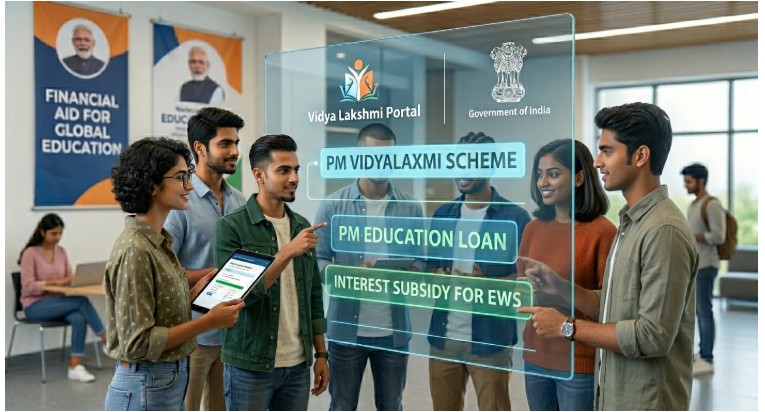
The Indian government has achieved significant progress in making education accessible for its citizens using technology and government subsidies. The Vidya Lakshmi Portal is a unified portal where students can explore and apply for loans.
Features:
Apply to many banks at once using a single application.
Keep track of your application with real-time updates.
Compare loan options with different interest rates.
The portal is closely related to many flagship programs:
PM education loan (Under the PMMY or similar interest subsidy schemes).
PM Vidyalaxmi scheme:Ensures that no student is denied higher education due to a lack of funds.
Education loan scheme by Narendra Modi: It is focused on providing interest subsidies to EWS (Economically Weaker Sections) during the Moratorium Period.
This platform helps you in a big way by simplifying how to apply for student loans by not requiring you to physically visit multiple bank branches.
Documents Required for Education Loan
Preparation is 90% of the Battle:
Having your document required for education loan ready saves you a lot of time. Being prepared will reduce your waiting period by half.
Student Documents:
Admission letter: Confirmation of your admission and fee structure.
Academic documents: 10th, 12th, and graduation mark sheets.
Test documents: GRE, GMAT, TOEFL, or IELTS certificates.
KYC: Aadhaar Card, PAN Card, and Passport.
Financial documents:
Income proof: Salary slips of last 3 months.
ITR: Income Tax Returns of last 2 years.
Bank statements: Last 6 months’ salary credit.
For Collateral Loans:
Property documents: Title deeds, allotment letter.
Legal verification: Search report from a bank-approved lawyer.
Valuation report: Assessment by a certified engineer/valuer.
How to Apply for Student Loans
The process of application and disbursement is a structured one. Here is the step-by-step guide on how to apply for student loans effectively:
Select the University: First, apply for the I-20 (for USA) or CAS (for UK).
Compare the lenders: Compare the interest rates offered by the banks with the interest offered by the NBFCs.
Eligibility: Check the eligibility criteria using the online tools by providing the income details of the co-applicant.
Submit the application: Apply through the Vidya Lakshmi Portal or the website of the lending institution.
Uploading the documents: Ensure the scanned documents are clear.
Waiting for approval: Be prepared to answer questions regarding career goals.
Secured Loan Application Process
The secured loan application is a physical verification-based process. The loan application is subject to a Property valuation ( 5-10 days) and a Legal verification carried out by the bank’s panel lawyers. The total time frame is 15-25 days.
Non-Collateral Loan Process
The non-collateral loan application is a lean process. The loan application is subject to a Profile evaluation, University verification, and Income verification. The loan application is approved within 7-15 days.
When Should You Choose a Collateral Loan?
A collateral loan isn't just about having property; it's a strategic move.
✔ You have assets: If your family owns a clear-titled property.
✔ You want lower interest: Over a 10-year period, saving 3% interest can save you ₹15–20 lakhs.
✔ You need a high loan amount: For costs exceeding ₹50 lakhs.
When Should You Choose a Non-Collateral Loan?
This is the modern way of funding your education, based on your own potential.
✔ You don’t have assets: Or your parents are not comfortable pledging their house.
✔ You need fast approval: If your visa deadline is nearing and you require a "Sanction Letter" urgently.
✔ You have strong academics: If you are going to a Top 50 Global University, lenders will compete to give you a loan.
Hidden Costs You Should Know
The interest rate is only the "Sticker Price." Look deeper into:
Processing Fees: Ranges from 0.5% to 2%. Some public banks waive this during "Education Loan Melas."
Insurance Fees: Lenders require the borrower to take life insurance for the amount they will borrow.
Foreign Exchange Conversion Fees: If the bank is going to transfer the amount to your University, you will end up losing a small percentage.
Prepayment Penalties: While most Education Loans do not have this, make sure you can pay back the loan without any extra charges.
Real-Life Example: The Story of Two Students
Student Profile: Rahul and Sneha both secured admission in the MS in Data Science program in the US.
Total Loan Required: ₹60 lakh.
Option 1: Rahul opts for a Collateral Loan
Interest: 9%
Result: Rahul pays a Lower amount as EMI after completing his studies. His father’s Fixed Deposit was used as collateral.
Option 2: Sneha opts for a Non-Collateral Loan
Interest: 12%
Result: She got her loan approved within 6 days and was able to book a cheaper flight and apply for her Visa early.
Decision is based on the priorities of cost or speed.
Common Mistakes Students Make
To ensure that your application does not get rejected, avoid these common mistakes:
Not comparing lenders: Taking the first offer that comes your way.
Ignoring ROI: Taking a ₹50 lakh loan for a course that pays only ₹30 lakh annually.
Incomplete documents required for education loan: This is the #1 reason for delays.
Applying without admission: Banks need a formal offer letter to process your request.
Pro Tip for Students
If you're looking for study abroad near me, keep in mind that your financial planning is equally important as your SOP or LOR. Your loan decision affects:
Your university: Can you afford your dream university or the ‘safe' university?
Your financial stability: What is the amount you will pay as EMIs from your salary?
Your future: Your loan will help you buy your first home abroad.
Final Verdict
There is no one-size-fits-all answer in the collateral vs non-collateral education loan debate.
Choose Collateral Loan if you want the Lower interest and Higher amount.
Choose Non-Collateral Loan if you want the Faster processing and No asset risk.
Conclusion
The choice between collateral vs non-collateral education loan is a critical decision for any student who is planning to study abroad. In the year 2026, with the help of the PM Vidyalaxmi scheme and the Vidya Lakshmi Portal, availing a loan is easier than ever. However, the student now requires a greater amount of "Financial Literacy" than ever before.
A good decision can:
Save you money
Reduce stress
Help you focus on your education
Take time to research, use an education loan interest rate calculator, and plan wisely. Because studying abroad is not just about a degree—it’s about a financially secure future.
Data sourced from RBI Annual Report 2024, SBI/BoB official loan pages, Credila, Avanse, and Prodigy Finance product disclosures. Rates are indicative and subject to change. Consult a financial advisor before taking a loan.
Start Your Study Abroad Journey
Join thousands of students who achieved their dreams with Yastudy.