Amazon, Google and Meta Slashing H-1B Filings in 2026 — What It Means If You Are Studying in the US
Tarun Chandel
Recently • 8 min read

There is a quiet shift happening inside the American tech industry right now — and for Indian students studying in the United States, it may be one of the most important changes nobody is talking about loudly enough.
Because the companies that once represented the dream ending of the international student journey are beginning to move differently.
For years, the pathway felt almost culturally understood among Indian STEM students:
Planning to Study Abroad?
Get personalized guidance from experienced education counselors.
Get into a strong US university.
Survive the coursework.
Land internships.
Get hired by a major tech company.
Move from OPT to H-1B sponsorship.
And at the center of that dream were names students knew by heart:
Amazon.
Google.
Meta.
These companies were not just employers. They became symbols of possibility for an entire generation of Indian engineers, coders, AI researchers, and data scientists who believed global careers could be built through the American education system.
But in 2026, something measurable has changed.
Immigration attorneys, hiring analysts, and USCIS filing patterns are all pointing toward the same trend: some of the largest H-1B sponsors in the tech industry appear to be significantly reducing the volume of H-1B petitions they submit compared to previous years.
There were no dramatic press conferences announcing this shift.
No viral headlines.
No official statement saying the old pathway was disappearing.
Instead, the change is showing up quietly — in hiring behavior, internal sponsorship policies, immigration filing data, and conversations happening behind the scenes inside law firms that work closely with these companies.
And for Indian students currently sitting inside American universities, this news lands heavily.
Because these are not random employers.
These are the exact companies many students built their financial calculations around when deciding to spend ₹70 lakh, ₹80 lakh, sometimes more than ₹1 crore on a US education.
The expectation was not only a degree.
It was access to a professional ecosystem that historically absorbed huge numbers of international STEM graduates into long-term employment pathways.
Now, that ecosystem feels less certain.
And when you combine this shift with everything else happening simultaneously in 2026 — tighter visa scrutiny, uncertainty around OPT, possible changes to Duration of Status rules, rising immigration complexity, and discussions around dramatically higher H-1B costs — the emotional impact becomes much larger than a hiring trend alone.
For many Indian students, it feels like the underlying math of the American dream is changing while they are already inside the system.
A student pursuing computer science suddenly wonders whether the pathway after graduation still exists in the same way it did for seniors who graduated three or four years earlier.
A master’s student in AI or data science begins questioning whether the enormous loan their family accepted still carries the same probability of long-term return.
And perhaps most painfully, students who did everything “right” — top grades, internships, research, networking, technical preparation — are now realizing that broader structural forces may matter just as much as individual merit.
That realization is emotionally difficult because it forces a generation of students to rethink assumptions they once treated as almost guaranteed.
Not whether America still offers opportunity.
It absolutely does.
But whether the old pathway — study, OPT, Big Tech sponsorship, long-term stability — still functions with the same predictability that convinced so many Indian families to invest everything into it in the first place.
And in 2026, that is no longer a simple question anymore.
What Is Actually Happening — The Big Tech H-1B Reduction in Numbers:
Big Tech H1B Reduction 2026 Indian Graduates — The Documented Evidence:
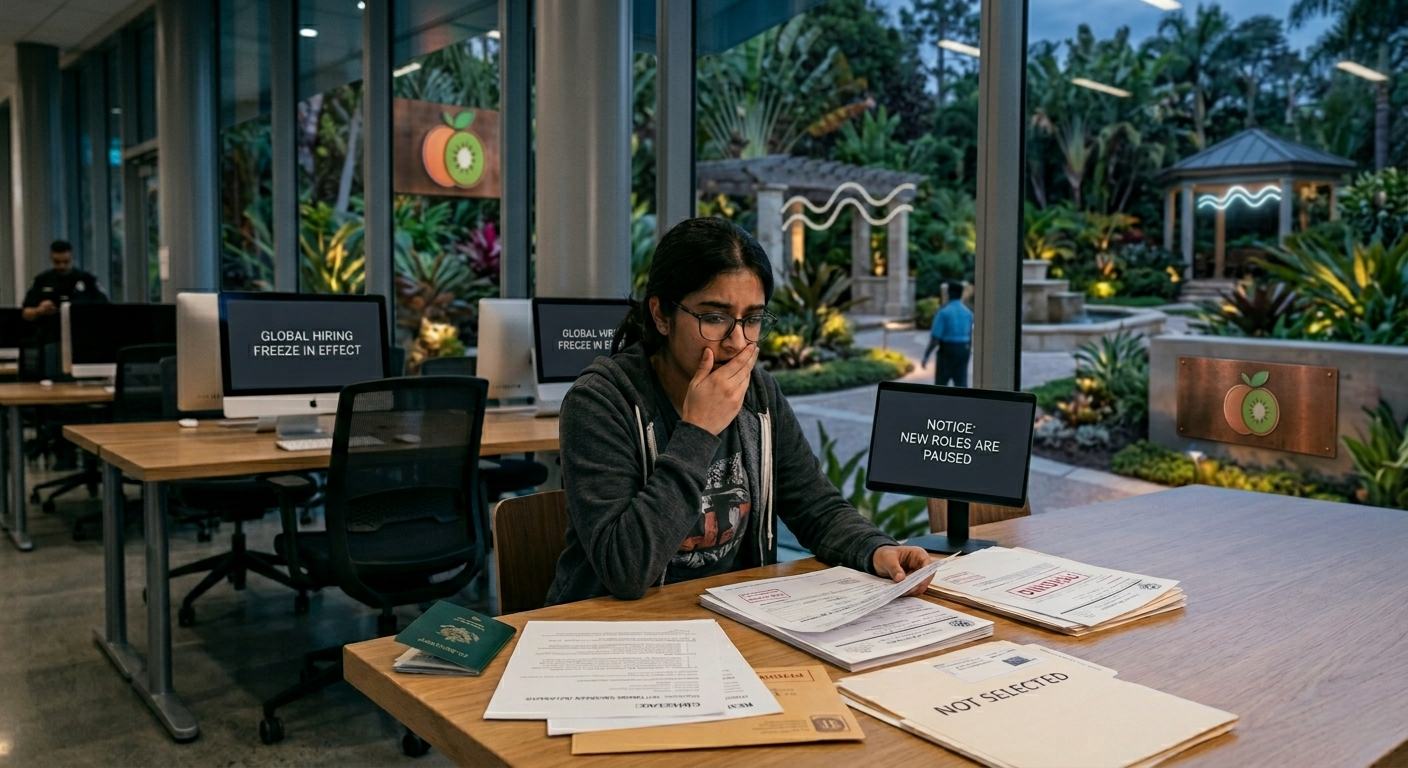
For many Indian students in the United States, the warning signs did not arrive through one dramatic announcement.
They appeared slowly. Quietly.
Almost invisibly at first.
A senior graduating without sponsorship.
An internship that no longer converted into a full-time role.
A recruiter suddenly asking, “Do you require visa sponsorship?” much earlier in the conversation than before.
Then the patterns started becoming harder to ignore.
And when multiple streams of data begin pointing in the same direction, the story becomes bigger than isolated experiences.
One of the clearest indicators comes from H-1B filing behavior itself.
The annual H-1B cap — 85,000 total visas, including both the regular quota and the advanced degree exemption — continues to fill every year because global demand for American employment remains enormous.
But beneath that headline, something important has changed.
The composition of filings is no longer what it was during the peak hiring years of 2022 and 2023.
Some of the largest technology companies that historically sponsored huge numbers of Indian STEM graduates appear to be submitting significantly fewer H-1B petitions than before. And for students who built their entire career roadmap around those employers, that shift feels deeply personal.
Because these companies once represented certainty.
A master’s student in computer science could reasonably believe that if they performed well enough academically, secured internships, and built the right technical profile, a pathway into companies like Amazon, Google, or Meta was realistically achievable.
But the tech industry that fueled those expectations has changed dramatically over the past few years.
Layoffs hit hard between 2022 and 2024. Tens of thousands of employees across major tech firms lost jobs, including many connected to visa-sponsored positions.
At Amazon, workforce reductions reshaped hiring priorities.
At Google, broader restructuring inside Alphabet tightened recruitment strategies.
At Meta, Mark Zuckerberg’s “year of efficiency” became more than a slogan — it translated into leaner hiring, reduced expansion, and a much smaller appetite for aggressive sponsorship growth.
And behind closed doors, immigration law firms working with these companies began noticing something even more important: the overall approach to H-1B sponsorship itself was becoming more cautious.
Several US immigration attorneys publicly reported that many Big Tech clients filed fewer H-1B petitions during the 2025–2026 cycles compared to the hiring boom years immediately after the pandemic.
The reasons are layered:
Lower overall hiring demand.
Pressure to prioritize domestic recruitment.
Economic caution.
Political sensitivity surrounding immigration.
And a growing corporate calculation that high-profile H-1B sponsorship now carries more scrutiny than before.
For Indian students, this creates an emotional collision between expectation and reality.
Because the image many families still carry of the US tech market was built during a very different era — one where talent shortages, aggressive expansion, and massive hiring created extraordinary opportunities for international graduates.
But students entering the system in 2026 are facing a different landscape entirely.
Not hopeless.
Not impossible.
But undeniably more competitive, more selective, and far less predictable than the version sold to the previous generation.
And perhaps the hardest part is this:
Many students discovering these changes are already deep inside the journey.
The loans are already taken.
The tuition is already paid.
The degree is already underway.
Which means this is no longer just a discussion about immigration policy or hiring statistics.
It is about thousands of young people quietly realizing that the pathway they believed was stable may now require a completely different level of strategy, flexibility, and realism to navigate successfully.
H1B Cap Reached 2026 Indian Students Alternatives — The Lottery Math That Has Worsened:
The main source of irritation for Indian students is that, although the H-1B cap is reached annually, not all applicants are successful. This is reflected in their search for alternatives. It implies that winners are chosen from among all participants in the lottery.
The lottery mathematics in 2026:
Annual H-1B cap: 85,000 total (65,000 regular + 20,000 advanced degree exemption for US master's holders)
Registered petitions in recent cycles: 400,000–780,000
Selection probability per attempt: approximately 14–22% for regular cap; somewhat higher for advanced degree exemption holders
Cumulative probability over 3 STEM OPT attempts: approximately 45–55% for advanced degree holders.
However, they are total figures. OPT to H1B lottery odds for 2026 When Big Tech businesses, which have previously submitted a lot of H-1B applications for Indian OPT workers, cut back on their filing numbers, the India-specific calculation gets worse:
Indian STEM graduates who disproportionately depended on Big Tech corporations for sponsorship will file fewer H-1B petitions as a result of fewer Big Tech filings. Big Tech's OPT-to-H-1B pipeline for Indian students is closing at the same time that pressure is being placed on other international students' employment alternatives.
The MS USA Job Market 2026 Indian Students Outlook:
What the US STEM Jobs Future Indian Graduates 2026 Actually Looks Like:
For reasons beyond H-1B filing volumes, the MS USA job market for Indian students in 2026 is far more difficult than it was in 2021 or 2022:
Technology sector contraction: There has been a significant correction to the post-pandemic technology recruiting spree that resulted in record pay and aggressive H-1B sponsorship. Over 350,000 layoffs in the technology sector have been reported in the US between 2023 and 2025, impacting both new OPT candidates and current H-1B holders.
Impact of AI automation on entry-level positions: AI-driven productivity gains that lower headcount requirements for the same output most directly affect the particular roles that Indian STEM graduates have traditionally entered the US job market through, such as software development, data analysis, QA engineering, and backend development.
Preference for domestic candidates: The political climate of 2025–2026 has given large US firms incentives to openly show their preference for American workers, which has an impact on OPT hiring decisions even at businesses that still submit H-1B petitions.
The assessment of US STEM jobs for Indian graduates in 2026 is not unachievable, but it is far more difficult, unclear, and reliant on individual distinction than it was three years ago.
OPT to H1B Lottery Chances 2026 India — The Realistic Probability:
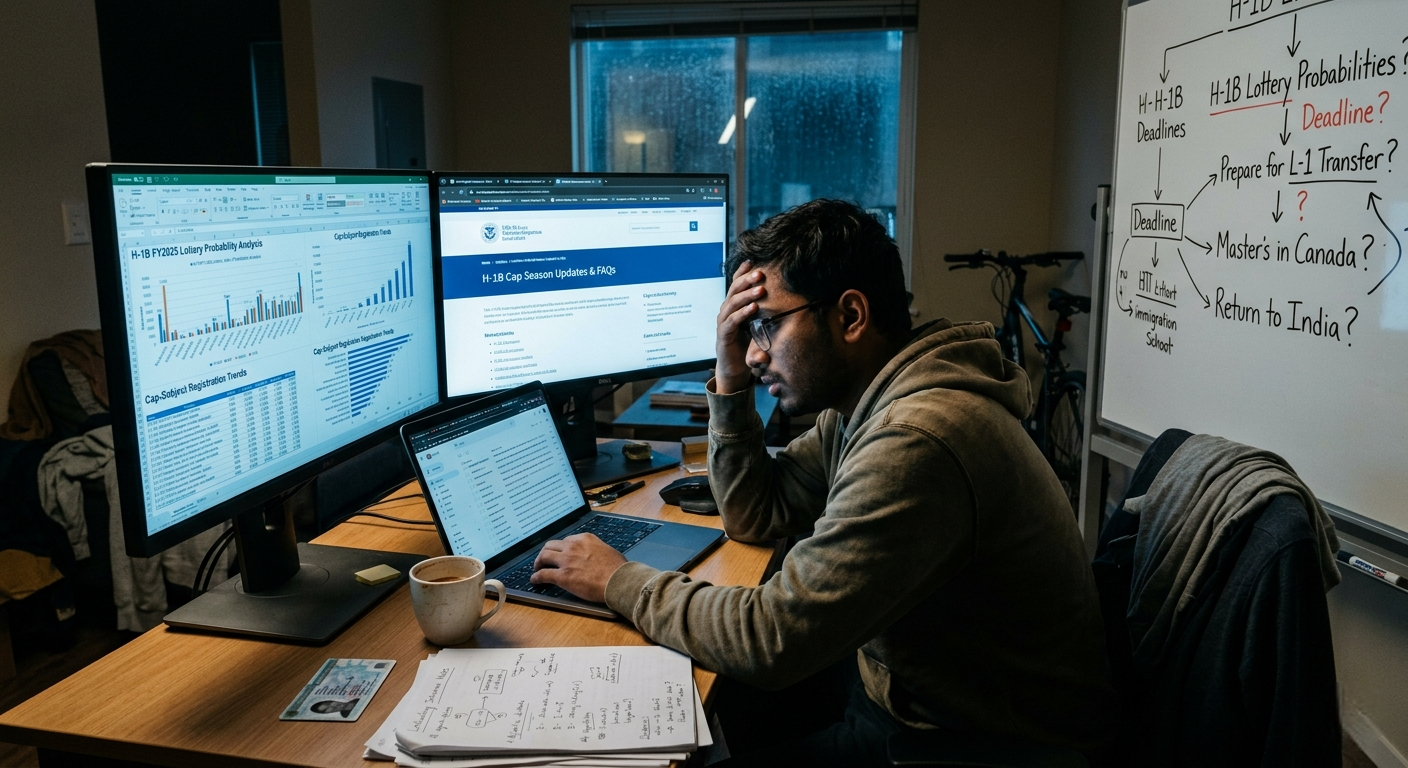
The OPT to H1B lottery chances 2026 India calculation must now incorporate:
Reduced Big Tech filing volumes (fewer petitions on behalf of Indian OPT workers)
Proposed $100,000 H-1B employer fee (if enacted, eliminating mid-sized and small employer sponsorship)
Potentially reduced STEM OPT duration (from 36 months to 12 months if OPT rulemaking proceeds)
General technology sector hiring contraction reducing OPT employment rates.
An Indian STEM graduate's realistic cumulative H-1B success likelihood in 2026, taking into consideration the following factors:
45–55% over three attempts is the ideal case (STEM OPT maintained, no employer fee increase). Moderate situation (partial impact on employer fees, STEM OPT maintained): 30–40% after three tries Pessimistic scenario: 15–22% single attempt (STEM OPT limited to one attempt, expensive employer charge)
A ₹60–80 lakh investment in a US master's degree with a 15–55% chance of producing the US job that warrants it represents a risk profile that should be explicitly acknowledged rather than taken for granted.
US vs Europe Job Offer Indian STEM Graduates 2026 — The Comparison That Matters:
The Germany and EU Alternative for Indian STEM Graduates:
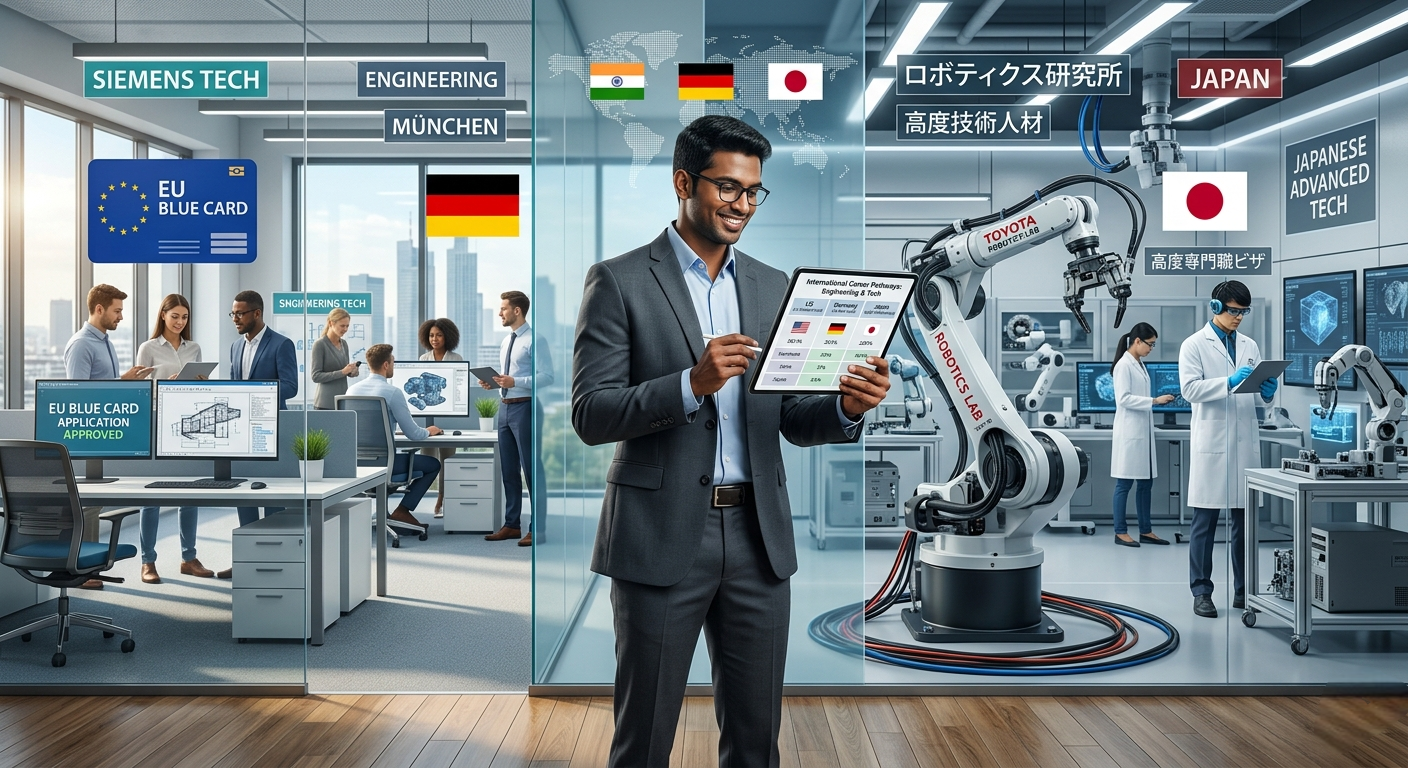
Over the past two years, the US vs. Europe employment offer contrast for Indian STEM graduates in 2026 has drastically changed in favor of Europe, driven concurrently by the US road becoming less guaranteed and the European pathway becoming more overtly welcoming.
In 2026, Germany will specifically give Indian STEM graduates:
In 2025, Germany reported a shortfall of more than 400,000 qualified professionals, mostly in the fields of engineering, IT, software development, data science, and healthcare. Indian STEM professionals now have more and faster opportunities because to the German government's Fachkæfteeinwanderungsgesetz (Skilled Worker Immigration Act) amendments.
The employment pathway comparison:
Factor | US (2026) | Germany (2026) |
Graduate job search visa | OPT (under threat) | 18-month job seeker visa (stable) |
Employer fee for work permit | $100,000 proposed | Standard processing fee |
Lottery required | Yes (25–35% annual odds) | No lottery |
Average entry salary (IT) | ₹44 lakh – ₹50 lakh | ₹40 Lakhs – ₹49 Lakhs |
Permanent residency pathway | H-1B → Green Card (7–20+ year wait for Indians) | EU Blue Card → PR in 21–33 months |
Education cost | ₹15 Lakhs to ₹1.2 Crore | ₹18 lakh and ₹30 lakh |
There is a real salary gap, with US incomes being higher overall. However, the US vs. Europe job offer Indian STEM graduates 2026 comparison increasingly favors the European pathway for students who are honest about the risk they are accepting when considering the cost differential (₹0 tuition in Germany vs. ₹60–80 lakh in the US), the risk differential (no lottery vs. 25–35% annual odds), and the timeline differential (21–33 months to German PR vs. 7–20+ years to US Green Card for Indians under the per-country cap).
Japan's Growing STEM Job Market for Indian Graduates:
Future Indian graduates' options for US STEM careers in 2026 are also growing in Japan. The 2025 immigration reforms in Japan have made it easier and quicker for foreign STEM graduates to move from student to worker to permanent resident. There is a real need for Indian graduates with STEM capabilities due to Japan's severe labor shortage in semiconductor manufacturing, robotics, AI research, pharmaceutical science, and automotive technology.
Japan's fully financed government scholarship, the MEXT scholarship, offers a free route to a top-notch Japanese university education, while the 2025–2026 immigration framework offers better post-graduation job opportunities than before.
What Indian Students Currently in the US Should Do Right Now:
Immediate Actions for Indian STEM Students on OPT:
The Big Tech H1B reduction in 2026 applies to those who are now on OPT in the US or who will finish their degree there in 2026. The status of Indian graduates calls for proactive measures:
Don't rely just on Big Tech sponsorship; diversify your employer objectives right now. In the current climate, mid-sized technology corporations, government contractors, defense contractors, and healthcare technology companies all file H-1B petitions and may provide a higher chance of sponsorship.
Examine sponsorship history specific to your employer; USCIS releases H-1B employer information. Find out which particular companies in your industry submitted the most H-1B applications the previous year, then focus on them.
Develop the EU Blue Card qualification concurrently. To be eligible for either the EU Blue Card or German Ausbildung recognition, you must prove that your degree is equivalent to a German qualification. Starting this procedure while on OPT makes it possible to quit without having to start anew.
Keep an eye on the Federal Register for OPT rulemaking; whether you have one or three lottery attempts depends on the results of the STEM OPT review.
Expert Guidance on Your US Career Crisis — Yastudy Provides It Free:
Together with the OPT threat, F-1 visa reduction, and fixed-term change, the Amazon Google Meta H1B filing cuts for Indian students in 2026 necessitate individualised, truthful career and study abroad advice from someone who has no financial interest in keeping you committed to the US track.
Yastudy — Noida's most trusted and genuinely student-first study abroad consultancy — provides complete guidance on US career uncertainty and European alternative pathways at absolutely zero cost to students.
Zero consultation fees. Zero application charges. Zero hidden costs. Free. Always.
Yastudy is funded by universities in Germany, Japan, the UK, Canada, and the US in order to link qualified Indian students. Students are never the source of revenue. This suggests that every recommendation is given with your best interests in mind and that there is no commission pressure to keep you in the US if Germany is a better fit for you.
What Yastudy provides at no cost:
US career risk assessment — honest evaluation of your OPT-to-H-1B probability given your specific field and employer targeting
Germany alternative career pathway — zero tuition education plus EU Blue Card employment pathway analysis
MEXT scholarship Japan support — research plan, professor outreach, Embassy documentation
University shortlisting across all destinations
Complete application support — SOP, CV, Letters of Recommendation
Education loan guidance through Vidya Laxmi Portal
Pre-departure orientation — country-specific, practical
Conclusion — The Big Tech Pipeline Is Narrowing. The Question Is What You Build Instead:
Indian STEM talent is still able to find fantastic foreign opportunities despite the Amazon Google Meta H1B filing cuts for 2026. It is the conclusion of one particular route, the Big Tech OPT-to-H-1B conveyor belt, which was never as dependable as it seemed and is now clearly, quantifiably shrinking.
The students who successfully navigate 2026 are those who recognize this contraction and create alternative plans that do not rely on it. These plans include Japan's MEXT scholarship and improving employment framework, Germany's free tuition and lottery-free EU Blue Card pathway, and an honest evaluation of whether the US pathway still makes financial and career sense for their particular circumstances.
The 2026 Indian STEM graduates' job offer comparison between the US and Europe has changed. Yastudy offers professional, tailored, and totally free advice to address that change.
Start Your Study Abroad Journey
Join thousands of students who achieved their dreams with Yastudy.