OPT Programme Under Threat — What Indian STEM Students in the US Must Know Right Now
Tarun Chandel
Recently • 8 min read

This is not a drill.
You should thoroughly read this advice before deciding on your next course of action if you are an Indian student presently studying in the US on an F-1 visa or if you intend to travel to the US for a STEM degree with the expectation of working there through OPT afterward.
The OPT program threat that Trump poses to Indian students in 2025 is not a theoretical danger concealed in an unread policy document. An estimated 200,000 Indian STEM graduates in the US rely on this program annually, which serves as the financial foundation for the overall India-to-US education investment argument. It is an active, documented, politically motivated threat.
Planning to Study Abroad?
Get personalized guidance from experienced education counselors.
Since its expansion in 2008, there has never been more administrative and political pressure on Optional Practical Training, especially STEM OPT. Additionally, Indian students who came to the US with a financial plan that anticipated OPT would be available after graduation are the ones most vulnerable to this threat.
Your full alert briefing is contained in this handbook. We describe OPT in detail, the particular risks it faces under the present administration, the realistic risk scenarios, what you can do to protect yourself now, and what you can do in the worst-case scenario.
What Is OPT and Why Does It Matter So Much to Indian Students?

Optional Practical Training — The Programme That Makes the US Education Investment Work
Under a program run by US Citizenship and Immigration Services (USCIS), F-1 international students can work in the US in a position directly related to their field of study either before graduation (pre-completion OPT) or after graduation (post-completion OPT) without losing their F-1 student visa status.
After graduation, standard OPT permits up to 12 months of work authorization. A STEM OPT Extension grants an extra 24 months of work authorization for graduates in STEM fields (science, technology, engineering, or mathematics), for a total of 36 months of US work authorization following graduation.
Why 36 Months Is the Magic Number for Indian Students
Every Indian family with a child enrolled in a US STEM program realizes intuitively that the OPT program Trump threat Indian students face is existential for a particular financial reason:
An annual lottery is used to distribute the H-1B visa, which is the main route from F-1 student to long-term US work authorization. The acceptance rate for Indian citizens in the H-1B lottery has been between 25 and 35 percent annually in recent years. This implies that most Indian STEM OPT workers do not receive an H-1B in any given year and are forced to either leave the US, obtain a different visa status, or try again in the following lottery cycle.
Indian grads have three complete lottery rounds to win an H-1B during the 36-month STEM OPT timeframe. Compared to what a 12-month conventional OPT window would offer, an Indian STEM graduate with 36 months of OPT has three separate opportunities at the H-1B lottery, significantly increasing their total possibility of acquiring long-term US work authorization.
For Indian students, the financial economics of a US STEM education drastically changes if STEM OPT is eliminated and the window is shortened from 36 months to 12 months. One lottery try rather than three. a significantly lower chance of using the US degree to pursue a profession in the US. a far lower return on investment for a four-year degree at a private American university, which can cost more than ₹1 crore.
For this reason, the OPT program's threat to Indian students posed by Trump is more than just a policy annoyance. It poses an existential danger to Indian families' ability to afford US STEM education.
What Specific Threats Is OPT Facing Under the Trump Administration?
The Administration's Stated Position on OPT
As of mid-2025, the Trump administration had neither formally abolished OPT nor reduced it through regulatory action. However, every Indian STEM student needs to be aware of the credible and grave threat environment created by the administration's declared stances, the actions of some individuals, and the larger ideological orientation of immigration policy in 2025.
Key statements and actions driving the OPT threat:
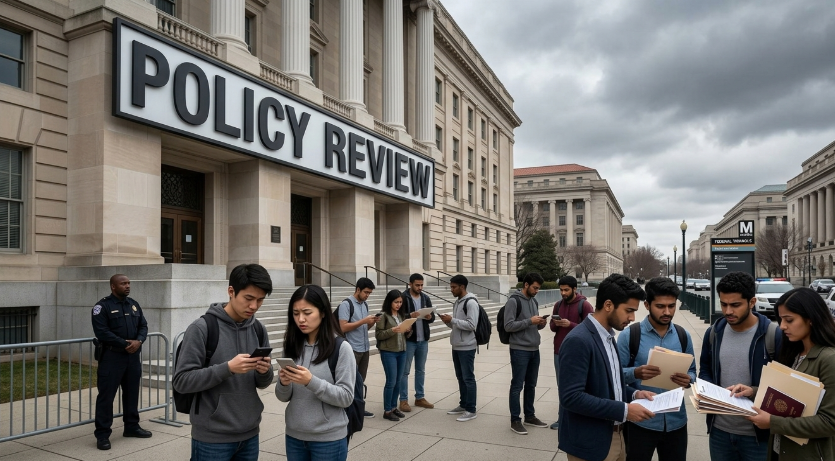
The present administration's Department of Homeland Security (DHS) has made it known that it is carrying out a "complete assessment" of student visa work authorization programs, which specifically includes OPT. No completion date or schedule for the review's results have been released since it was announced in March 2025.
OPT displaces American workers and provides a subsidized labor market for businesses who recruit foreign students rather than US citizens, according to public statements made by administration officials, including those in the Department of Labor. Restrictionist immigration organizations have long criticized OPT, and the current administration has given them additional political backing.
Although not official policy, President Trump's remarks indicate the administration's overall stance on student work authorization. He has stated that foreign students who come to the US should "go home" after graduation rather than staying in the US workforce.
The Legal Vulnerability of STEM OPT
The legal foundation of STEM OPT is more insecure than many people realize, which is one reason why the OPT program poses a particularly serious threat to Indian students.
STEM OPT is a result of a regulatory rule established by DHS during the Obama administration in 2016 rather than an act of Congress, which would require congressional action to abolish. Since it is a regulatory rule rather than a statute, it can be changed or removed through the regulatory rulemaking process, which does not require congressional approval but is not instantaneous.
Washington Alliance of Technology Workers v. U.S. Department of Homeland Security, a previous court challenge to STEM OPT, was resolved in favor of DHS in 2021, maintaining the program's legal foundation. However, the DHS under the current administration may start a new regulation process to change or do away with STEM OPT; this process may proceed more quickly than most people anticipate.
The Practical Enforcement Threat — Beyond Formal Rulemaking
The OPT program Trump danger Indian students confront includes a real enforcement dimension that is already causing disruption, even in the absence of a formal abolition of OPT through rulemaking:
Enforcement by employers: The administration has stepped up E-Verify compliance inspections and worksite enforcement visits at businesses that hire OPT employees. Employers may be reluctant to hire OPT workers due to greater compliance scrutiny; this is not because OPT is unlawful, but rather because hiring US citizens or green card holders is more advantageous due to the administrative burden and possibility of a compliance error.
Delays in obtaining Social Security numbers, which are necessary to start working, have been reported by a number of Indian students on OPT. Some immigration lawyers ascribe these delays to heightened processing scrutiny rather than an administrative bottleneck.
STEM OPT employer reporting requirements: Employers are already required by STEM OPT to provide training plans and progress reports. Some smaller firms, which could normally hire Indian STEM OPT workers, prefer to avoid the added compliance burden created by increased DHS inspection of these standards by simply not hiring OPT workers.
Who Is Most at Risk — The Indian Student Profiles Most Exposed
Profile 1 — Current STEM OPT Workers
You are in the most immediately exposed position if you are currently working on STEM OPT in the United States. Current STEM OPT holders would be impacted by a regulatory change that restricts or eliminates STEM OPT; however, the precise impact on workers during the mid-authorization period would depend on the regulatory language and any transition arrangements.
What to do at this moment: Maintain strict adherence to all STEM OPT requirements, including address reporting to your DSO, Form I-983 training plan modifications, and employer reporting deadlines. Even prior to any regulation change, you are at risk of having your position terminated due to any noncompliance. Regarding your particular circumstances, speak with your DSO and an immigration lawyer.
Profile 2 — Final-Year STEM Students Preparing for OPT
You are in a particularly precarious situation if you are finishing your STEM degree and intend to apply for OPT either before or right after graduation. Timing is crucial since your OPT application should be submitted and, preferably, accepted before any regulatory changes take effect.
What to do at this moment: As early as USCIS regulations permit, you can apply for OPT up to ninety days prior to the completion of your program. Early filing results in early approval, offering a greater safety net against potential regulatory changes.
Profile 3 — Indian Students Planning to Apply to US STEM Programs
This notice is especially important if you are currently in India and intend to pursue a master's or doctoral program in STEM in the United States, as you have the greatest flexibility and possibilities. You still have complete knowledge and option when deciding whether to move further with a US STEM application and, if not, where to go.
The financial argument for your intended US schooling is predicated on the idea that STEM OPT will be accessible after you graduate in two to three years. There is a real danger to such notion. Before investing ₹50 lakh to ₹1 crore in US education, you should honestly assess if the post-graduation career pathway you are relying on will continue to exist in its current form.
The H-1B Connection — Why OPT Threat Compounds the H-1B Problem
OPT and H-1B — Two Pillars of the Same Structure
The OPT program is not the only thing that poses a threat to Indian students. It exacerbates an H-1B issue that Indian students were already dealing with before to 2025.
Even students who successfully complete OPT and wish to remain in the US face a 65–75% chance of not earning an H-1B in any given year, since the H-1B lottery acceptance percentage for Indian nationals has been between 25–35% annually in previous years. Three chances to enter this lottery are provided by STEM OPT's 36-month window, increasing cumulative success percentages. That cumulative improvement vanishes when STEM OPT is eliminated.
The Complete Financial Risk Calculation
For an Indian family investing in a 2-year US master's programme at a mid-tier US public university:
Total cost: approximately ₹60–80 lakh
Expected return: US career earnings in dollars, converting to significant rupee-denominated wealth over a 5–10 year career in the US
Risk factor 1 (pre-2025): H-1B lottery probability — approximately 25–35% per attempt, approximately 65–75% cumulative success over 3 STEM OPT attempts
Risk factor 2 (2025 addition): STEM OPT itself may be curtailed — reducing to 1 lottery attempt and dramatically reducing cumulative success probability
Risk factor 3 (2025 addition): F-1 visa itself is harder to obtain — 69% drop in issuances in Q1 2025
Between 2022 and 2025, the risk profile of an investment in STEM education in the United States altered significantly. Compared to individuals who made this investment in 2020 or 2022, families making it in 2025 are doing it in a risk climate that is essentially different.
Germany and Japan — The STEM Alternatives That Are Gaining Fast

The threat posed by Trump to Indian students through the OPT program has hastened a change that was already taking place: Indian STEM students are seriously considering Germany and Japan as alternatives to the US and finding that they are truly competitive.
Germany — The STEM Alternative With Zero Tuition and 18-Month Job Seeker Visa
Over 400,000 skilled workers are reportedly lacking in Germany each year, with the majority of these shortages occurring in the STEM sectors that Indian students specialize in. The post-study work track in Germany differs structurally from the US model in a way that is far more predictable:
18-month job seeker visa: graduates of German universities are automatically granted an 18-month work authorization to pursue employment in Germany. Not a lottery. During the job search phase, employer sponsorship is not necessary. No yearly cap.
Indian STEM graduates can apply for an EU Blue Card, which offers work privileges within the EU and a clear route to permanent residency in Germany after 21–33 months, once they are employed above the income criteria.
Zero tuition fees: International students at public German universities are not required to pay tuition, which results in a far lower financial commitment than in the US and a better financial risk profile.
Japan — MEXT Scholarship and a Growing STEM Ecosystem
Japan's MEXT scholarship is the most complete government scholarship for individual students in the world, covering full tuition, round-trip travel, health insurance, and a monthly stipend of ₹83,000.
In contrast to Japan's historically restrictive immigration climate, the country's 2026 immigration reforms have made it easier for foreign STEM graduates to stay and work in Japan after graduation.
Japan is a truly world-class STEM research environment for Indian students studying robotics, materials science, automotive engineering, semiconductor technology, and pharmaceutical sciences.
Get Expert Guidance on the OPT Crisis — YastudyDoes It Free
There is no one right approach that applies to all students, and the OPT program Trump danger Indian students face is a truly complicated, quickly changing scenario with significant financial ramifications. The best course of action depends totally on your unique profile, your field, your financial circumstances, and your risk tolerance, regardless of whether you are presently on OPT, getting ready to apply for it, or are still in India organizing your study abroad experience.
You shouldn't make this decision alone, and you shouldn't have to pay for professional advice.
Yastudy— Noida's most trusted and genuinely student-first study abroad consultancy — provides complete, personalised guidance on the OPT crisis and all its implications at absolutely zero cost to every student.
Zero consultation fees. Zero document review charges. Zero SOP or application fees. Zero hidden costs. Always.
How YaStudy's Free Model Protects Your Interest
All of YaStudy's funding comes from university partnerships; universities in Germany, Japan, the UK, Canada, the US, and other countries pay Yastudyto match eligible Indian students with their programs. Students are never the source of income.
This implies that if your interests are better served by Germany or Japan, Yastudyhas no financial motive to push you toward the US. The advise is actually objective and solely concerned with your professional path, financial security, and academic performance.
What Yastudyoffers students managing the OPT problem at no cost:
OPT risk assessment — honest evaluation of how the current threat environment affects your specific situation and field
US programme evaluation — does your planned US STEM programme still make financial sense with OPT uncertainty factored in?
Germany STEM programme shortlisting — TU Munich, RWTH Aachen, KIT, University of Stuttgart matched to your field and profile
Japan MEXT scholarship application support — research plan writing, professor outreach, Embassy documentation
EU Blue Card pathway analysis — post-German-graduation career planning for Indian STEM students
Complete application support — SOP, CV, Letters of Recommendation, academic transcripts for any destination
Visa documentation review — complete checklist reviewed before any consulate submission
DAAD and other scholarship identification — funded options in Germany matched to your STEM field
Pre-departure orientation — country-specific guidance so you arrive prepared and confident
Hundreds of Indian STEM students have used YaStudy's entirely free platform to strategically manage this situation, including those who are now on OPT in the US and are creating backup plans, as well as those who are still in India and are reevaluating the US choice.
The Worst-Case Scenario — And How to Prepare for It
If STEM OPT Is Eliminated — What Happens Next?
Let's be direct about the worst-case scenario so you can plan for it rather than be blindsided by it.
If the Trump administration completes a regulatory rulemaking eliminating or curtailing STEM OPT:
Current STEM OPT holders would likely face a transition period — the regulatory rule would specify the timeline. Based on precedent from other regulatory changes, this could be 60–180 days.
Future STEM graduates would face only 12 months of standard OPT — one H-1B lottery attempt.
The financial model of US STEM education for Indian students would fundamentally change.
Contingency pathways that would remain:
H-1B through employer sponsorship — still available, but with only one annual lottery attempt per OPT year
L-1 visa — for Indian students who go to work for a US company's Indian subsidiary and are later transferred to the US
O-1 visa — for individuals with extraordinary ability — relevant for a small number of exceptional researchers
German EU Blue Card — for Indian STEM graduates willing to relocate from the US to Germany (valid option — German employers increasingly recruit internationally)
Japan work visa — for graduates willing to develop Japanese language skills and relocate
Companies That Would Be Most Affected
Indian students working at technology companies would be disproportionately impacted by the OPT program Trump threat, especially the huge US IT corporations that are the main employers of Indian STEM OPT and H-1B workers. Indian STEM OPT employees make up a sizable portion of engineering teams at companies like Google, Microsoft, Amazon, Meta, Apple, and countless of smaller tech companies.
These businesses have substantial lobbying resources and have a track record of successfully promoting the continuation of H-1B and OPT programs. The administration's actions on OPT may be moderated or slowed by this lobbying effort, which is one of the reasons the conclusion is still really unknown rather than definite.
Conclusion — The Alert Is Real. The Options Are Real. Act Now.
The most significant challenge to the US education investment model for Indian STEM students in the history of the OPT program is the Trump threat Indian students will face in 2025. While there is no guarantee that STEM OPT will be repealed, there is little doubt that the risk is greater than it has ever been, that there are significant financial stakes, and that the highest-risk course of action is to wait passively for clarification while remaining fully committed to a US education plan.
Students who take action now, comprehend their unique exposure, create real backup plans, and decide whether the US is still the best place to invest or whether Germany and Japan offer comparable academic results with significantly lower financial risk profiles are the ones who successfully navigate this moment.
This handbook contains the information you require. Yastudyhas the professional advice you require. You don't have to pay anything for that advice.
Start Your Study Abroad Journey
Join thousands of students who achieved their dreams with Yastudy.