F-1 Visa Crisis: What Trump's Immigration Rules Mean for Indian Students Going to the US in 2026
Tarun Chandel
Recently • 8 min read

The email arrived without warning.
Early in 2025, thousands of Indian students attending American universities received a brief, well-crafted message from their international student office advising them to stay away from foreign countries, speak with immigration lawyers before making any plans, and keep a close eye on their visa status.
The headlines, which included cancelled visa appointments, OPT programs under review, SEVIS records terminated without explanation, and a political climate in Washington that was clearly communicating how welcome international students, especially those from India, actually were, were confusing to tens of thousands more Indian students in India who had been preparing their applications to US universities.
Planning to Study Abroad?
Get personalized guidance from experienced education counselors.
The Trump F1 visa impact on Indian students in 2025 is not a singular incident. For an entire generation of Indian students, the calculus of studying in the US is changing due to a rapidly changing policy environment. The stakes are so high that every family contemplating a US education must comprehend exactly what is happening, why it is happening, and what their actual options are.
This is that analysis.
What Has Actually Changed — The Policy Shifts Driving the Crisis
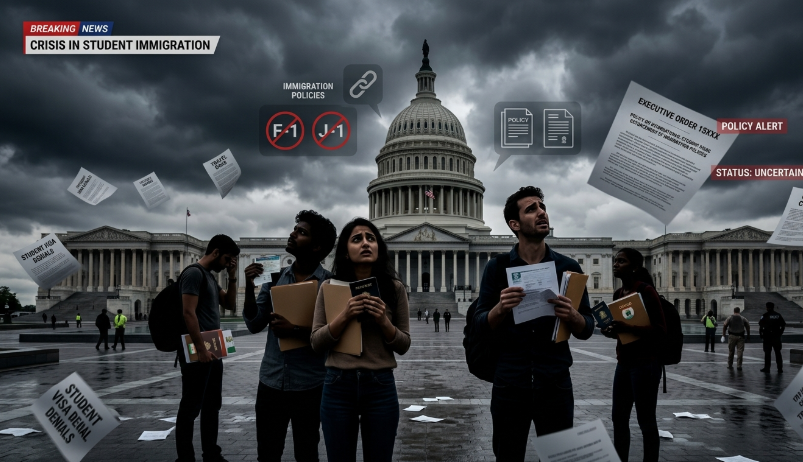
The Return of "America First" Immigration Enforcement
Immigration policy was drastically changed as soon as Donald Trump took office again in January 2025. In contrast to his first term, when court challenges frequently delayed and challenged immigration reforms, the second Trump administration acted far more quickly and institutionally preparedly across several immigration enforcement fronts concurrently.
For international students on F-1 visas, the impact was felt through several specific and interconnected policy changes:
Executive Order on Immigration Enforcement —signed within the first week of the administration, giving federal agencies instructions to drastically step up enforcement of immigration infractions, including visa holders' status violations. Accelerated enforcement action was taken against international students who were found to be in technical breach of their F-1 restrictions, such as working more than the allotted 20 hours per week on campus, delaying program reporting to SEVIS, or having minor academic status difficulties.
SEVIS Terminations — Thousands of international students' Student and Exchange Visitor Information System (SEVIS) records were canceled by US Immigration and Customs Enforcement (ICE) in March and April of 2025; many of these students had no criminal history or past immigration violations. An F-1 student's legal status in the US is essentially nullified by SEVIS termination, leaving them vulnerable to deportation.
Increased Social Media Scrutiny —The State Department increased its power to examine visa applicants' social media accounts, and consular staff were told to search for material that was regarded to be at odds with American ideals or endorsing groups that were thought to be detrimental to US interests. This led to documented instances of visa denials for Indian students based on social media activity, which under earlier administrations would have been completely normal.
The Specific Impact on Indian F-1 Students
The F1 visa Trump impact Indian students 2026 is not abstract policy — it has concrete, documented effects:
Visa interview wait times The wait periods for student visa interview appointments at US consulates in India, which are already among the longest in the world, increased in 2026. Some students reported waiting 12 to 18 months at the consulates in Mumbai and New Delhi.
Visa denial rates Relative to the same period in 2024, the number of Indian F-1 applicants rose by an anticipated 15–20% in the first quarter of 2025.
OPT (Optional Practical Training) uncertainty —The Trump administration made it clear that it intended to examine and perhaps reduce OPT programs, especially STEM OPT, which permits Indian graduates in engineering and technology to work in the US for a maximum of three years following graduation. The foundation of the US study-to-work pipeline for Indian students is STEM OPT.
H-1B pathway concerns — The general atmosphere of immigration restrictionism raised doubts about whether earning a US degree would consistently result in the work visa that most Indian students rely on for their return on investment, even though the H-1B visa regulation had not been formally altered by mid-2025.
The SEVIS Crisis — Understanding What Happened and Why It Matters
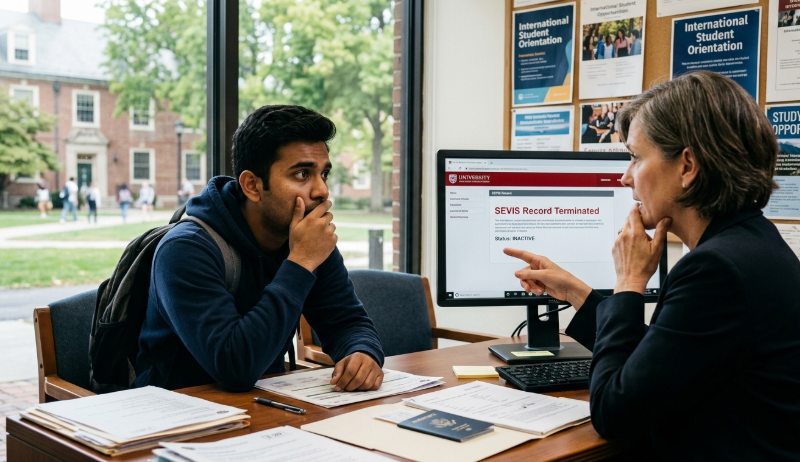
What Is SEVIS and Why Does It Control Your Entire US Student Life?
The US government database that keeps track of all F-1 and J-1 visa holders in the country is called the Student and Exchange Visitor Information System (SEVIS). Your enrollment status, academic progress, and any program modifications are reported to SEVIS by the international student office at your university. Your SEVIS record must be current and in good standing in order for you to legally stay in the country as a student.
You instantly lose your legal immigration status if your SEVIS record is terminated by any government agency, regardless of the reason. You are no longer permitted to work on OPT, attend classes, or be in the United States. You risk being detained and deported if you don't leave the country.
The 2025 SEVIS Termination Wave
Thousands of international students at American institutions were impacted by ICE's wholesale deletion of SEVIS records in the spring of 2025. The terminations were carried out with little warning and, frequently, without providing the impacted students or their institutions with a clear explanation.
The affected students included:
Students whose minor traffic infractions appeared in databases maintained by police authorities
Students whose social media activity had been flagged during national security reviews
Students with technical F-1 violations — such as a gap in enrollment during a semester they had taken approved medical leave
Students who were caught in what appeared to be a broad, algorithmically driven enforcement sweep with limited individual review
Many SEVIS records were later restored after several federal courts obtained temporary restraining orders preventing some of the terminations. But the episode showed that Trump's influence on F1 visas for Indian students in 2025 was not hypothetical; rather, it was manifesting as actual enforcement actions that affected actual students who had done nothing wrong on purpose.
What the OPT Threat Means for Indian Students' Financial Calculations
Why OPT Is the Foundation of the US Education Investment Case
The majority of Indian families who spend $40,000 to $80,000 (₹3,777,000 - ₹3,800,000 INR) to (₹7,550,000 - ₹7,600,000 INR) annually on living expenses and tuition, or $160,000 to $320,000 (₹15,250,000 – ₹15,320,000 INR) to (₹30,500,000 – ₹30,640,000 INR)over four years, are doing so based on a certain financial calculation:
US degree + OPT/STEM OPT work period + H-1B visa = career earnings in dollars that justify the investment
For the bulk of Indian engineering, computer science, and technology students, who make up the largest group of Indian students in America, the financial rationale of a US education collapses if OPT is eliminated or drastically reduced, especially STEM OPT.
As of mid-2025, the Trump administration's evaluation of OPT programs has not yet led to a formal restriction or discontinuation. However, the signals—public remarks made by administration officials, review orders, and the overall ideological orientation of immigration policy—have created real uncertainty that is already affecting the enrollment choices of Indian students.
Universities Are Reporting Enrollment Declines
For the 2025–2026 academic year, several large American colleges reported decreased or flat Indian student enrollment applications, even those that had enjoyed steady rise in Indian student enrollment for decades. In polls administered by foreign education organizations, students consistently gave the following explanations: anxiety about their visas, worries about OPT, confusion about their post-graduation career prospects, and a general feeling of alienation in the current political climate.
Students and families are making logical decisions by weighing a multi-lakh rupee investment against a more unpredictable policy environment; this is not fear.
The Specific Risks Every Indian F-1 Student and Applicant Must Understand
Risk 1 — Visa Stamping Abroad
Even for short visits to India or a third country, F-1 students must get their visas stamped before they may return to the United States. Visa stamping at US consulates overseas has become much more unclear under the present policy environment. Students who have valid I-20s and SEVIS records have either been refused re-entry stamps or have had their return to school delayed by lengthy secondary processing.
Immigration lawyers have clear practical advise for Indian students studying in the US: until the policy environment stabilizes, avoid traveling abroad unless absolutely necessary.
Risk 2 — Social Media and Public Expression
Indian F-1 visa applicants now face a new level of risk due to the US consulate authorities' increased use of social media screening. Public statements, likes, shares, and posts on social media sites like Facebook, LinkedIn, Instagram, and X (previously Twitter) may be reviewed. In 2025, decisions to deny visas have cited content pertaining to political activities, rallies, or positions deemed controversial by US authorities, including protests on campuses about international crises.
Risk 3 — The H-1B Uncertainty After Graduation
The major method by which Indian F-1 graduates turn their US education into a long-term US profession is still the post-graduation H-1B lottery. The H-1B lottery is already severely overloaded; each year, Indian citizens file between 60 and 70 percent of all H-1B petitions. However, because the lottery is country-neutral, the odds for each applicant are essentially the same regardless of nationality.
The risk is not that H-1B will be abolished, but rather that the larger policy landscape of 2025 raises questions about whether the program will be changed, whether wage requirements will rise, or whether enforcement priorities will change in ways that impact Indian graduates' capacity to convert from F-1 to H-1B status.
Risk 4 — Campus Climate and Safety
Many Indian students say that the school environment is notably less inviting than it was two or three years ago due to the political situation in the United States in 2025. Social media and student community forums have reported instances of foreign students being interrogated, briefly arrested, or subjected to aggressive interactions. Even though these occurrences are still comparatively rare, they add to the overall calculus of studying in the US by fostering a subjective sense of safety and belonging.
What Should Indian Students Considering the US Do Right Now?
If You Are Currently in the US on F-1
Do not travel internationally unless absolutely necessary and you have consulted an immigration attorney about current re-entry risks
Ensure your SEVIS record is active and accurate — contact your DSO (Designated School Official) at your university's international office to confirm
Review your F-1 status compliance —Make that you are working within approved hours, are enrolled full-time, and have reported any program modifications.
Document everything — keep copies of all visa documents, I-20s, SEVIS confirmations, and university enrollment records in a secure, accessible location
Know your rights — understand what you are and are not required to do if approached by law enforcement or ICE agents
If You Are in India Planning to Apply for F-1
Book your visa interview appointment early — wait times are long and getting longer
Review your social media — audit public posts and consider making accounts private during the visa process
Have a contingency plan — do not make your entire academic and financial plan dependent on US visa approval in the current environment
Consider applying to multiple countries simultaneously — Similar academic programs are available with much more stable and predictable visa regimes in Germany, Japan, the UK, and Canada (where applicable).
Germany and Japan — Why Smart Indian Students Are Pivoting
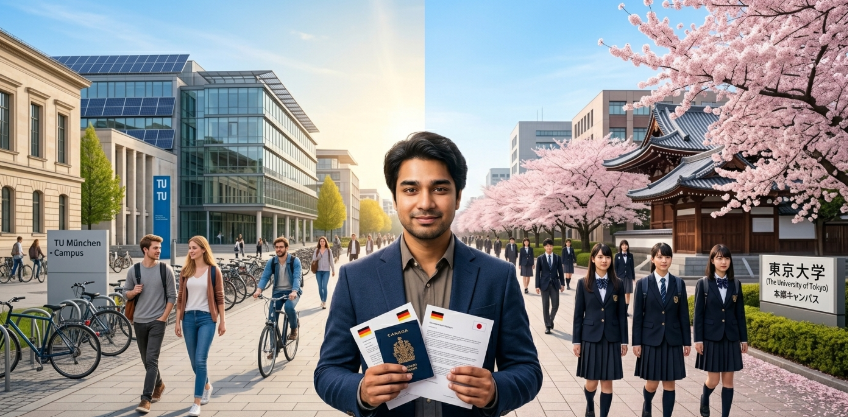
A tendency that started before 2026—the diversification of Indian students' study abroad destinations away from US dependence—has been intensified by the F1 visa Trump influence Indian students 2026 issue.
The two countries that have benefited most from this change are Germany and Japan, and for reasons that go beyond just avoiding the uncertainty surrounding US visas.
Germany offers:
Zero tuition fees at public universities — compared to $40,000–$80,000 (₹37,70,000 - ₹38,00,000 / ₹75,50,000 - ₹76,00,000)per year in the US
18-month post-study job seeker visa — transparent, policy-stable, and not subject to a lottery
EU Blue Card pathway to permanent residency — clear, well-defined, not politically volatile
Growing English-taught master's programs in engineering, IT, and sciences
A political environment that is actively seeking to attract and retain international talent
Japan offers:
MEXT scholarship — fully funded, covering tuition, ¥143,000 (₹86,735.61)monthly stipend, airfare, and health insurance
World-class research universities — University of Tokyo, Kyoto University, Osaka University
Active 2026 immigration reforms making it easier for international graduates to stay and build careers
A stable, welcoming, and highly safe environment for international students
A US master's degree at a mid-tier public university costs roughly ₹60–80 lakh over two years, making the financial comparison striking. For the same or better academic results and a more secure career future after graduation, a two-year German master's degree at a top public university in the world costs roughly ₹12–18 lakh.
Navigate This Crisis With Expert Guidance — YaStudy Does It Free
The situation regarding Trump's F1 visa impact on Indian students in 2025 is quite complicated. This is not a decision to make on your own or using general information from the internet, whether you are an Indian student in the US seeking to comprehend your risks, a prospective student reevaluating your plans, or a family trying to determine whether the US is still worth the investment.
YaStudy — Noida's most trusted and genuinely student-first study abroad consultancy — provides exactly the expert, personalised, honest guidance this moment requires. And they do it at absolutely zero cost to students.
Not a reduced fee. Not a free first session that becomes paid after that. Zero cost. Always. For every student.
Why YaStudy Is Uniquely Positioned for This Moment
YaStudy offers advice to Indian students in the US, Germany, Japan, the UK, Canada, and other countries. They have no financial interest to drive you toward the US if Germany or Japan better suits your academic and professional objectives because they are supported by university partnerships rather than student fees.
This is the crucial distinction. Since the US is where they make their money, a US-focused consultant will always find reasons why the US is still your best option. Since colleges in every location provide YaStudy with funding, their recommendations are based on your interests rather than their commission system.
What YaStudy provides at zero cost:
Honest US risk assessment — is your specific profile, field, and financial situation still suited for US in the current environment?
F-1 visa strategy — appointment booking, document preparation, social media audit guidance, interview preparation
OPT and post-graduation pathway analysis — realistic evaluation of your post-US graduation options
Alternative destination planning — Germany, Japan, UK options assessed against your specific academic profile
Scholarship identification — DAAD for Germany, MEXT for Japan, and other funded options identified for your profile
Complete application support — SOP, CV, Letters of Recommendation, transcripts, and all documentation
Visa documentation review — complete checklist for any destination before consulate submission
Pre-departure preparation — country-specific orientation so you arrive ready
In 2025, hundreds of Indian students who were unsure about obtaining a US visa utilized YaStudy's totally free platform to honestly evaluate their alternatives and create workable strategies, whether that meant a stronger US application or a fantastic alternative destination.
The Bigger Picture — What This Moment Tells Us About Study Abroad Strategy
The Dangerous Risk of Single-Country Dependence
A strategic vulnerability that Indian families have been developing for decades is demonstrated by the F1 visa Trump impact Indian students 2026 crisis: an over-reliance on a single study abroad location, the United States, whose immigration laws are subject to political volatility completely beyond the control of any individual student.
A political government shifts. A policy changes. Suddenly, factors entirely beyond of the student's control contradict the investing thesis that a whole family spent years building.
Students and families that approached their study abroad decision as a strategic choice among several feasible possibilities rather than as a single high-stakes wager on a single nation are the ones navigating 2025 the best.
Diversification Is Not Settling — It Is Sophistication
It is not a consolation award to choose Germany over the United States. An EU Blue Card career in Germany's technology sector combined with a master's degree from TU Munich or RWTH Aachen, two of Europe's most industry-connected technical universities, is a career outcome that rivals and frequently surpasses what is possible through the US F-1 to OPT to H-1B lottery pathway for engineering or IT students.
It is not a step down to choose Japan with a MEXT scholarship over a self-funded US degree. At no cost to the student, it is an intellectually superior, academically similar, and financially superior result in research-intensive fields.
For those involved, the Trump F1 visa impact on Indian students in 2025 is unpleasant. However, it is a turning point for students who are still organizing their study abroad experience, an opportunity to develop a plan that is actually solid rather than wishfully reliant on the political stability of one nation.
Conclusion — The US Is Still an Option. It Is No Longer the Only Option.
Some of the best universities in the world are still located in the United States. Trump's immigration policies do not diminish the quality of MIT, Stanford, Carnegie Mellon, and the University of Michigan. American academic culture, industry ties, and research infrastructure continue to be of the highest caliber.
However, the reality of how Trump's F1 visa will affect Indian students in 2026 is that the route to those universities, through those universities, and out of those universities into a secure American career is now more uncertain, more costly in terms of risk, and more reliant on uncontrollable political circumstances than it has ever been in the previous 30 years.
Panic is not the best course of action for Indian families and students handling this situation. It is knowledge, choices, and professional advice.
This guide contains the information. The choices—the United States, Germany, Japan, the United Kingdom, and other countries—are genuine and truly outstanding. YaStudy has professional advice. It also doesn't cost you anything.
Start Your Study Abroad Journey
Join thousands of students who achieved their dreams with Yastudy.