From Patna to Canada — Real Success Stories of Bihar Students Who Studied Abroad
Tarun Chandel
Recently • 8 min read

“No one from our mohalla has ever done this before.”
That sentence hangs in the air almost every time a student from Bihar talks about studying in Canada. Sometimes it’s spoken with pride. Sometimes with fear. And sometimes like a quiet warning from people who believe dreams like these belong to someone else.
But then, someone changes the story.
Planning to Study Abroad?
Get personalized guidance from experienced education counselors.
A boy from Muzaffarpur opens an email late at night and sees his acceptance letter from a Canadian university. A girl from a small village in Darbhanga boards her first international flight with a scholarship in her hand and tears in her mother’s eyes. A government school student from Ara stares at the words “University of British Columbia” next to his own name — something nobody in his neighborhood ever imagined possible.
For their families, these weren’t just admissions. They were moments that broke years of doubt, limitations, and silent fear.
And now, these stories are no longer rare exceptions whispered about in coaching centers or shared proudly in WhatsApp groups. They are happening again and again.
What once felt impossible is slowly becoming familiar.
Because when one student succeeds, it inspires another to believe. And when enough students follow the same path, a miracle stops looking like luck — and starts becoming a blueprint.
What you are about to read is not built from internet theories or “perfect” success stories. It comes from real students — students who once sat in small rooms in Patna, worried about visa money in Muzaffarpur, searched for scholarships late at night in Siwan, and questioned their future from crowded homes in Bhagalpur.
Today, many of them are studying in Canada, Germany, Japan, and other countries they once only saw on YouTube or heard about from distant relatives.
This guide is inspired by their journeys.
To protect their privacy, we’ve changed their names. But everything else is real — the marksheets that weren’t perfect, the financial struggles that kept families awake at night, the document rejections, the self-doubt, the long embassy waits, the fear of failure, and finally, the life-changing acceptance letters.
These stories are not about students who had everything figured out. They are about ordinary families trying to do something extraordinary.
So before you decide that studying abroad is “not possible” because of your district, your background, your English, or your financial situation, read these stories carefully.
You may discover that someone just like you has already walked the path you’re afraid to begin.
Why Bihar Student Success Stories Matter Beyond Inspiration
The Information Gap That These Stories Fill
These success stories of Bihar students studying abroad are about far more than motivation or feel-good headlines. They are proof that the journey is real — that a student sitting in a small town with limited resources can still find a path to universities in Canada, Germany, Japan, and beyond.
Because from the outside, studying abroad often looks impossible.
The expenses seem too high. The visa process feels confusing. The English requirements feel intimidating. And for many families in Bihar, there is another silent challenge — nobody around them has done it before.
Most study abroad advice online is built around students from cities like Bengaluru, Mumbai, Delhi, or Hyderabad. Students who grow up surrounded by coaching networks, relatives abroad, experienced consultants, and friends who already understand the process.
But a student from Bihar often starts from zero.
No roadmap.
No family connection overseas.
No one to explain SOPs, scholarships, blocked accounts, or visa interviews.
And yet, despite all of that, they are making it.
Not because the journey is easy, but because ambition can grow even in places where opportunities are limited. With strong academic discipline, relentless hard work, and access to information through mobile phones and digital media, students from Bihar are slowly rewriting what is considered possible.
That is why these stories matter.
They turn statistics into emotions. Numbers into human faces. They show the sleepless nights before IELTS exams, the parents calculating finances at the dining table, the fear of rejection emails, and the overwhelming moment when a visa finally gets approved.
These are not just success stories.
They are living proof that talent does not belong only to metro cities — and dreams do not need a privileged postcode to become real.
Case Study 1 — Vikram from Muzaffarpur: Engineering Dreams, Canadian Reality
Background — Starting From a Government College
When Vikram first told people he wanted to study in Canada, most of them smiled politely. A few laughed. Some asked the question he had already been asking himself for months:
“Is going abroad possible with a background like yours?”
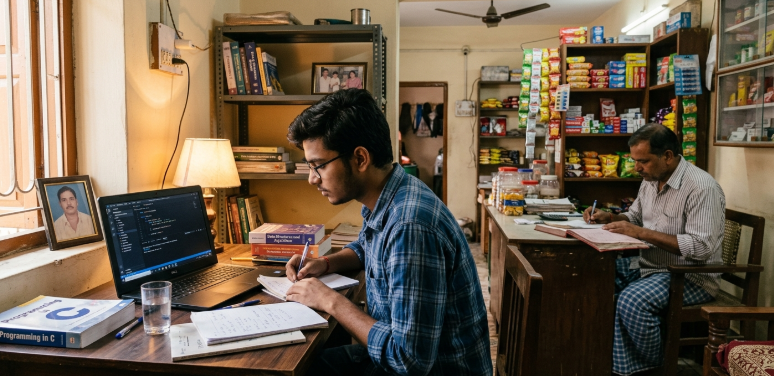
Vikram had completed his B.Tech in Computer Science from a government engineering college in Muzaffarpur with a 7.4 CGPA — decent, but not the kind of score that makes headlines. He had once dreamed of cracking JEE Advanced, but like millions of students across India, he couldn’t clear it. Life moved on, even though the disappointment stayed with him for a long time.
At home, things were simple. His father ran a small hardware shop that supported the entire family, earning around ₹35,000 a month. No one in their family had ever studied abroad. There were no relatives in Canada, no expensive consultants guiding them, no ready-made roadmap.
Just questions. Endless questions.
In 2022, when Vikram seriously started researching Canadian universities, he quickly ran into the same wall that stops many students from Bihar before they even begin: the belief that studying abroad is only for students with extraordinary marks or extraordinarily rich families.
And Vikram believed that too.
He didn’t come from an IIT. He didn’t have a perfect academic record. His family wasn’t financially strong. From every angle, it seemed like he lacked the “profile” people say is needed for studying overseas.
But somewhere between late-night Google searches, scholarship videos, and conversations with seniors online, one thought refused to leave his mind:
“What if impossible only looks impossible because nobody around me has done it yet?”
The Research Phase — Finding the Right Programme
For nearly eight months, Vikram quietly built his dream one search at a time.
Late at night, after everyone at home had gone to sleep, he would sit with his phone and laptop, watching YouTube videos about student visas, reading Reddit discussions from international students, and trying to understand a world that felt completely unfamiliar. Every answer led to another question. Every success story gave him a little more hope.
Slowly, the confusion began to clear.
For the first time, Vikram realized that Canadian universities were not only looking for students from elite colleges or perfect academic backgrounds. Especially in computer science master’s programs, many universities cared more about skills, clarity of purpose, and genuine academic potential than famous college names.
That discovery changed everything for him.
After weeks of research and a free consultation that finally helped him organize his thoughts, Vikram understood what truly mattered: a strong application, a competitive IELTS score, and a Statement of Purpose that honestly explained who he was, what he had learned, and why he wanted to study further.
Instead of chasing unrealistic universities just for prestige, he focused on opportunities that matched his profile and strengths.
Three universities became his realistic targets: the University of New Brunswick, the University of Regina, and Dalhousie University.
All three were respected Canadian public universities with Designated Learning Institution status, and more importantly, they valued students with solid programming ability and practical potential — even if they came from smaller colleges in places like Muzaffarpur.
For the first time, studying abroad stopped feeling like a fantasy.
It started feeling possible.
The Application — What Made the Difference
Vikram’s IELTS score was good — but not the kind that makes people stop and stare.
He scored an overall 7.0, with 6.5 in each section. Strong enough to qualify, yet far from the “perfect profile” students often believe they need for Canada.
And deep down, that worried him.
He knew thousands of applicants had better scores, better colleges, and stronger academic records. On paper, there was nothing extraordinary about him. But Vikram slowly realized something important during the application process:
Universities do not only look for numbers. They look for intent, effort, and authenticity.
So instead of trying to sound impressive, he focused on being real.
His Statement of Purpose became the heart of his application — nearly 900 carefully written words that told his story honestly. He wrote about his undergraduate project on database optimization for small business inventory management, a topic inspired by watching small local businesses struggle with inefficient systems back home.
But what truly made his SOP stand out was the effort behind it.
While researching universities, Vikram had spent hours reading published papers from a faculty member at the University of New Brunswick whose work focused on distributed systems. He did not simply mention the professor’s name to impress the admissions committee. He actually studied the research, understood parts of it, and connected those ideas to his own interests and future goals.
For the first time, his application stopped sounding like a copied template.
It sounded like him.
Another turning point came from someone who had quietly watched his journey from the beginning — his final-year project supervisor in Muzaffarpur. The professor, who had earned a PhD from a respected Indian university, did not write a generic recommendation filled with empty praise.
Instead, he wrote about Vikram’s persistence. His problem-solving ability. The long hours he spent refining his project. The curiosity he showed even when resources were limited.
It was not just a recommendation letter.
It was someone credible saying, “This student is capable. He deserves a chance.”
And sometimes, that single voice of belief can carry a student further than any perfect score ever could.
The Funding — How a Bihar Family Made It Work
Vikram's two-year master's program at the University of New Brunswick will cost him about CAD 48,000 in tuition and CAD 24,000 in living expenses, for a total of about CAD 72,000 (about ₹45 lakh at the time of his application).
This was a number that initially seemed impossible for Vikram's family. What made it work:
Education loan through the Vidya Laxmi Portal — ₹30 lakh sanctioned by Canara Bank against property collateral
University entrance scholarship — CAD 5,000 (approximately ₹3.1 lakh) awarded at admission based on his academic record
Part-time work During his studies, he had steady part-time work at CAD 15 per hour on the University of New Brunswick campus and in the surrounding region, which covered about 40–50% of his living expenses.
The Outcome
In 2024, Vikram received his degree from the University of New Brunswick. He was granted a three-year post-graduation work permit. He currently makes CAD 72,000 a year working as a software engineer for a technology company in Fredericton, New Brunswick. He has been repaying his university loan for the past 14 months.
His younger sibling from Muzaffarpur is currently applying to universities in Canada.
Case Study 2 — Sunita from Siwan: Against Every Expectation
Background — A Girl From a Small Town With Big Plans
Because Sunita's narrative contradicts the most ingrained beliefs about who gets to go, it is the one that makes the most waves in Bihar's study abroad discussions.
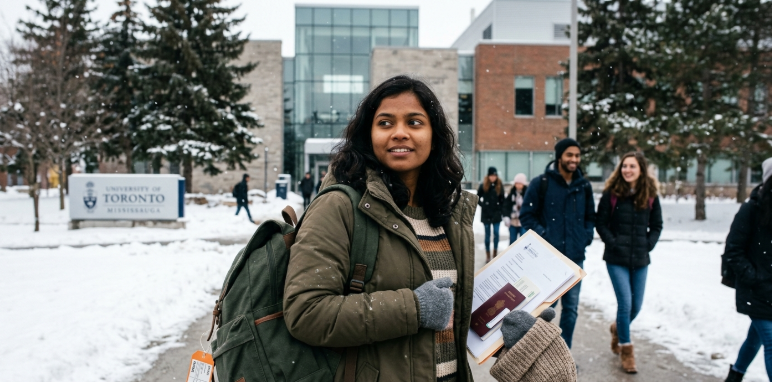
Sunita earned a 68% aggregate while completing her B.Sc. in Biotechnology at Magadh University in Bodh Gaya. In her extended family, she was the first woman to earn a degree in science. She described her desire to study in Canada as "something I found on YouTube at 2 AM and could not stop thinking about."
Her family first objected due to cultural concerns about a young Siwan woman living alone abroad rather than the expense, which they had not yet calculated. After months of discussion, showing Sunita's study to family friends, and clearly outlining the price differences between a private Indian alternative and a Canadian education, the opposition began to wane.
The Programme — Finding Biotechnology in Canada
Sunita's problem was unique to her field. Major research universities in Canada, such as the University of Toronto, UBC, McGill, and the University of Alberta, are home to the majority of biotechnology master's programs. These universities have rigorous entrance requirements and fierce competition.
Instead of going straight after these, Sunita found a strategic path: a Graduate Diploma in Biotechnology Management at a mid-tier Canadian university, followed by a possible master's transfer, with the help of a study abroad consultant. This two-step strategy was created especially for her profile: a less competitive entry point and a clear academic progression.
The Visa — Navigating the Most Stressful Part
The hardest thing Sunita had to do was apply for a study permit in Canada. Although her financial records, which were based on family savings and her father's income as a government school teacher, were theoretically sufficient, they were flimsy by Canadian standards. Her initial application was sent back for more paperwork.
The officer expressed worries about her proven connections to India and the viability of her financial plan, according to the GCMS notes that she obtained via the ATIP site. Her second application contained the following:
A detailed affidavit from her father outlining the family's sponsorship commitment
Fixed deposit certificates accumulated over 18 months
A rewritten Study Plan that specifically and credibly addressed her post-graduation return plan to India — connecting her Canadian qualification to a specific career opportunity in Bihar's pharmaceutical manufacturing sector
Her second application was approved.
The Outcome
With a stellar academic record, Sunita is presently in her second year at her Canadian university. She received a university graduate bursary, which lowered her second-year tuition by CAD 3,000. She earns CAD 14 per hour working part-time in a campus laboratory within the 20 hours per week allowed for overseas students.
After being hesitant at first, her family in Siwan is now, in her words, "the biggest supporters for study abroad in our entire area." She has received requests for information about the procedure from three families in her mohalla.
Case Study 3 — Rohit from Patna: The Engineer Who Almost Went to Pune
Background — The Classic Bihar Dilemma
In 2023, Rohit had two offers. One is a private engineering college in Pune that charges ₹12.6 lakh over two years for an M.Tech in Structural Engineering, with tuition of ₹4.5 lakh and a hostel arrangement of ₹1.8 lakh annually. Two: a family friend had recommended a preliminary investigation into Canadian universities.
Rohit earned a truly competitive B.Tech in Civil Engineering from NIT Patna. He had a 7.8 CGPA. Although he had a respectable GATE score, it was insufficient to gain entrance to the IIT master's program. The Pune offer was genuine, guaranteed, and well-funded. The option to go to Canada was hypothetical.
The Comparison — When Rohit Did the Math
What changed Rohit's decision was a direct financial and outcome comparison that he built in a spreadsheet over three weeks:
Pune M.Tech:
Total cost: ₹12.6 lakh
Expected starting salary in India: ₹6–9 lakh per year
Career trajectory: Indian construction and infrastructure sector
Canadian Master's in Civil/Structural Engineering (University of Manitoba or University of Saskatchewan):
Total cost (tuition + living, 2 years): approximately ₹32–38 lakh
Expected starting salary in Canada after PGWP: CAD 65,000–80,000 (approximately ₹40–50 lakh per year)
Career trajectory: Canadian infrastructure sector with PGWP and potential permanent residency
The difference in cost was between ₹20 and ₹26 lakh. When comparing career earnings over a five-year period, the outcome difference was orders of magnitude greater.
Canada was Rohit's choice.
The Application — NIT Patna Opens Doors
The biggest advantage Rohit had was his B.Tech from NIT Patna. Canadian master's programs in civil engineering consistently appreciate NIT alumni, and some even cite NIT as a recognized college in their admissions guidelines.
His SOP linked the University of Saskatchewan's structural engineering research group to his final-year thesis on seismic retrofitting of heritage sites in Bihar, a really unique and regionally relevant research subject. He identified the particular professor, referenced two of their published works, and described how his research experience in the Bihar context gave him a distinctive viewpoint on the infrastructure issues he intended to investigate in Canada.
With a partial research assistantship that lowered his effective tuition by CAD 8,000, he was accepted into the University of Saskatchewan's Master of Engineering program in structural engineering.
The Outcome
Right now, Rohit is finishing up his second year. The duration of his research assistantship has been extended. He added a paper to his resume at a Canadian structural engineering conference, which he fully credits to his Canadian university's research atmosphere as opposed to what he thinks he would have encountered in Pune.
His work permit after graduation is still pending. Through the university's job fair, three Canadian engineering consultancies have expressed interest in him.
What These Bihar Success Stories Have in Common — The Five Lessons
Looking across Vikram's story from Muzaffarpur, Sunita's from Siwan, and Rohit's from Patna, five consistent patterns emerge that explain Bihar students Canada study abroad success:
Lesson 1 — Realistic Institution Targeting Wins
The most renowned Canadian universities were not the focus of any of these students. Instead of competing for space with students from IITs and metropolitan universities, all three identified institutions where their unique academic profile—strong grades from non-premium institutions, relevant research or project experience, and clear field alignment—created a true competitive advantage.
Lesson 2 — The SOP Is Everything
The Statement of Purpose was the document that transformed a suitable academic profile into a successful admission in each case. These SOPs were prepared with understanding of what Canadian admissions committees actually consider, not what generic templates indicate. They are particular, honest, research-connected, and institution-specific.
Lesson 3 — Financial Planning Starts 12 Months Early
At least a year prior to submitting their visa applications, all three students started assembling their financial records, including bank statements, fixed deposits, and family financial planning. None of these cases had the hurried financial paperwork that leads to so many Bihar student visa denials.
Lesson 4 — Rejection Is a Data Point, Not a Full Stop
Sunita's initial application for a visa was denied. She handled it as information, asking for her GCMS notes, comprehending the particular issue, accurately addressing it, and reapplying. Successful Bihar study abroad applicants consistently respond to initial rejection in an analytical rather than defeated manner.
Lesson 5 — They Got the Right Guidance at the Right Time
At a crucial juncture in their journeys, each of these students received precise, frank, and knowledgeable advice that enabled them to select the best program, institution, financial strategy, and SOP.
How YaStudy Supports Bihar Students — At Zero Cost
The kind of guidance that shaped each story in this guide — specific, honest, expert, and outcome-focused — is exactly what YaStudy provides for Bihar students every day.
And here is what most Bihar families do not know: it costs nothing.
Zero. Not a consultation fee. Not a document review charge. Not an SOP writing fee. Not a processing charge. Nothing. Ever. For any student.
Why YaStudy Is Free — And Why That Matters Specifically for Bihar Families
Universities in Canada, Germany, Japan, the UK, and Australia pay YaStudy to link eligible Indian students to their programs as part of its university-partnership business model. Students are never the source of income.
YaStudy's zero-cost methodology eliminates the first and most direct barrier to getting professional advice for Bihar families, for whom the ₹50,000–₹2,00,000 consultation fees paid by many study abroad advisors represent a real financial barrier.
What YaStudy provides at zero cost for Bihar students:
Profile assessment — honest evaluation of your academic background and realistic study abroad options matching your grades and field
University shortlisting — Canada, Germany, Japan, UK matched to your specific profile
SOP writing and review — the most critical document, crafted to what admissions committees actually want from Bihar students specifically
Financial documentation strategy — how to build the 12-month financial history that makes visa applications strong
GCMS note analysis — for students who have faced prior rejection and need to understand the specific concern before reapplying
Education loan guidance — connecting Bihar families to Vidya Laxmi Portal, bank education loan options, and government schemes
Visa documentation review — complete checklist reviewed before submission to any country's consulate
Scholarship identification — university bursaries, DAAD for Germany, MEXT for Japan matched to your profile
Pre-departure orientation — so Bihar students arrive at their destination prepared, not panicked
The success examples in this guide—Vikram from Muzaffarpur, Sunita from Siwan, and Rohit from Patna—showcase what occurs when Bihar students with solid academic backgrounds receive the appropriate support at the appropriate time.
The purpose of YaStudy is to provide that support to all Bihar students who wish to pursue it.
Conclusion — The Path From Bihar to Canada Is Real. The Question Is Whether You Take It.
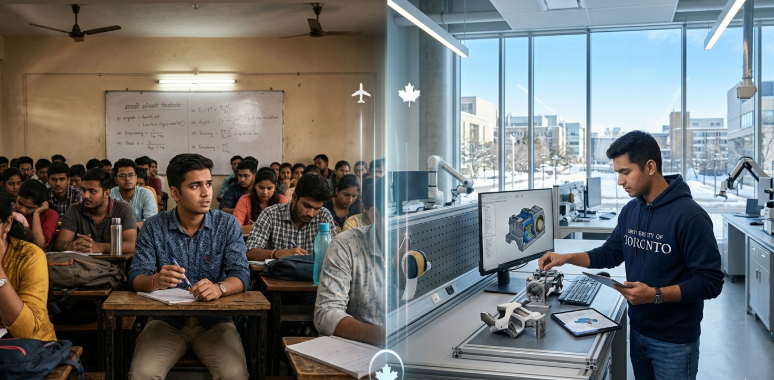
Success tales of Bihar students studying abroad in Canada are not accidental. They are not the result of remarkable luck or privilege. They are the outcome of competitive academic preparation, which Bihar generates in large quantities, along with the appropriate knowledge, financial planning, application strategy, and timely assistance.
There was no well-known college name on Vikram's degree from Muzaffarpur. Sunita from Siwan had no relatives who had previously engaged in this behavior. Patna resident Rohit nearly went with the smaller, safer alternative. The willingness to conduct the research, create the strategy, and take the action was what all three possessed.
The path from Patna to Canada — or Patna to Germany, or Patna to Japan — is real, navigable, and increasingly well-trodden by students from exactly your background and district.
The guidance to walk it is free.
Start Your Study Abroad Journey
Join thousands of students who achieved their dreams with Yastudy.