India–US Trade Deal 2026 — Will It Actually Help Indian Students Get US Visas Easier?
Tarun Chandel
Recently • 8 min read

When Prime Minister Modi and President Trump shook hands in February 2026 and announced the framework of a landmark India US trade deal February 2026 education impact Conversations started right away among Indian student communities on YouTube comment sections, WhatsApp groups, and university counseling offices.
It made sense to be hopeful. The human aspect of the relationship would undoubtedly improve if India and the US are developing the most important bilateral trade relationship in their respective histories—if tariffs are being lowered, supply chains are being integrated, and billions of dollars in commerce are being committed. F-1 visas would undoubtedly become simpler. The 69% decline in the number of Indian student visas issued in the first part of 2025 will undoubtedly reverse. The Indian student visa community would undoubtedly feel the impact of the 2026 India-US trade agreement.
This analysis provides you with an honest response to that hope, based on what the trade agreement does and does not contain, how similar diplomatic agreements have historically resulted in student mobility outcomes, and what Indian students should really consider when making study abroad decisions in 2026 and 2027.
Planning to Study Abroad?
Get personalized guidance from experienced education counselors.
The truth is more nuanced than either optimists or pessimists would like to acknowledge.
What the India–US Trade Deal Actually Contains
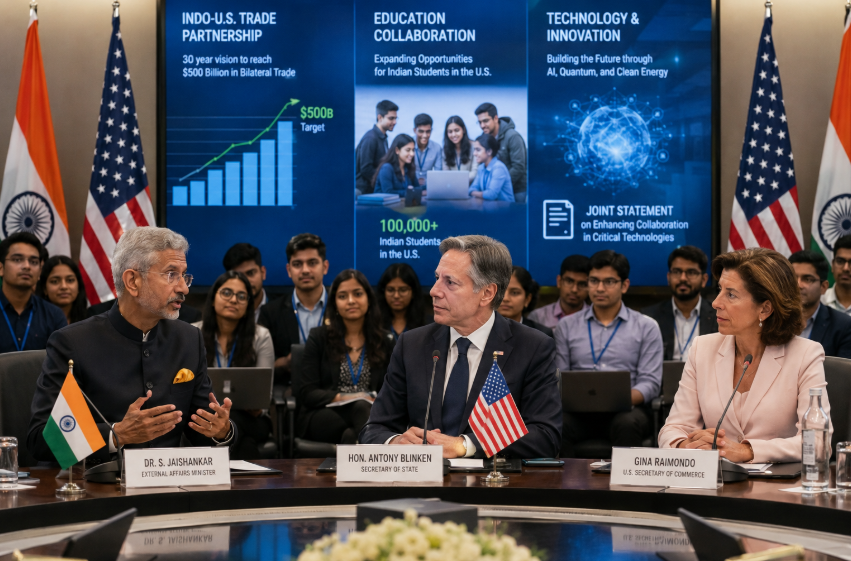
The US India Tariff Deal Student Mobility 2026 — What Was and Was Not Agreed
Several types of bilateral economic relationships are covered under the US-India tariff accord student mobility 2026 framework, which was unveiled in February 2026:
What the trade deal addresses:
Tariff reductions on specific categories of goods — agricultural products, manufacturing components, technology hardware
Enhanced market access provisions for specific service sectors
Investment facilitation frameworks for US companies operating in India
Defence and technology cooperation provisions
Intellectual property harmonisation commitments
What the trade deal does not directly address:
F-1 student visa processing times or approval rates
H-1B visa allocation volumes or lottery procedures
OPT programme duration or scope
Student visa fee structures
Consular staffing levels at US missions in India
Preliminary announcements of the India-US academic partnership trade deal 2026 mentioned increased academic exchange provisions, joint degree program facilitation between Indian and American universities, and expanded research collaboration frameworks, but they made no mention of structural changes to the student visa approval process.
Many hopeful assessments of the deal's impact for students overlook this crucial divergence.
India US Academic Partnership Trade Deal 2026 — The Education Provisions Specifically
The India-US Academic Partnership Trade Agreement 2026 framework has the following education-specific provisions:
Joint research funding: Both governments' pledges to support cooperative research initiatives involving American research universities, Indian IITs, and IISc, with an emphasis on biotechnology, clean energy, artificial intelligence, and semiconductor technology.
Credential recognition framework: A pledge to create a bilateral academic credential recognition framework that, if put into practice, would enable Indian degrees to be more regularly accepted for admission to graduate programs in the United States and vice versa.
Recruitment by US colleges in India following trade agreements: With promises to simplify the institutional cooperation frameworks that allow Indian students to obtain transfer credits and joint degree choices, language in the deal structure encourages US universities to start or grow their Indian student recruiting activities.
Facilitating the creation of American university programs or campuses in India, based on the NEP 2020 framework for foreign universities, is referred to as campus establishment facilitation.
These are significant long-term provisions. The majority of Indian students are genuinely worried about the F-1 visa approval rate, but none of them directly address this issue.
Will F1 Visas Actually Get Easier — The Honest Analysis
F1 Visa Improvement India US Diplomatic Relations 2026 — Historical Evidence
The simplest way to address the F1 visa improvement India US diplomatic relations 2026 question is to look at past data: have better student visa results historically resulted from improved US-India diplomatic relations?
There is conflicting—and very instructive—evidence.
Although the US-India Civil Nuclear Agreement of 2008 marked a significant improvement in bilateral relations, there was no discernible shift in the F-1 visa approval rates for Indian students in the years that followed.
Educational exchanges and student mobility were particularly mentioned in the US-India Strategic Partnership Framework of 2015. Over the next three years, F-1 visa wait times increased rather than decreased as consular workloads outpaced manpower.
Trade and diplomatic agreements establish structures and objectives; this is a recurring theme. Because agencies that oversee visa processing—the Department of State for consular operations and DHS for immigration policy—operate under their own mandates and are not directly instructed by trade agreement provisions, they do not automatically translate into operational changes in visa processing.
The particular structural issue in 2026: The F-1 visa decline of 69% in early 2025 was caused by policy decisions—SEVIS terminations, heightened social media scrutiny, and fewer consular appointments—that fall under the executive branch's discretion and aren't structurally addressed by any trade agreement clauses.
The trade agreement's provisions do not directly control DHS enforcement priorities, State Department consular staffing, or SEVIS management methods, all of which are necessary to improve F-1 visa outcomes for Indian students.
India US Trade Deal Skilled Worker Mobility Education — What Might Actually Change
If implemented, the skilled worker mobility education provisions of the India-US trade deal could have a significant impact on Indian students in the medium term rather than right away.
Credential recognition: Indian undergraduate degrees from accredited universities might have less difficulty in US graduate program admissions if the bilateral credential recognition framework is truly created and put into practice. The implementation horizon is at least three to five years.
Increased J-1 exchange visitor program allocations: Trade agreements may result in increased J-1 visas for academics, research scholars, and exchange students. For some groups of Indian scholars and researchers, the enhanced J-1 provisions in the India-US agreement may offer a different legal route.
US universities' recruitment efforts in India after the trade agreement: More Indian students may have access to admission route assistance that lowers application hurdles if American universities greatly increase their recruitment efforts in India, made possible by the agreement. This could enhance institutional assistance and the quality of applications, but it does not alter visa rules.
Political signalling effect: The trade agreement shows that both governments value their bilateral relationship, which may allow the State Department to prioritize increasing consular staffing in India and DHS to moderate its most aggressive enforcement postures toward Indian students. This is the most immediate potential benefit. Though hypothetical, this is not irrational.
What Indian Students Should Actually Do in 2026
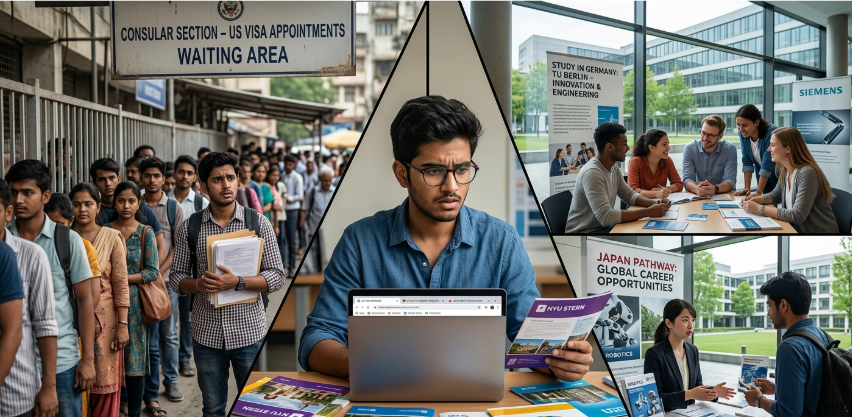
US Universities India Recruitment Post Trade Deal — The Practical Reality
The practical timescale for Indian students planning their study in 2026 and 2027 means they cannot wait for trade deal provisions to achieve operational improvements in visa processing, even if the increase of US colleges' recruiting to India following the trade pact materializes.
The framework for rational decision-making in 2026:
With 12–18 month consular wait times, high rejection rates, OPT in jeopardy, and a decrease in H-1B filings from large firms, the F-1 visa climate in 2026 is still structurally difficult. For applicants in Fall 2026 or even Fall 2027, the trade agreement does not alter any of these practical realities, but it gives optimism for medium-term improvement.
When making judgments on their study abroad plans in 2026, students should consider the existing operational environment rather than aspirational trade deal terms whose implementation timeline is measured in years.
The current operational environment reality:
F-1 visa: difficult, slow, increasingly uncertain
OPT: under threat through separate DHS rulemaking
H-1B: Big Tech reducing filings, employer fee increase proposed
Germany: zero tuition, stable visa, non-lottery EU career pathway
Japan: MEXT scholarship available, improving post-graduation employment framework
Practically speaking, the 2026 India-US trade agreement will have the following effects on Indian students' visa experiences: symbolically significant, possibly substantial in three to five years, and not operationally relevant for students making decisions right away.
What to Watch — Indicators That the Trade Deal Is Producing Real Visa Improvement
For Indian students monitoring whether the US India tariff deal student mobility 2026 is actually producing operational improvements, these are the specific indicators to watch:
Wait periods for consular appointments: Use the US State Department's visa wait time tool every month. If wait times at the consulates in Hyderabad, Chennai, Delhi, and Mumbai are getting shorter than 12 to 18 months, this is a sign of improved operations.
F-1 visa issuance statistics are released on a quarterly basis by the US State Department. These figures would show a recovery from the 69% decline in Q1 2025.
OPT regulatory developments: A formal withdrawal of the DHS regulatory evaluation of STEM OPT would be a sign that the political climate has sufficiently calmed down to safeguard this vital program.
SEVIS termination rates: A notable decline in SEVIS termination actions against Indian students would suggest a relaxing of the enforcement stance.
Navigate 2026 With Expert Guidance — Yastudy Does It Free
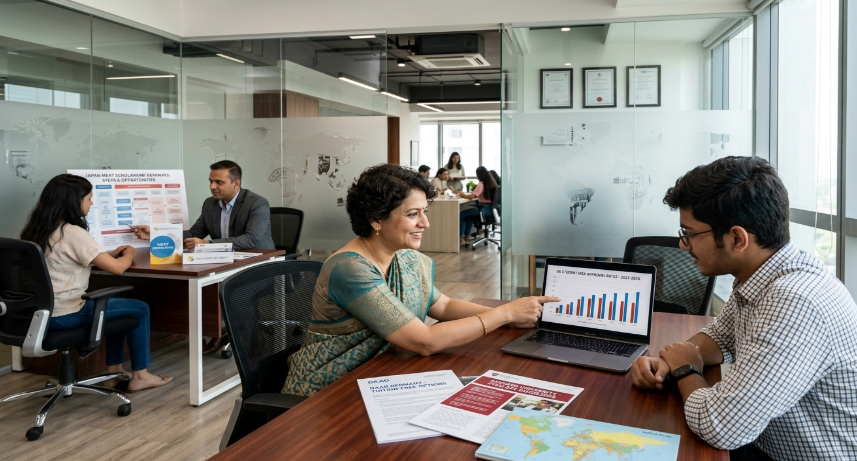
For students making quick judgments, this guide's study of the influence of the India-US trade deal 2026 on Indian students' visas leads only one direction: base your plan on what is operationally true today, not on what trade deal provisions might deliver in three years.
Students who selected Germany or Japan in the interim will have made wise educational investments regardless of whether the trade agreement results in actual operational improvements by Fall 2027. Students who awaited improvement will have missed out on application cycles if the trade agreement's student mobility provisions remain aspirational frameworks without practical execution.
Yastudy — Noida's most trusted and genuinely student-first study abroad consultancy — helps Indian students navigate exactly this kind of uncertain, rapidly changing policy environment at absolutely zero cost.
Zero consultation fees. Zero document charges. Zero hidden costs. Free. Always.
Why Yastudy Is Free — And Why That Is the Right Model for This Moment
University collaborations in Germany, Japan, the UK, Canada, and the US pay Yastudy to connect eligible Indian students. Students are never the source of income. This implies:
No financial incentive to keep you committed to the US if Germany serves you better
No commission pressure in either direction on the US-vs-Europe decision
Honest analysis of whether the trade deal provisions are operationally significant for your specific application timeline
What Yastudy provides at zero cost:
US visa environment assessment — honest evaluation of F-1 visa probability for your specific profile and timeline
Trade deal provision monitoring — tracking which specific provisions are being implemented and what they mean for students
Germany zero tuition alternative — university shortlisting, SOP support, APS certificate guidance
Japan MEXT scholarship support — research plan, professor outreach, Embassy documentation
Complete application support for any destination — SOP, CV, Letters of Recommendation
Visa documentation review before any consulate submission
Education loan guidance through Vidya Laxmi Portal
Conclusion — Hope Is Not a Study Abroad Strategy
The impact of the February 2026 India-US trade agreement on education is genuine, beneficial, and might result in significant increases in student mobility between the US and India over a period of three to five years.
Hope, however, is not a study abroad tactic. Indian students should base their choices about Fall 2026 and Fall 2027 applications on the current practical visa situation rather than the aspirational environment that trade deal rules may eventually produce.
The current situation includes a 69% decrease in F-1 visas, a threat to OPT, a reduction in Big Tech H-1B applications, and 12–18 month wait times at consulates. Germany's environment: non-lottery EU professional pathway, steady visa, and free tuition. Japan's environment: better post-graduation structure, MEXT scholarship.
The long-term collaboration will benefit from the 2026 academic partnership trade agreement between the US and India. This is not an indication that you should alter your decision to study abroad in 2026.
Yastudy offers the advice you need to choose the best choice for your particular profile, timetable, and career objectives. It also doesn't cost you anything.
Start Your Study Abroad Journey
Join thousands of students who achieved their dreams with Yastudy.