Why 80% of Indian Students Are Getting Rejected by Canada — Explained Simply
Tarun Chandel
Recently • 8 min read

Let's discuss the figure that no one in the study abroad sector wants to publicly state.
Indian applicants' rejection rates for student visas to Canada have risen to heights that were unimaginable just five years ago. The IRCC, Canada's immigration department, rejects between 40% and 80% of Indian student visa applications, depending on the province, the type of institution, and the application month.
Go back and read that.
Planning to Study Abroad?
Get personalized guidance from experienced education counselors.
Approximately 50% to 40% of Indian students who apply for a Canadian student visa go through every step of the procedure, including preparing for the IELTS, applying to universities, gathering documentation, paying fees, and making financial arrangements for their families, only to be turned down.
This is not unlucky. This isn't a coincidence. Furthermore, it has nothing to do with Indian students' lack of qualifications.
It is a result of a number of structural changes in Canada's immigration system, policy changes, and particular application errors that, if you understand them, are entirely explicable and, in many cases, preventable.
To help you understand exactly what is happening, why it is happening, and what you can do about it, this article breaks out every single element influencing the Canada student visa denial rate that Indians are facing in 2026.
First, Let's Understand How a Canadian Student Visa Decision Is Made
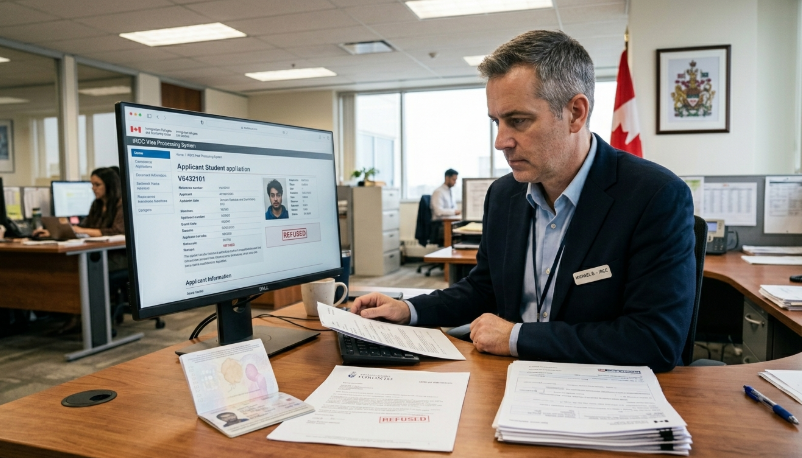
Before explaining why applications fail, let's understand how they are evaluated. This is the foundation everything else builds on.
Who Decides Your Canada Student Visa?
A visa officer at Immigration, Refugees and Citizenship Canada (IRCC) reviews your application. This officer is an immigration official, not a university admissions officer. It is not their responsibility to determine your academic qualifications. It is their responsibility to determine whether you are a true temporary resident, which is someone who will come to Canada to study and then depart once their studies are completed.
This distinction is crucial because it explains why the majority of Indian applicants for student visas to Canada are denied.
The Single Question Every Visa Officer Is Asking
When an IRCC officer reviews your application, they are fundamentally asking one question:
"Does this applicant have a genuine intention to study in Canada temporarily — or are they using a student visa as a pathway to permanent immigration?"
This lens is used to analyze everything, including your financial records, SOP, choice of institution, academic history, and family circumstances in India. Regardless of how great your other qualifications are, your application is susceptible to rejection the instant anything in it indicates that immigration rather than education is your main motivation.
The Policy Shift Nobody Told You About
Canada's 2024 Study Permit Cap — The Root of the Problem
The first-ever cap on study permits for foreign students was announced by the Canadian government in January 2024. Compared to 2023 levels, the cap decreased the amount of study licenses granted nationwide by around 35%.
Concerns regarding the "integrity of the international student program" and the strain that foreign students were putting on Canadian housing, healthcare, and social services were cited as the official justification.
The actual effect was a substantially reduced pool of accessible study permits distributed across a much larger pool of international applicants, with a disproportionate amount of the drop going to Indian students, who had previously been the largest nationality among international students in Canada.
The Canada student visa rejection rate that Indians face is not a passing flaw because this cap was extended till 2026 with additional restrictions. It is a purposeful result of policy.
Provincial Attestation Letters — A New Barrier Indian Students Often Miss
A Provincial Attestation Letter (PAL) from a Canadian province verifying that their study permit application falls within that province's allotted cap space is required for the majority of international student applicants starting in January 2024, with the exception of those applying to master's, doctoral, or primary and secondary programs.
The study permit application is returned unprocessed in the absence of a PAL from the applicable province. This new criteria caught many Indian students—including some consultants—off guard in 2025 and 2026, leading to applications being returned or denied before they were even examined.
The 7 Real Reasons Indian Students Are Being Rejected
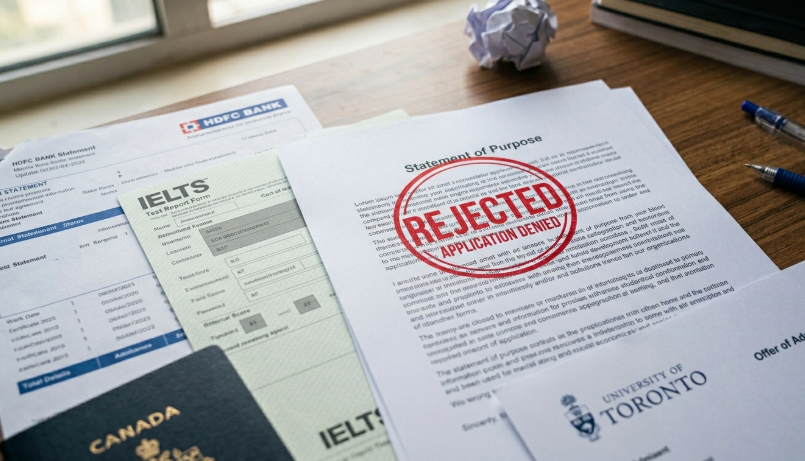
Let's now go over each specific factor that contributes to Indians' high rejection rate for student visas to Canada, all in an easy-to-understand manner.
Reason 1 — Your Application Looks Like an Immigration Application, Not a Study Application
This is the primary cause. Visa officers in Canada are taught to spot what the IRCC refers to internally as "dual intent concerns"—situations in which the applicant seems to wish to exploit a student visa as a first step toward permanent residency.
Signals that trigger this concern in Indian applications:
No clear explanation of why you will return to India after your studies
No family, property, or career ties in India documented in your application
Choosing a program or institution that doesn't logically connect to your academic background
Choosing a province or city known for high Indian immigration concentration
Any language in your SOP that hints at wanting to stay in Canada permanently
The solution is that each component of your application should convey a coherent narrative about a student who has a clear academic objective, a clear rationale for selecting Canada for that objective, and an equally clear rationale for going back to India thereafter.
Reason 2 — The "Funds Appeared Overnight" Problem
In Canada, candidates must demonstrate their ability to pay for their education. However, IRCC officers are proficient bank statement readers. They are searching for a reliable, consistent financial history rather than a sizable sum.
The pattern that triggers automatic scrutiny:
Bank balance is very low for months
A large deposit appears 2–4 weeks before the visa application
The source of the deposit is unclear or undocumented
This trend, which is evident in a large number of Indian applications, indicates to the officer that the family did not actually have those resources, but rather that the money was temporarily provided to satisfy the visa criteria.
The solution is to start preparing your financial records 12 months before to the date of your planned application. A single large recent balance is not nearly as convincing as fixed deposits, mutual fund statements, property assessments, and 12 months of consistent account statements.
Reason 3 — A Generic, Template SOP That Says Nothing Specific
The majority of Indian applications lose the most ground in the Study Plan or Statement of Purpose. Every week, IRCC officials read hundreds of SOPs. Within the first two sentences, they are able to recognize generic assertions, replicated structures, and template language.
"Canada is a world-class destination for higher education with different cultural experiences" or "I have always dreamed of continuing my further education overseas to obtain global exposure" are examples of statements....present in almost 60% of SOPs for Indian students. They make no mention of you, your program, or your organization. They make it impossible for the officer to believe that your application is legitimate.
The solution: Your SOP needs to specify the program, the faculty or research at that particular institution, the reasons why that program advances your particular career objective, and a specific, believable post-graduation plan in India that is connected to actual situations in your life.
Reason 4 — Applying to Low-Credibility Institutions
Between 2019 and 2023, the number of Indian students enrolled in hundreds of private colleges in Canada's designated learning institution (DLI) network increased dramatically, especially in Ontario and British Columbia. Many of these establishments were recognized by the IRCC as vulnerabilities in the immigration system by 2024.
Regardless of the individual applicant's characteristics, applications to smaller private colleges—especially those that offer diploma or certificate programs in business, hospitality, or general management—face far greater rejection rates than those to public institutions.
The solution: Public universities (University of Toronto, University of British Columbia, McGill, McMaster, University of Alberta, and others) offer much superior long-term employment prospects and visa acceptance rates if you're applying to Canada.
Reason 5 — Academic Inconsistency Between Undergraduate and Chosen Program
When a mechanical engineering graduate applies for a diploma in event management in Canada, an IRCC immigration officer naturally wonders why. The officer will conclude that the program decision is not academically driven if your SOP does not offer a convincing, rational response to that query.
Program-switching applications, where the selected Canadian program has no obvious connection to the applicant's Indian educational background, are rejected at much higher rates than applications where the academic progression is logical, according to data on India's Canada student visa rejection rate.
Applying to programs that organically relate to your academic background is the solution. If you truly need to change careers, your SOP must provide a solid, detailed explanation of the change, such as professional experience, industry research, or a well-reasoned career pivot supported by data.
Reason 6 — IELTS Scores That Don't Meet Program Requirements
Despite its apparent simplicity, this one is responsible for an unexpectedly high amount of rejections. Many Indian students receive an IELTS band of 6.0 or 6.5 overall, but they fall short of the minimum required by their particular program in one area, usually speaking or writing.
Minimum scores for each component, rather than merely the total, are becoming more and more specified by Canadian colleges. Even if your total band is 6.5, a 6.0 in writing when the program requires 6.5 in each band is a rejection trigger.
The solution: Before applying, review the component-level IELTS criteria for your particular program. Before submitting your application, retake the IELTS if you score below any component criteria.
Reason 7 — Inconsistencies Across Documents
This is the silent rejection reason — the one that is hardest to catch because it is often an innocent administrative error rather than a deliberate misrepresentation.
Common inconsistencies that trigger rejection:
Name spelled differently across passport, academic certificates, and bank statements
Dates of study or employment that don't match between SOP and supporting documents
Financial figures cited in SOP that don't match bank statements
Address inconsistencies between different documents
Even when anomalies are obviously clerical errors, IRCC officers interpret them as signs of dishonesty. Any disparity raises questions, and questions usually lead to rejection.
The solution: Before submitting, arrange all of the documents side by side and make sure that each one has the same name, date, figure, and address.
What Most Indian Students Don't Realize About the IRCC Review Process
Your Application History Is Visible
Every prior application for a Canadian visa, including those that were denied, is stored in the IRCC's database and is accessible to all officers who assess your subsequent applications. Although it raises more questions, a previous rejection is not disqualified. Officers are likely to see your reapplication as proof that the first worry was legitimate if you reapply without actually addressing the cause for the prior refusal.
GCMS Notes Reveal What the Letter Doesn't
You don't learn anything from the official rejection letter. The officer's internal notes, which you can obtain by submitting an Access to Information and Privacy (ATIP) request, provide you with precise information about the specific issue that led to the rejection, the papers that were deemed inadequate, and the particular language in your SOP or financial evidence that caused concerns.
How to get GCMS notes: It is free and takes about 30 days to submit an ATIP request on the official Government of Canada website.
Before taking any further action, any Indian student who has been turned down should ask for GCMS notes.
Visa Officers Have Country-Specific Refusal Rate Targets
Immigration attorneys and consultants with access to statistical data frequently observe that applications of Indian origin are subject to more scrutiny than those of many other nationalities, even though the IRCC does not formally publish country-specific refusal benchmarks. This trend accelerated after fraudulent document cases from India made headlines worldwide in 2022.
This is not an excuse to give up; rather, it is an excuse to submit an application that eliminates all room for doubt by being so precise, credible, and well-documented.
The Smartest Thing You Can Do Right Now — Talk to YaStudy for Free

The majority of Indian students who are unsure about obtaining a Canada student visa are not being told the truth about this reality: the rejection percentage for Indian students is permanent. There has been a structural shift in the policy environment. Canada's 2026–2027 immigration environment will always include the cap, the PAL requirement, the enhanced documentation criteria, and the greater scrutiny of private college applications.
That means your choices are:
Apply to Canada with a significantly stronger, strategically rebuilt application
Consider alternative destinations — Germany, Japan, UK — that offer equivalent or superior academic and career outcomes with greater visa predictability
Either way, the decision deserves expert guidance from someone with no financial interest in which direction you choose.
YaStudy — Noida's most trusted and genuinely student-first study abroad consultancy — is exactly that.
Why YaStudy Is Different From Every Other Consultant
There are no fees for students using YaStudy. There are no consultation costs. There are no SOP writing fees. There are no fees for visa advice. There are never any unstated expenses at any point in the process.
This isn't a special offer. It is the model of permanent operation. All of YaStudy's funding comes from university partnerships; universities in Germany, Japan, the UK, Canada, and Australia pay YaStudy to match eligible Indian students with their programs. Students are never the source of income.
Because of this fundamental truth, all of YaStudy's recommendations are actually beneficial to you. If you are better served by Germany or Japan, there is no commission incentive to move to Canada. There is no obligation to select a specific university. The guidance is clear, professional, and entirely goal-oriented.
What YaStudy provides at zero cost for every student:
Honest assessment of whether your Canada application is strong enough to succeed — or needs fundamental rebuilding
GCMS note analysis — understanding your specific rejection reason and building a targeted reapplication strategy
Complete SOP rewriting — from template to specific, from generic to compelling
Financial documentation strategy — what to prepare, over what timeline, and how to present it
Institution selection advice — public universities vs private colleges, province selection, program fit
Alternative destination planning — Germany and Japan options assessed honestly against your profile
Scholarship guidance — DAAD for Germany, MEXT for Japan, and other fully funded options
Complete visa documentation review — before submission to any country's consulate
With the help of YaStudy's free platform, hundreds of Indian students who were rejected from Canada or who avoided it by getting the right advice before applying have created their international education plans and are now enrolled in prestigious universities without having to pay a single rupee in consultant fees.
Should You Still Apply to Canada in 2026–27?
This is the honest question. Here is the honest answer.
Yes, Apply to Canada If —
You are applying to a recognised public university — not a private diploma college
Your academic progression is logical — undergraduate field connects to your Canadian program
Your financial documentation shows 12 months of genuine, sustained resources
Your SOP is completely original, specific, and credible — not template-based
You have clear, documented ties to India — family, property, career plan
You have obtained the Provincial Attestation Letter from your target province
Your IELTS meets every component requirement of your specific program
Consider Germany or Japan First If —
You have already been rejected once by Canada without a clear, fixable reason
Your financial documentation cannot show a sustained 12-month history
You are applying to a private college rather than a public university
Your academic background doesn't connect logically to your chosen Canadian program
You want zero or near-zero tuition costs with greater visa certainty
You are eligible for MEXT scholarship (Japan) or DAAD scholarship (Germany)
Indians are facing a real, high, and structurally driven rejection rate for student visas to Canada in 2026. However, it is not the sole route to a top-notch foreign education, nor is it necessary for every applicant.
Conclusion — Understanding Is the First Step to Getting It Right
Indians' 2026 student visa refusal rate for Canada makes sense. You can comprehend, deal with, and overcome each of the reasons listed in this guide, including the policy cap, the PAL need, the financial documentation patterns, the generic SOPs, the institution credibility issues, and the dual intent signals.
Students who achieve success with Canada in 2026–2027 are not more fortunate than those who do not. They are more equipped. They are aware of what the IRCC is truly assessing. They create applications that take care of any issues before they become a basis for rejection.
Additionally, students who go to Germany or Japan after being rejected by Canada frequently find that, thanks to the proper coaching at the appropriate time, they have ended up in a superior academic setting, at a lesser cost, and with greater career assurance.
You currently have access to that guidance. Free. Expert. Honest.
Start Your Study Abroad Journey
Join thousands of students who achieved their dreams with Yastudy.