Canada Cancelled the Student Direct Stream (SDS) — What Does It Mean for Indian Students in 2025?
Tarun Chandel
Recently • 8 min read

This is the news you did not want to hear if you were hoping to expedite your Canadian student visa through the Student Direct Stream.
Immigration, Refugees and Citizenship Canada (IRCC) announced on November 8, 2024, that the Student Direct Stream, an expedited visa processing program that had been the preferred application route for hundreds of thousands of Indian students applying to Canadian universities and colleges since its expansion in 2018, would be immediately discontinued.
There is no period of transition. No gradual retreat. No prior notice. With instant effect.
Planning to Study Abroad?
Get personalized guidance from experienced education counselors.
Students who had received university offers and were preparing their financial documentation specifically for the SDS route, as well as future applicants who had built their entire Canada study plan around the program's 20-day processing timeline, were all immediately and widely impacted by the Canada SDS cancellation of Indian students.
This article provides all the information you need if you are an Indian student who was depending on SDS or if you are now attempting to comprehend what Canada's student visa procedure looks like without it. What SDS was, why it was canceled, the current procedure, and—above all—what its cancellation implies for your choice of whether or not Canada is still the best place for you to study abroad in 2026 and 2027.
What Was the Student Direct Stream — And Why Did It Matter So Much?
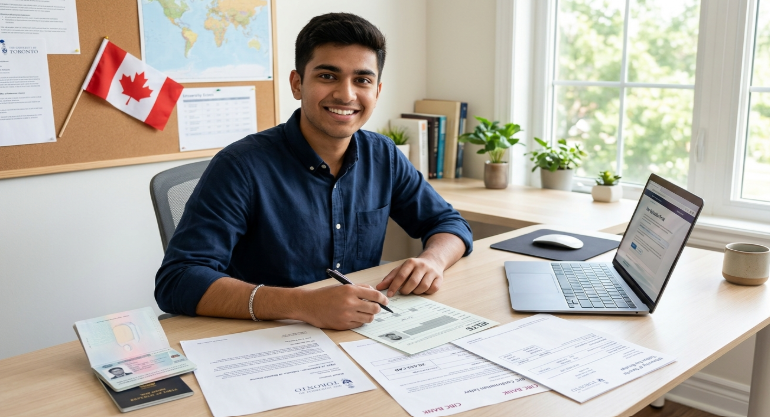
SDS — The Programme That Changed Canadian Student Visa Processing for Indian Students
In 2018, the IRCC launched the Student Direct Stream, an accelerated study visa application process that was extended to Indian nationals that same year. In comparison to the typical study permit application, which took an average of 60 to 90 days (and frequently much longer during peak periods), it was intended to process student visa applications from qualified applicants in 20 business days or fewer.
The program provided a number of particular benefits for Indian students who were cancelled by Canada SDS.
Speed: Students could receive their study permit decision weeks or months ahead of their non-SDS counterparts because to the 20-business-day processing promise. This is crucial for completing university enrollment requirements, making housing arrangements, scheduling flights, and organizing pre-departure procedures.
Predictability: The Guaranteed Investment Certificate (GIC), IELTS results, and upfront tuition payment were all part of the planned SDS requirements, which provided applicants with a clear and transparent path. You have a reasonable level of confidence on your timetable if you fulfilled the SDS requirements and filed a full application.
Processing certainty:The conventional processing queue's unpredictability and variability were decreased by routing SDS applications to a specialized processing stream with dedicated officers.
SDS had become the de facto norm for Indian students in particular, who by 2022–2023 were submitting hundreds of thousands of applications to Canada. Instead than using the regular stream, the great majority of Indian student applicants used SDS.
What SDS Required — The Specific Eligibility Criteria
To use the Student Direct Stream before its cancellation, Indian applicants needed to meet all of the following criteria:
Guaranteed Investment Certificate (GIC): The proof of financial sufficiency needed for SDS was the purchase of a Canadian GIC worth CAD 10,000 (about ₹6.2 lakh) from a participating Canadian financial institution.
IELTS score: Minimum overall band of 6.0 with no individual component below 6.0
Upfront tuition payment: Payment of the first year's tuition fees to the designated learning institution before visa application
Medical examination: Completed upfront before application submission (rather than on-request as in the standard stream)
Acceptance from a designated learning institution (DLI)
Clean immigration history and no prior study permit rejections
Indian students accepted these criteria as the cost of the quicker, more predictable application timeframe, despite the fact that the upfront tuition payment and GIC may total ₹10–15 lakh in immediate expenses.
Why Did Canada Cancel SDS? The Real Reasons
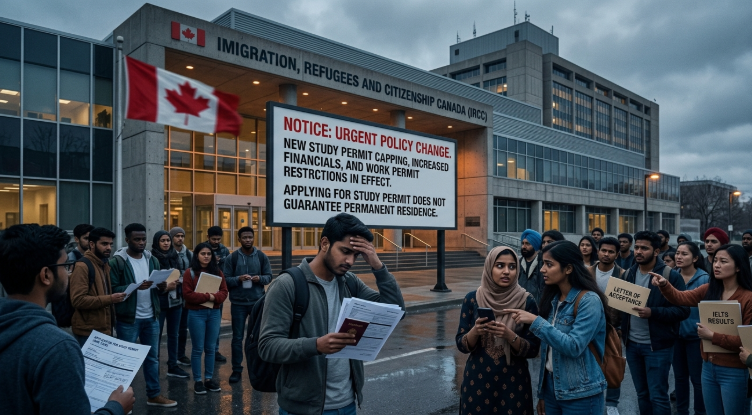
Concerns over the integrity of the foreign student program and the need to "provide a more consistent experience for all study permit applicants" were mentioned in the IRCC's official statement regarding the Canada SDS cancellation of Indian students.
However, the official language hides the true policy drivers, which are far more important and deserving of a thorough study.
Reason 1 — The International Student Cap and Programme Integrity Concerns
Canada imposed a cap on study permits for foreign students in January 2024, which resulted in a roughly 35% decrease in the total number of permits awarded nationwide. With the number of overseas students in Canada rising from about 300,000 in 2012 to over 1 million by 2023, this cap was implemented in response to growing public and political concern.
This change in policy was prompted by a number of issues, including housing pressure in large Canadian cities, the strain on healthcare and social services, and—most importantly—the use of student visas as a backdoor to permanent residency, especially through lower-quality private colleges that were offering easy admission and diploma programs that were more appealing to students looking for immigration pathways than education.
It was believed that the SDS program contributed to the volume issue that the cap was meant to solve by offering expedited processing to a significant number of applications from particular nations, particularly India.
Reason 2 — Document Fraud and Programme Exploitation
Significant amounts of fake document submission were found by Canadian immigration authorities in the SDS application stream, especially in relation to academic certificates from India, financial records, and English language test results. Political pressure to examine the integrity controls of the SDS program was generated by a number of high-profile cases involving falsified IELTS score certifications from Indian candidates.
IRCC was able to apply more uniform scrutiny to a greater percentage of applications by doing away with SDS and mandating that all applicants go through the normal processing stream, which entails more thorough document assessment.
Reason 3 — Policy Normalisation
The Canadian government's overarching policy goals for 2024–2025 were to lessen the distinction between applicant streams and provide a more uniform, regulated system for processing international students. As part of the same policy direction of slowing, standardizing, and lowering the volume of international student approvals, SDS was canceled along with other expedited processing pathways and the Provincial Attestation Letter (PAL) requirement.
What the Canada Student Visa Process Looks Like Now — Without SDS
The Standard Study Permit Application Stream
All Indian students seeking study permits in Canada, including those who completely satisfy the SDS requirements, must now apply through the regular study permit stream due to the elimination of SDS.
In practical terms, that means the following:
Processing time: Indian student applications typically take 60–90 days to process during off-peak times and 90–150+ days during the busiest application seasons (March–July and October–December). Indian applications are currently in the general queue because there is no SDS specific processing lane.
No dedicated processing commitment: For regular stream applications, IRCC does not guarantee a deadline. Processing timeframes are not guaranteed; they are estimations.
Online application: Applications are submitted through the IRCC portal.
Documents required — standard stream:
Letter of acceptance from a Designated Learning Institution
Provincial Attestation Letter (PAL) — mandatory for most applicants since 2024
Proof of financial support (bank statements, GIC still recommended though not mandatory)
Valid passport
Photographs
Statement of Purpose / Study Plan
IELTS or other language proficiency proof
Academic transcripts
Proof of fee payment or financial capacity
Biometrics (if not previously provided)
The GIC — Still Relevant Without SDS?
While it is not required for the normal stream, the Guaranteed Investment Certificate was required for SDS. Nonetheless, the IRCC continues to support and favor GIC as evidence of financial resources since it shows that CAD 10,000 in liquid assets are available in a Canadian institution, which is a more reliable form of proof than only foreign bank statements.
The GIC is still valid and should be included as part of the financial documents in the standard stream application for Indian applicants who have already acquired one for their SDS application.
The New Timeline Reality — Planning Around Longer Processing
Processing time is the most immediate practical effect of Canada SDS cancellation that Indian students now need to prepare for. The updated deadline for Fall 2026 applications is as follows:
Start date: September 2026 October–December 2025 is the deadline for university applications. Decision on admission received: February–April 2026 PAL acquired: April 2026 (in collaboration with the university) Application for study permission submitted: April–May 2026 60–150 days is the typical processing period. Anticipated outcome: July–September 2026
It has a narrow margin. The September 2026 start date for Fall 2026 intake is at danger if the admission letter, PAL, or processing take longer than expected.
This timetable was doable because to the SDS guarantee of 20 business days. Applications for Fall 2026 must be submitted earlier, with more meticulous timetable management, and with truly solid backup plans in the absence of SDS.
What This Means for Indian Students Who Were Mid-Application
Applications Already Submitted Under SDS
The IRCC has said that study permit applications filed via the SDS stream prior to November 8, 2024, will continue to be handled in accordance with the SDS criteria and timeframe; the cancelation did not have an impact on applications that were already in the system.
However, because the program was wound down and cases were transferred to the conventional processing system, processing timelines may have slipped if you submitted your SDS application and have not yet heard back.
If you have questions regarding your timetable, check the status of your application via the IRCC client portal and think about getting in touch with the international student office at your DLI.
Applications Not Yet Submitted
If you were preparing an SDS application and had not yet submitted — your application will now go through the standard stream. This means:
Your GIC (if already purchased) remains valid and useful as financial proof — submit it as part of your standard application
Your upfront tuition payment (if already made) remains valid
Your IELTS score (if it met SDS minimums) remains valid — the standard stream has the same or similar language requirements
Your timeline planning needs to be revised significantly — add 40–60 days to your processing time expectation
Is Canada Still Worth It After SDS Cancellation? The Honest Assessment
The Cumulative Impact on Indian Students
The fourth significant policy change impacting Indian student visa applicants in about 18 months is the Canada SDS cancelled Indian students must process:
International student cap — January 2024, reducing total study permits by 35%
Provincial Attestation Letter (PAL) requirement — January 2024, adding a new mandatory document
Increased visa scrutiny and higher rejection rates — ongoing through 2024–2025
SDS cancellation — November 2024, removing the fast-track processing pathway
Each of these adjustments would be important on its own. When taken as a whole, they show how Canada's relationship with Indian student applicants has changed structurally, going from being a friendly and quick processing destination to one that is much more restrictive, slower, and unpredictable.
What Has Not Changed
It's crucial to recognize what hasn't changed before the evaluation turns completely negative:
Universities in Canada are still quite good. Immigration policy changes have little effect on the academic quality, research infrastructure, or graduate outcomes of universities including the University of Toronto, UBC, McGill, McMaster, and University of Waterloo.
Permits to work after graduation are still available. The Post-Graduation Work Permit (PGWP), which permits foreign graduates to work in Canada for a maximum of three years following graduation, is still in place. For Indian students who finish their education in Canada, it is still a useful route.
There are ways to become a permanent resident. For eligible graduates, Express Entry and provincial nominee programs continue to provide a route from student to permanent residence.
Canada's excellence is not the question. In 2025–2026, it will depend on how dependable the visa environment is and how predictable the timeframe is.
Navigate the Post-SDS Canada Application — Or Explore Better Options — With Yastudyfor Free

The continually evolving, policy-driven intricacy of the Canada SDS canceled Indian students scenario is precisely what makes expert advice so useful and required.
This decision requires professional, individualized advice from someone who has no financial stake in your choice, whether you are attempting to navigate the new standard stream application process for Canada, reevaluating whether Canada is still the best destination given the cumulative policy changes, or investigating Germany, Japan, the UK, or other destinations as alternatives.
Yastudy— Noida's most trusted and genuinely student-first study abroad consultancy — provides exactly that guidance. At zero cost to you. Always.
Not a reduced consultation fee. Not a free first session that converts to paid later. Zero. Free. For every student. At every stage.
The YastudyDifference — Why Free Matters More Than Ever Right Now
Universities in Canada, Germany, Japan, the UK, Australia, and other countries pay Yastudyto link eligible Indian students to their programs as part of its university-partnership business model. Students are never the source of income.
Everything Yastudyteaches you is actually in your best interest because of this structural truth. If you are better served by Germany or Japan, there is no commission incentive to encourage you to move to Canada. There is no financial justification for keeping you in an unsuccessful visa application procedure. The counsel is professional, the advise is sincere, and there is no expense to you.
There are no consultation costs. No fees for document reviews. There are no SOP drafting costs. There are no fees for visa advice. There are no processing costs. No additional expenses. Ever.
What Yastudyprovides at zero cost after SDS cancellation:
Post-SDS timeline assessment — can your Fall 2026 Canada plan still work under the standard stream timeline?
PAL coordination guidance — how to obtain your Provincial Attestation Letter through your DLI
Standard stream application support — complete document checklist, financial documentation strategy, SOP preparation
Rejection risk assessment — honest evaluation of whether your profile is strong enough for the current Canada environment
Alternative destination planning — Germany and Japan assessed honestly as alternatives where Canada's policy environment makes the risk unacceptable
DAAD scholarship guidance for Germany — fully funded options identified for your field
MEXT scholarship support for Japan — research plan, professor outreach, Embassy documentation
Complete application support for any destination — SOP, CV, Letters of Recommendation, transcripts
Visa documentation review — complete checklist reviewed before submission to any country's consulate
YaStudy's totally free platform has helped hundreds of Indian students who have been impacted by Canada's cumulative policy changes—the cap, the PAL, the SDS cancellation, and the higher rejection rates—make wise, knowledgeable choices regarding their study abroad plans. Some successfully rebuilt their applications for Canada. Others found that Japan or Germany was actually a better choice, as they were accepted into top colleges without having to spend a single rupee in consulting fees.
Conclusion — SDS Is Gone, But Your Options Are Not
Indian students relied on Canada SDS, which was more than simply an administrative initiative. For hundreds of thousands of Indian families, it was the cornerstone of the Canada study plan—the assurance of speed, predictability, and a transparent procedure that made the time, money, and hope investment seem reasonable.
Its cancelation, along with the PAL requirement, the study permit cap, and the high rejection rates of 2024–2025, has drastically altered the study abroad landscape in Canada for Indian students.
This does not imply that Canada is unachievable. This means that compared to two years ago, Canada now demands more time, greater tolerance for uncertainty, more rigorous documentation, and more backup planning. Canada is still a feasible and worthwhile option for some Indian students who have good financial profiles, genuine ties to India, and are pursuing particular Canadian universities for academic or professional reasons.
For others, especially those who chose Canada mainly because it was easily accessible, reasonably priced in comparison to the US, and had a quick visa application process, the post-SDS environment might be a sign that it's time to take a closer look at Germany, Japan, or other locations that provide comparable academic quality with increased visa certainty and, in many cases, significantly lower costs.
The decision is yours. The guidance is free. And it is available right now.
Start Your Study Abroad Journey
Join thousands of students who achieved their dreams with Yastudy.