Australia's 485 Graduate Visa Fee Doubled to AUD 4,600 — Is It Still Worth It for Indian Students in 2026?
Tarun Chandel
Recently • 8 min read

The number spread through Indian student groups almost overnight.
AUD 4,600.
Planning to Study Abroad?
Get personalized guidance from experienced education counselors.
At first, many students thought it had to be a mistake. A typo. A rumor exaggerated online. But then the confirmations started coming in — screenshots, official notices, immigration discussions, worried conversations between students already in Australia and families preparing to send their children there.
And suddenly, the financial equation around studying in Australia felt very different.
The visa at the center of the shock was the Subclass 485 Temporary Graduate Visa — the post-study work visa that thousands of Indian students depend on after graduation.
This is not a small optional step in the Australian study abroad journey.
For many students, it is the entire bridge between education and financial recovery.
The 485 visa is what allows graduates to remain in Australia after completing their degree, gain work experience, earn in Australian dollars, and attempt to recover at least part of the enormous investment their families made in international education.
And in 2026, the application cost surged to AUD 4,600.
Just a short time earlier, the same visa cost AUD 1,895.
That means the increase was not gradual.
It was explosive.
An overnight jump of roughly 143%.
Nearly ₹3 lakh in Indian currency for a single visa application.
And perhaps the most stressful part for families: the fee is non-refundable, even if the visa is refused.
For many Indian students, especially middle-class families already stretching finances to afford tuition, living expenses, and international travel, this number hit emotionally as much as financially.
Because suddenly the question was no longer simply:
“Can we afford the degree?”
Now the question became:
“Can we still realistically afford the pathway after the degree too?”
That distinction matters enormously.
For years, Australia attracted Indian students not only because of universities, but because the overall system felt relatively clear: study, work temporarily after graduation, gain experience, and potentially build long-term opportunities. The post-study work pathway was part of the emotional and financial logic behind choosing Australia in the first place.
But when the cost of simply accessing that pathway rises this sharply, students are forced into a much harder conversation about risk, return, and long-term planning.
And that is exactly why this moment matters.
Not because Australia suddenly stopped being valuable. It still offers excellent universities, strong quality of life, globally respected degrees, and meaningful career opportunities for many students.
But because in 2026, Indian students can no longer make study abroad decisions based only on marketing, rankings, or social media success stories.
They need to evaluate the full ecosystem honestly:
Tuition costs.
Living expenses.
Visa policy stability.
Post-study work access.
Immigration uncertainty.
And the real financial pressure families may face after graduation.
This is not fear-driven advice.
And it is not promotional reassurance either.
It is something far more useful: clarity.
Because before investing lakhs of rupees and several years of your life into an international education plan, you deserve an honest answer to one very important question:
In 2026, is the Australia 485 visa pathway still worth it for Indian students?
And that answer requires facts — not emotions alone.
What Is the Subclass 485 Visa and Why Does It Define the Australia Investment Case?
The Post-Study Work Visa That Makes Australian Education Financially Rational:
The reason the AUD 4,600 Subclass 485 visa fee has caused such intense anxiety among Indian students is simple: for most students, the 485 visa is not just another immigration document.
It is the foundation that makes the entire Australian study abroad investment financially believable in the first place.
When Indian families choose Australia for higher education, they are often committing extraordinary amounts of money. Tuition fees, living expenses, insurance, travel, accommodation, and daily survival costs together can push the total investment for a degree anywhere between AUD 80,000 and AUD 120,000.
That is not a casual expense.
For many families, it represents years of savings, education loans, fixed deposits broken early, or financial pressure carried quietly in the background because they believe the opportunity will ultimately be worth it.
And the reason that sacrifice feels justifiable is because students are not only paying for a classroom education. They are investing in what comes after graduation.
The Subclass 485 visa is the bridge to that future.
It allows international graduates to stay in Australia temporarily after completing their studies, work legally, earn in Australian dollars, gain international experience, and begin recovering the enormous financial investment their families made.
Without that bridge, the equation changes dramatically.
Imagine spending close to ₹50 lakh or more on an overseas degree — and then being required to leave the country almost immediately after graduation, before having any meaningful opportunity to work, build savings, or gain long-term professional traction.
That possibility is what makes students nervous.
Because without access to post-study work opportunities, one of the biggest financial justifications for choosing Australia becomes much weaker. The degree may still hold academic value, yes. But the pathway that helps students transform that degree into economic stability becomes far less certain.
And this is why the debate around the 485 visa fee increase is emotionally larger than the fee itself.
It is not just about paying more money for paperwork.
It is about students wondering whether the system they planned their futures around is becoming harder to access at every stage.
For Indian students in 2026, studying abroad is no longer only an educational decision.
It is a high-stakes financial strategy involving career planning, immigration policy, currency conversion, employability, and long-term family sacrifice.
And when the cost of the most important post-study pathway suddenly rises so dramatically, students naturally begin asking difficult but necessary questions:
Will the return still justify the investment?
Will post-study work opportunities remain realistically accessible?
And how much uncertainty can one family afford to absorb before the dream itself becomes financially dangerous?
Those are no longer emotional questions anymore.
They are practical survival questions for an entire generation of international students.
The 485 visa duration 2 years 3 years eligibility structure in 2026:
Graduate Work stream: requires that a job on the relevant skilled occupation list be closely related to your qualification. Depending on the field and study location, the duration might range from 18 months to 5 years (longer stays are available in regional areas).
Post-Study Work stream: Available to students who studied in Australia for at least 2 years. Duration based on qualification:
Bachelor's or honours degree: 2 years
Master's by coursework: 3 years
Master's by research: 3 years
Doctoral degree: 4 years
For the majority of Indian graduates, the duration calculation is just as crucial as the cost calculation because the Australia 485 visa duration 2 years 3 years eligibility decides how long you have to find employment, get Australian work experience, and maybe transfer to permanent residency.
The March 2026 Fee Increase — What Changed and Why:
The Australia Post Study Work Visa Fee Increase March 2026 — Full Details:
As part of the Australian government's larger international student policy reform framework, which aims to lower the overall number of international students, improve the integrity of visas, and increase revenue from international students who stay in Australia after graduation, the post-study work visa fee increase for Australia was announced in March 2026.
Prior to March 2026: ₹1,05,000
; after March 2026:₹2,55,000 ; increase: ₹1,50,000 (about 143%) In rupees: At current exchange rates, about ₹2.55 lakh
The principal applicant is responsible for paying the charge. The overall cost of a 485 visa for a student with a partner is roughly AUD 6,900 (roughly ₹3.8 lakh), with secondary applicants—typically a spouse—paying 50% of the original price (AUD 2,300).
This fee increase did not arrive in isolation. It follows:
Increased Student visa (subclass 500) application fees
Reduction of the income threshold for student work rights (to 24 hours per week during term)
Introduction of international student enrollment caps at major universities
Increased cost of living across Australian capitals
The overall message of Australian immigration policy from 2024 to 2026 is consistent: Australia is purposefully increasing the cost and selectivity of international student paths. The main concern is whether this is in the best interests of Indian students.
Is the Australia 485 Visa Worth It 2026 Indian Graduates — The Financial Calculation:
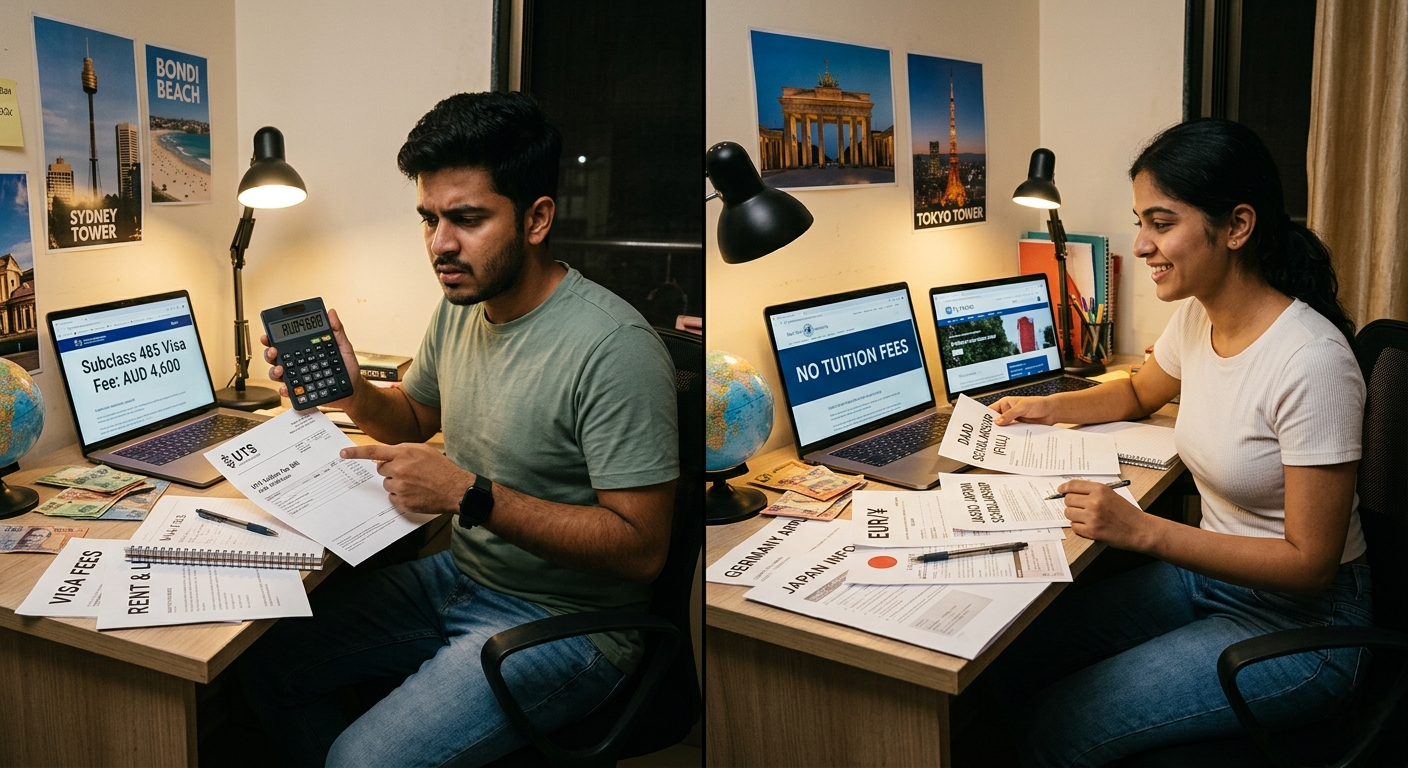
The Complete Investment Picture at New Fee Levels:
To answer whether the Australia 485 visa worth it 2026 Indian graduates must now evaluate, we need the complete financial picture — not just the visa fee:
Expense | Cost (₹ approx.) |
Tuition (2-year master's, mid-tier) | ₹22–60 lakh |
Living expenses (2 years, Sydney/Melbourne) | ₹14–20 lakh |
Student visa (subclass 500) | ₹1.15 lakh to ₹1.35 lakh |
OSHC health cover (2 years) | ₹90,000–₹95,000 |
485 visa (new fee) | ₹2.96 lakh to ₹3 lakh |
Total | ₹41.01 lakh to ₹85.30 lakh |
The return side:
Australian graduate employment salaries for Indian STEM graduates in 2026:
IT and software: ₹50 Lakhs to ₹90+ Lakhs annually
Engineering: ₹47 Lakhs to ₹77 Lakhs annually
Accounting and finance: ₹36 lakh to ₹57 lakh+ annually
Gross income potential in the lower pay band is roughly ₹1.00 crore–₹1.25 crore over a three-year Post-Study Work stream 485 visa (master's by coursework). This far outweighs the entire cost of education; on paper, graduates who find work in their profession still have a strong financial case.
"For graduates who obtain employment in their field" is a crucial disclaimer. Since 2023, there has been pressure on Australian graduate employment rates for international students in competitive fields. Several studies have shown that overseas graduates take longer than domestic graduates to obtain work related to their field.
The risk calculation is altered by the Australia 485 visa fee, which quadrupled in 2026 for Indian students. This is not because the investment is technically unattainable, but rather because the cost of a poor outcome (such as being denied a visa or being unable to find work that is related to their field) is much increased.
Australia Post Study Alternatives to 485 Visa — What Indian Students Are Exploring:
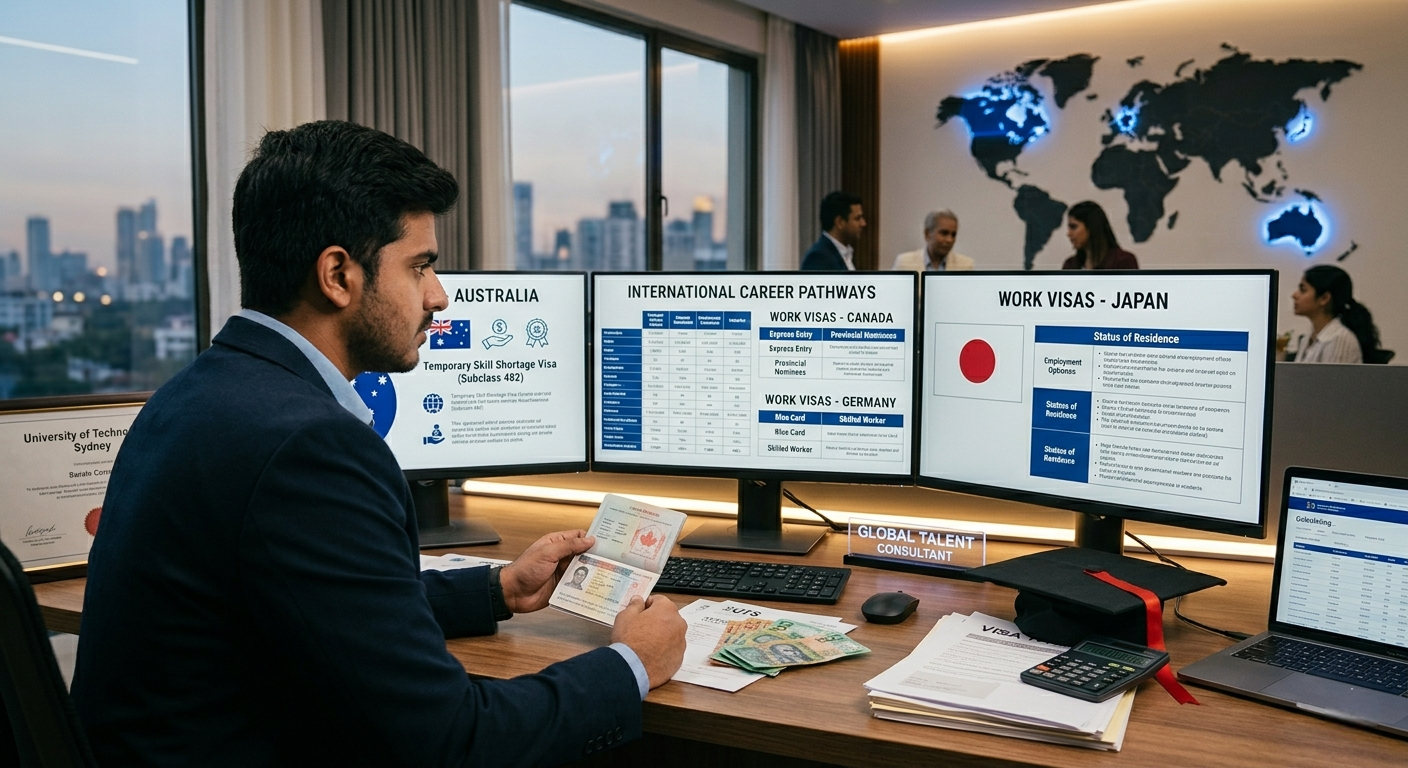
The Post Study Alternatives That Have Become More Attractive:
The Australian study abroad business does not promote the discussion of post-study alternatives to 485 visas, but as fees rise, Indian students are increasingly having this talk for themselves.
Option 1: Germany's 18-Month EU Blue Card + Job Seeker Visa
The following structural differences between Australia's and Germany's post-graduation pathways make the comparison instructive:
No application fee equivalent — the 18-month job seeker visa is obtained through standard immigration processing
No lottery — finding employment in Germany triggers automatic eligibility for a work permit
EU Blue Card after employment — clear, defined pathway to permanent residency in 21–33 months
Total education cost: approximately ₹20–35 lakh (zero tuition, living expenses only)
The Australia vs Canada post study work cost comparison 2026 is significant — but the Australia vs Germany comparison is even more dramatic:
Australia | Germany | |
Total education cost (2-year master's) | ₹40–70 lakh | ₹20–35 lakh |
Post-study work fee | AUD 4,600 (₹2.96 - 3 lakh) | ₹6,700–₹6,900 |
Post-study work duration | 2–3 years | 18 months job search + employment duration |
Lottery required | No | No |
Pathway certainty | Moderate | High |
Alternative 2 — Canada's Post-Graduation Work Permit (PGWP):
The 2026 post-study work cost comparison between Australia and Canada has changed in intriguing ways:
The price of Canada's PGWP is about CAD 255 (about ₹15,000), which is significantly less than Australia's AUD 4,600. The PGWP lasts up to three years, which corresponds to the length of your academic program. Canadian universities provide comparable academic quality to Australian institutions at comparable or marginally lower tuition costs, especially for STEM, management, and health sciences.
The problem: Since 2024, Canada's own visa regulations have tightened; increased rejection rates, the PAL requirement, and the SDS cancellation have all created new risks. It's not easy to compare Canada and Australia; you have to be honest about which country's unique problems are better suited to your profile.
Alternative 3 — Japan's MEXT Scholarship + Work Permit:
For Indian students eligible for the MEXT scholarship, the comparison requires no extended analysis:
MEXT total cost: ₹0 (tuition covered, monthly stipend of ¥143,000 provided, airfare paid)
Australia total cost: ₹62–78 lakh
Regardless of the 485 fee level, Japan is unquestionably the better financial option for qualified students thanks to the MEXT scholarship, which completely changes the discussion of Australia post-study options to 485 visas.
The Decision Framework — Should You Still Apply to Australia?
Apply to Australia If —
The Australia 485 visa worth it estimate for Indian grads in 2026 is still valid if:
Mining technology, agricultural science, and several fintech ecosystems are examples of Australian industry advantages that Germany and Japan are unable to match.
In your particular curriculum, the Australian university of your choice—ANU, University of Melbourne, or UNSW for specializations—holds true international distinction.
The ₹62–78 lakh total investment can be absorbed by your financial circumstances without relying on a lottery or a very uncertain job outcome to create the return.
You have built community or family ties in Australia that offer you both professional and practical support.
Your permanent residency pathway method is specifically supported by the 485 visa's two-year, three-year eligible extended window.
Reconsider and Evaluate Germany or Japan If —
There are real parallels in German or Japanese colleges for your area, whether it be engineering, IT, computer science, or the sciences.
For your family, the ₹40–55 lakh expense difference between Germany and Australia is substantial.
You qualify for MEXT, which makes Japan's free option truly accessible.
The overall investment exceeds your school loan capacity due to the cumulative increase in Australia post-study work visa fees in March 2026, as well as increases in tuition and living expenses.
You desire more assurance about your post-graduation route than Australia's cutthroat graduate employment market currently offers.
Get the Right Guidance — Yastudy Does It for Free:
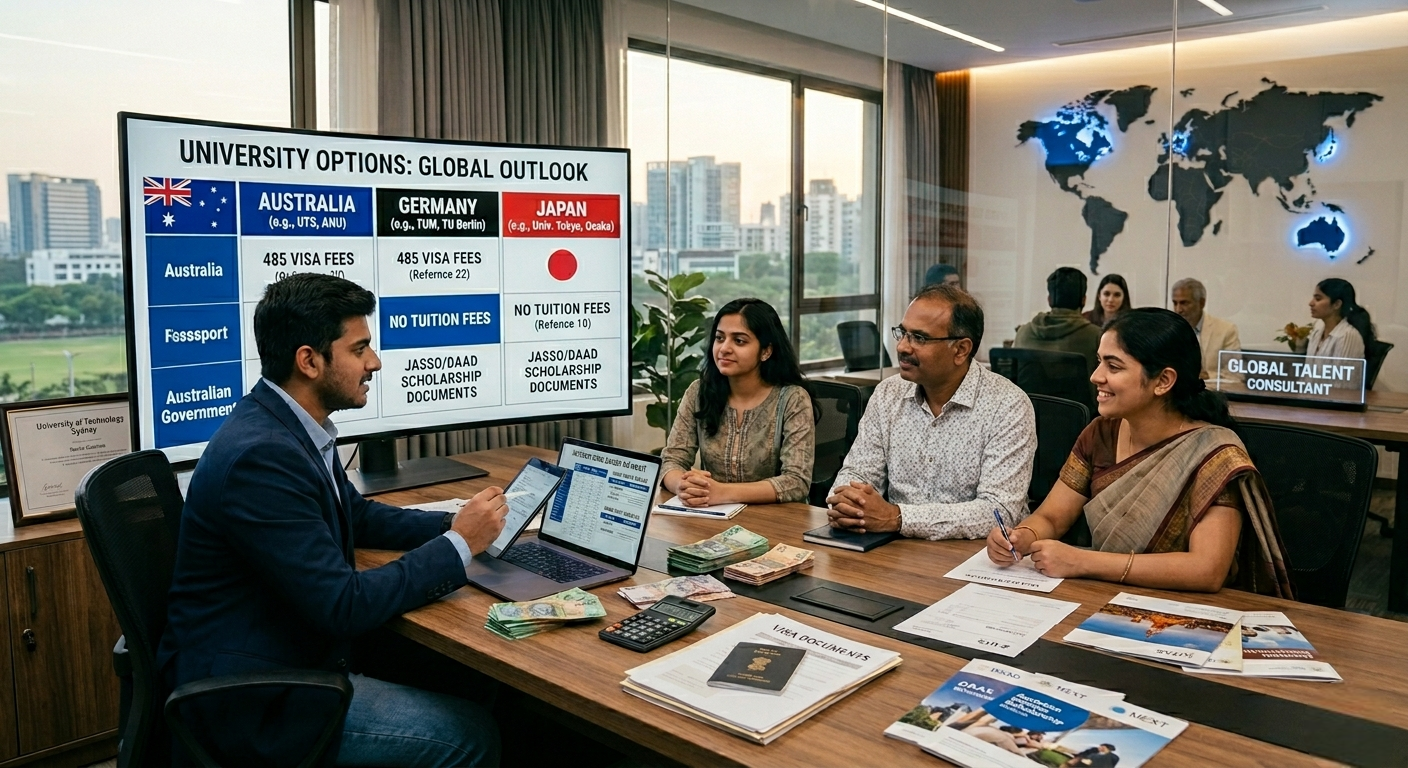
The issue of Indian students facing the doubled 2026 Australia 485 visa fee calls for a personalized, honest appraisal rather than generic assurances from a consultant who has a financial stake in keeping you committed to Australia regardless of whether it is truly the best option.
Yastudy — Noida's most trusted and genuinely student-first study abroad consultancy — provides exactly that analysis at absolutely zero cost to every student.
Zero consultation fees. Zero application fees. Zero SOP charges. Zero hidden costs at any stage. Always free.
Why Yastudy Is Free — And Why That Changes Everything:
Universities in Australia, Germany, Japan, the United Kingdom, and Canada pay Yastudy to match eligible Indian students with their programs. Students are never the source of income. This implies that every suggestion is made with your best interests in mind; there is no financial motivation to push Australia if Germany or Japan are a better fit.
What Yastudy offers for free:
Australia 485 cost-benefit analysis — complete financial calculation for your specific field, institution, and family situation
Germany alternative assessment — zero tuition programmes matched to your academic profile
MEXT eligibility check — honest evaluation of your Japan scholarship options
Australia vs Canada post study work cost comparison for your specific situation
University shortlisting across all destinations
Complete application support — SOP, CV, Letters of Recommendation
Visa documentation review before any consulate submission
Education loan guidance through Vidya Laxmi Portal
Scholarship identification — DAAD, MEXT, and other funded options
Conclusion — The Fee Is Real. So Are the Alternatives:
The Australia subclass 485 visa, which costs AUD 4600 in 2026, is genuine, important, and part of a larger cost trend that makes studying in Australia the most expensive major study abroad option for Indian students in 2026.
The March 2026 increase in the cost of an Australia post-study work visa does not, by itself, make studying in Australia a poor investment for all students. However, it is now a worse investment than it was two years ago, and the contrast between Japan's MEXT scholarship and Germany's free tuition is stronger than ever.
Depending on your particular industry, financial situation, career aspirations, and risk tolerance, Australia may still be the best option for you. The most beneficial thing you can do right now is to accurately make that assessment under the guidance of an impartial, knowledgeable, and honest professional.
That advice is accessible. It is proficient. You don't have to pay anything.
Start Your Study Abroad Journey
Join thousands of students who achieved their dreams with Yastudy.