Germany vs Canada for Indian Students in 2026 - The Comparison That Actually Tells You Which One Is Right for You
Soumili
Recently • 8 min read

Stop Asking Which Is Better. Start Asking Which Is Better for You.
Every year, thousands of Indian students from cities like Noida, Patna, and across Bihar narrow their study abroad options down to two countries and then spend months unable to choose between them. Germany and Canada represent the two most debated destinations in Indian study abroad conversations in 2026, and the debate persists because both countries offer genuinely compelling propositions for different types of students with different priorities.
Planning to Study Abroad?
Get personalized guidance from experienced education counselors.
The problem with most Germany vs Canada study abroad comparisons for Indian students in 2026 is that they try to declare a winner. Germany wins on cost. Canada wins in English. Germany wins on PR stability. Canada wins on post-study work rights. The scorecards go back and forth, and students end up more confused than when they started.
This blog does something different. It gives you the honest, dimension-by-dimension comparison that allows you to identify which country aligns with your specific situation, because the right answer genuinely depends on who you are, what you are studying, what you want your life to look like in ten years, and what financial reality you are working with. By the end of this, you will know which country makes more sense for you, and you will know exactly which questions to ask before you commit.
The Cost Reality - Free Tuition vs Expensive Fees
Germany Free Tuition vs Canada Expensive Fees - What the Numbers Actually Look Like:
This is the comparison that almost always opens the Germany vs Canada conversation, and for good reason. The financial gap between the two countries is one of the starkest in the entire study abroad landscape.
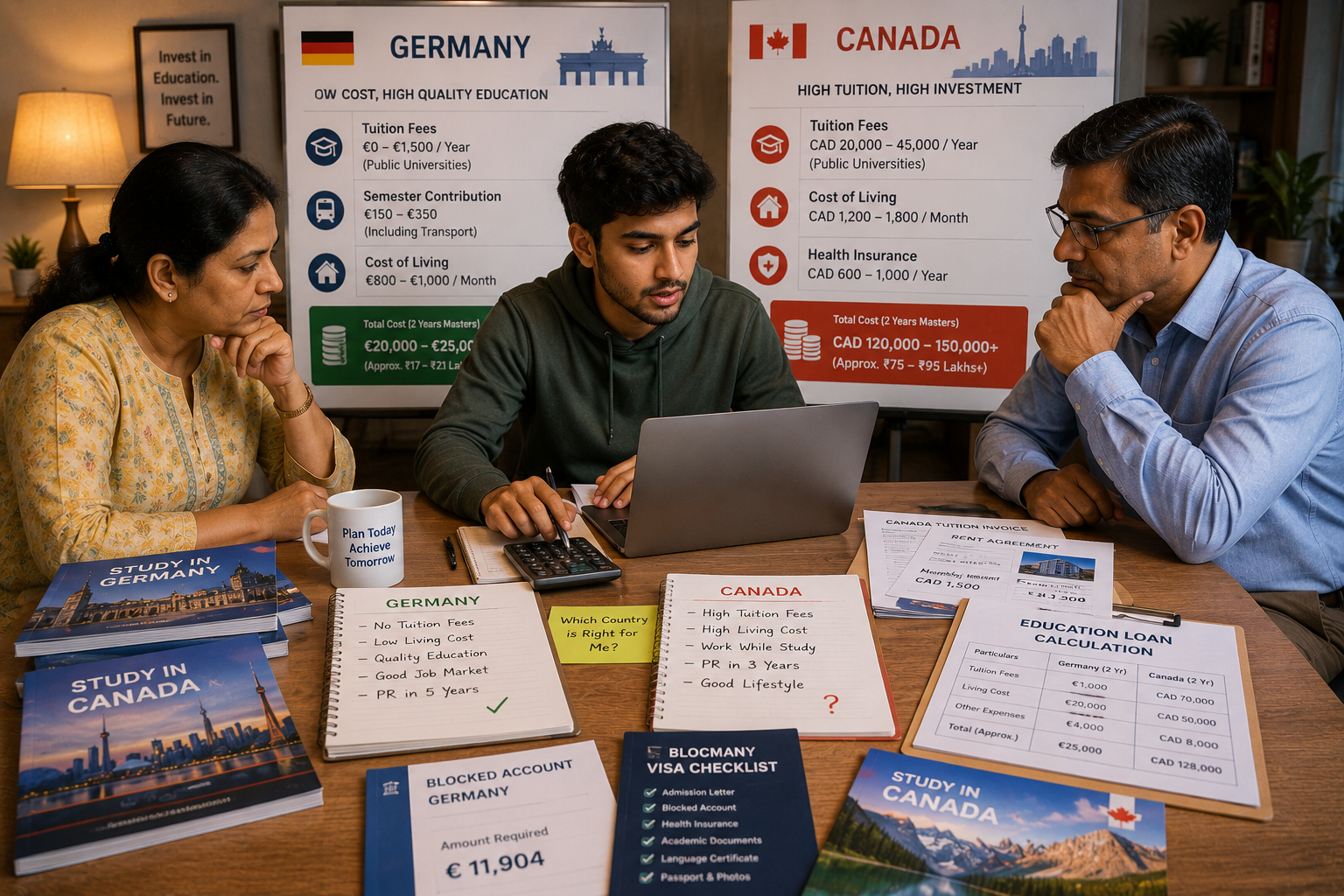
Germany's public universities charge minimal or zero tuition fees to international students at the undergraduate and postgraduate level. Most public universities charge a semester contribution of between ₹13,356 and ₹31,163 per semester, which covers administrative costs and often includes a public transport pass for the city. For a two-year masters programme, the total tuition outlay at a German public university is typically between 600 and ₹157,053 - a figure that Indian students who have been looking at Canadian university fee schedules often have to read twice to believe.
Canada is a fundamentally different financial proposition. International student tuition at Canadian universities ranges from ₹1,402,272 to ₹3,155,111 per year depending on the programme and institution. A two-year masters in Canada typically costs between ₹2,804,543 and ₹6,310,222 in tuition alone, before living costs are factored in. Add accommodation, food, transport, health insurance, and personal expenses, and the total cost of a two-year Canadian postgraduate programme for an Indian student frequently exceeds ₹8,413,630 to ₹10,517,037, or roughly 75 to 95 lakh rupees at current exchange rates.
The Germany free tuition vs Canada expensive fees comparison is not subtle. For families financing a degree through education loans, the difference between graduating with a debt of 8 to 10 lakh rupees from a German programme and 75 to 95 lakh rupees from a Canadian one is a financial reality that shapes the first decade of a graduate's working life. This single variable is the primary reason Masters in Germany consultancy in India has seen sustained and growing demand among Indian students who have done the cost calculation seriously.
The Visa Reality - Which Country Is Actually Easier for Indian Students
Germany Visa Easier Than Canada in 2026 - What This Means Practically:
The Germany visa vs Canada visa comparison for Indian students in 2026 requires understanding both the application process and the approval environment, because both have changed in recent years.
Germany's student visa for Indian nationals is processed through the German consulate in Mumbai, Chennai, Delhi, or Kolkata depending on jurisdiction. The process involves submitting a university admission letter, proof of financial resources, typically a blocked account of approximately ₹1,335,557 for one year, health insurance, academic documents, and a language proficiency certificate. Processing times typically range from six to twelve weeks. Approval rates for properly prepared applications with genuine university admissions are high, and the process, while document-intensive, is predictable and well-documented.
Canada's study permit process has become considerably more complex and less predictable over the past two years. Canada introduced the Student Direct Stream for Indian applicants, which in theory accelerates processing, but the broader context is one of policy tightening. Canada has capped international student intake at the national level, placed restrictions on certain college programmes, and scrutinised financial documentation with increasing rigour. Refusal rates for Indian applicants have risen, and the reasons for refusals are sometimes opaque in ways that make reapplication difficult to navigate without experienced support.
For Noida study visa consultants and Patna study visa experts working with students in 2026, the practical experience is that a well-prepared German student visa application is more predictably successful than a Canadian study permit application, all else being equal. This does not mean Canada is impossible - it means Germany is more stable as a visa destination in the current environment.
The Language Question - German Requirement vs English in Canada
How Real Is the German Language Barrier for Indian Students:
The German language requirement vs English in Canada for Indian students is the most commonly cited reason students choose Canada over Germany, and it deserves honest examination rather than dismissal.
The reality in 2026 is more nuanced than it appears. A growing number of German public universities offer English-taught postgraduate programmes, particularly in technology, engineering, data science, business, and applied sciences. Students applying to these programmes do not need German language proficiency for the academic component of their studies. They need an English proficiency score - IELTS or TOEFL - and in some cases no language test at all if their undergraduate instruction was in English.
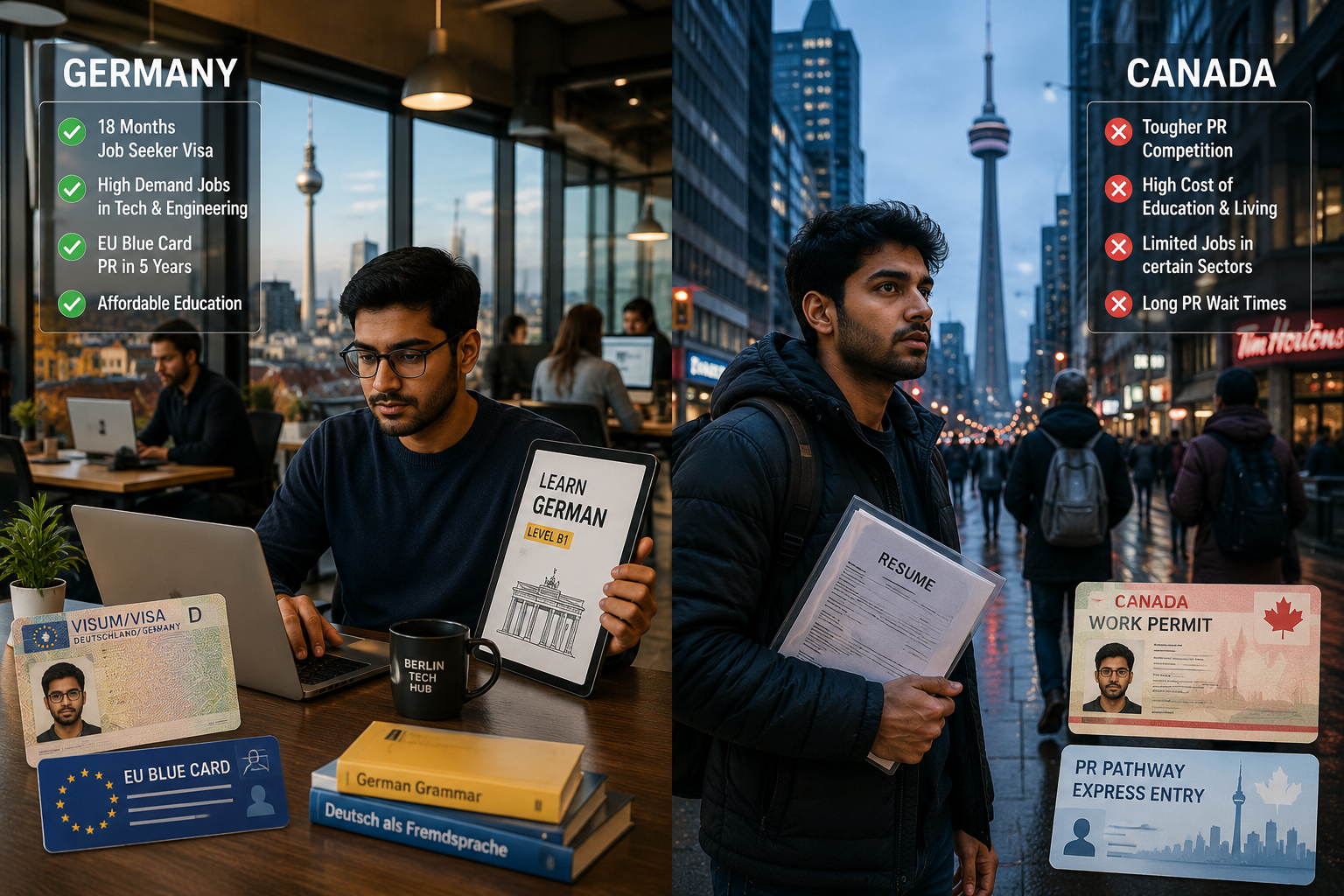
The German language requirement becomes relevant in daily life and in post-graduation employment. Germany's job market, while internationally oriented in the technology and engineering sectors, operates predominantly in Germany across most industries. Indian graduates who invest in reaching B2 level German proficiency during their studies significantly expand their employment options compared to those who do not. This is a time investment during your studies of roughly four to six hours per week, not a barrier to entry but a differentiator in the job market after graduation.
Canada operates entirely in English, which removes the language learning burden but also means you are competing in a job market with millions of native English speakers and tens of thousands of other international students. The absence of a language barrier does not translate automatically into a superior employment outcome.
For students pursuing study abroad without IELTS consultancy guidance, Germany actually offers some of the most viable pathways in this space, with certain German public universities accepting internal English proficiency tests or undergraduate English instruction as sufficient for admission without a formal IELTS requirement.
The Job Market and PR Pathway - Where Does Each Country Take You
Job Market Germany vs Canada for Indian Graduates in 2026:
The job market comparison between Germany and Canada for Indian graduates in 2026 reflects two very different labour market contexts.
Germany is experiencing a structural labour shortage across its technology, engineering, healthcare, and skilled trades sectors that is not a temporary phenomenon. The German government has actively reformed its immigration framework to attract and retain skilled international graduates, and the post-study job seeker visa allows graduates to remain in Germany for up to 18 months after graduation to find employment commensurate with their qualifications. Technology sector salaries in Germany for entry-level graduates with strong skills range from 45,000 to 65,000 euros annually, which relative to Germany's cost of living compares favourably with Canadian equivalents.
Canada's job market for international graduates has become considerably more competitive over the past two years. Record levels of international student intake have created a situation where the number of graduates seeking employment under the Post-Graduation Work Permit significantly exceeds available positions in many cities and sectors. Technology sector roles remain competitive but are no longer the reliably accessible pathway they were three years ago, and graduates in non-technology fields are finding the Canadian job market particularly challenging.
Canada PR vs Germany PR Pathway for Indian Students:
The Canada PR vs Germany PR pathway for Indian students comparison is one of the most consequential dimensions of this decision for students whose goal extends beyond a degree to long-term settlement.
Canada's PR pathway through Express Entry has been one of the most clearly structured immigration routes available to Indian students for years. The Comprehensive Ranking System rewards Canadian work experience, education, and language scores, and graduates with a Post-Graduation Work Permit who secure Canadian employment are typically well-positioned for PR within three to five years of graduation. However, CRS cut-off scores have risen, draw volumes have become less predictable, and the provincial nominee programme pathways that many Indian students relied on have become more competitive.
Germany's PR pathway is less well-known among Indian students but is structurally sound. After five years of legal residence and employment in Germany, permanent settlement is available. For graduates who secure employment under Germany's skilled worker framework, the timeline to settlement is clear and the requirements are achievable. Germany also offers EU Blue Card status to highly qualified graduates earning above the threshold salary, which accelerates certain benefits and provides greater employment flexibility across EU member states.
For study in Germany consultants in Noida advising students on long-term settlement, the German PR pathway is increasingly being presented as a serious alternative to the Canadian route rather than a distant second option.
Germany vs Canada for IT Students from India:
Germany vs Canada for IT students from India in 2026 is the most searched subset of this comparison, and the answer in 2026 tilts more clearly toward Germany than it did three years ago.
Germany's technology sector, centred on Berlin, Munich, Hamburg, and Frankfurt, is actively hiring international graduates with strong skills in software development, data engineering, machine learning, and cloud infrastructure. English is the working language in a significant proportion of German technology companies. The combination of zero tuition fees for the degree, a functional job market in the target sector, a structured post-graduation stay right, and a clear PR pathway makes Germany a compelling end-to-end proposition for Indian IT students in a way that Canada no longer as reliably delivers.
Why This Decision Deserves Expert Guidance - and Why Yastudy Gives It for Free
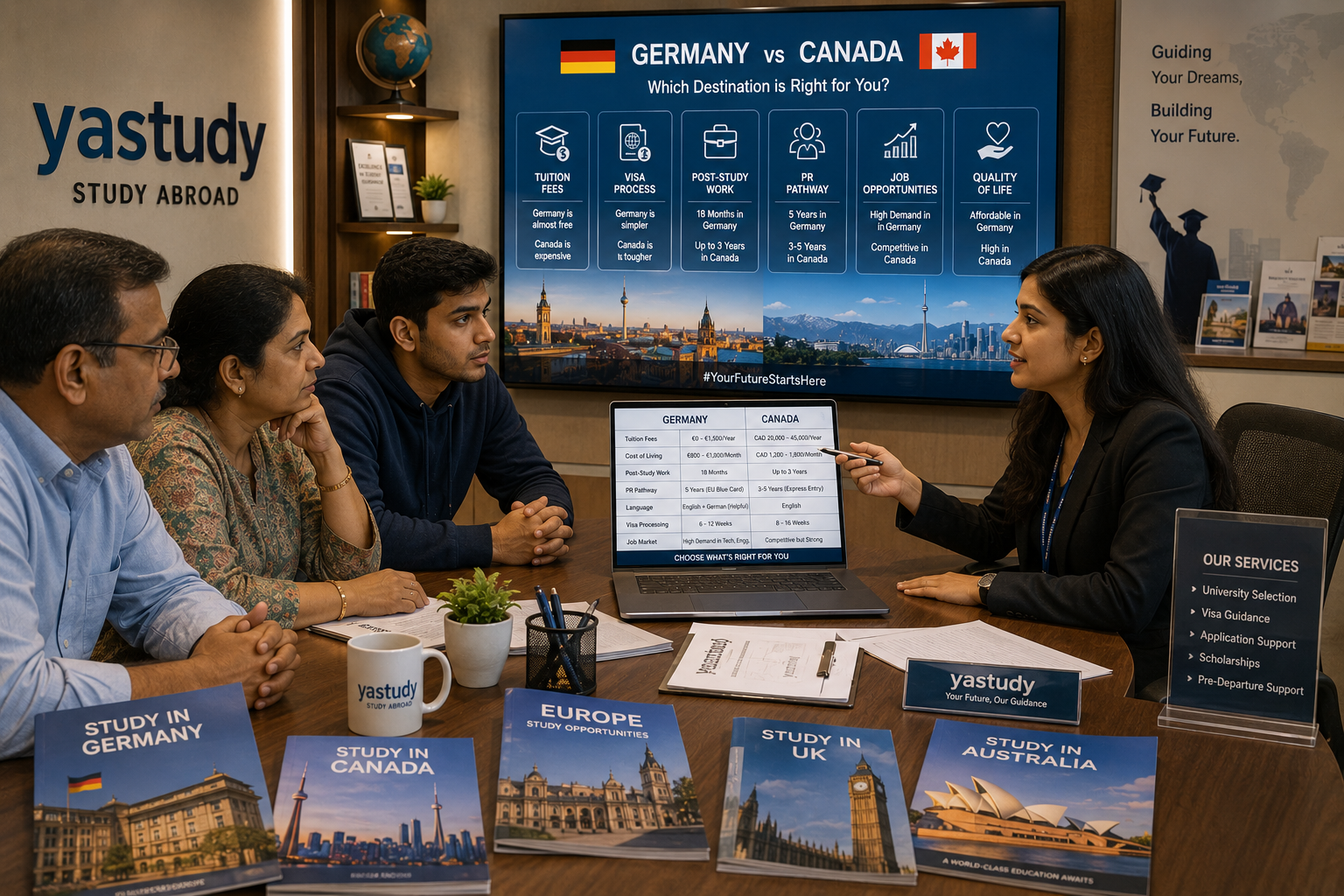
The Germany vs Canada comparison for Indian students ultimately comes down to a set of variables that are specific to each individual: financial situation, risk tolerance, language learning willingness, career sector, target immigration outcome, and the specific programmes available in each country for that student's academic profile.
Getting this decision right requires a counsellor who is genuinely current on both destinations, who has no financial incentive to push you toward the higher-fee option, and who treats your individual circumstances as the starting point rather than a standard recommendation.
Yastudy is the No.1 study abroad consultancy in Noida and the No.1 study abroad consultancy in Patna because it consistently delivers exactly this kind of guidance, at zero cost to the student. Yastudy does not charge students anything - no consultation fee, no processing charge, no document cost, no hidden expense at any point. The consultancy charges the universities and institutions it partners with, which means its counsellors are structurally free from the conflict of interest that distorts advice at fee-charging consultancies. Whether Germany or Canada is the right answer for you, Yastudy's counsellors will tell you honestly and then support you through the entire process at no cost.
As the top overseas education consultant in Noida and the top overseas education consultant in Patna, Yastudy covers both destinations with genuine depth. The study in Germany consultants in Noida and study in Germany consultants in Patna at Yastudy are among the most current in the country on German university admissions, blocked account requirements, visa documentation, and post-graduation employment pathways. The study in Canada consultants in India at Yastudy are equally current on Canada's evolving study permit environment, intake caps, and the provinces and programmes where Indian students are still finding strong outcomes in 2026.
For students in Noida, the study abroad consultancy in Noida Sector 132 is open for walk-in consultations with no appointment required. For students across Bihar, the study abroad office in Patna Boring Road offers the same free study abroad consultation from counsellors who will give you the Germany vs Canada comparison that is specific to your profile, your budget, and your goals. Yastudy also offers free study abroad consultation online at yastudy.com for students who prefer to begin the conversation remotely.
Whether you are among the students looking for affordable study abroad consultants in India who will not charge you for honest guidance, or among those specifically seeking the fastest student visa consultants in Noida for Germany, or students searching for trusted overseas education consultants in Patna for masters abroad, Yastudy is where the search ends.
CONCLUSION:
The choice between Germany and Canada for your higher education in 2026 ultimately hinges on your budget and linguistic preferences. Choose Germany if your goal is to minimize student debt by taking advantage of tuition-free public universities, entering a robust tech and engineering sector, and you are prepared to invest the effort into learning the German language to secure top-tier job opportunities and permanent residency.
Conversely, choose Canada if you prioritize a fully English-speaking academic and professional environment alongside a historically established Express Entry pathway to PR, provided you have the financial readiness to absorb substantially higher tuition and living costs in an increasingly competitive market. For tailored guidance tailored to your specific profile, you can register for a free consultation through Yastudy online or visit their regional offices in Noida and Patna.
Start Your Study Abroad Journey
Join thousands of students who achieved their dreams with Yastudy.