Micro Credentials, Bootcamps, and Short Courses Abroad - Are They Actually Worth It for Indian Students in 2026?
Soumili
Recently • 8 min read

Every year, hundreds of thousands of Indian students commit to two-year masters programmes abroad. They take on significant debt, navigate complex visa processes, relocate to unfamiliar cities, and invest years of their lives in the expectation that a full postgraduate degree from a foreign university will deliver the career transformation they are seeking.
At the same time, a quieter but rapidly growing group of Indian students and young professionals is making a different calculation. They are looking at micro credentials and short courses abroad for Indian students in 2026, at coding bootcamps in Berlin and Barcelona, at six-month certification programmes at universities in the UK and Canada, at online credentials from internationally recognised institutions, and asking a question that the study abroad industry has been slow to answer honestly: do these shorter, cheaper, faster alternatives actually deliver comparable career outcomes?
Planning to Study Abroad?
Get personalized guidance from experienced education counselors.
The honest answer is: it depends, and the variables that determine the answer are worth understanding in detail before you make a decision that costs either two years of your life and a significant sum of money, or six months and a fraction of that cost. This blog gives you the comparison that most consultancies are not incentivised to give you.
What Micro Credentials and Short Courses Abroad Actually Are:
The Landscape Has Changed Dramatically:
Short term certifications abroad for Indian students in 2026 cover a wider range of programmes and institutional types than the term suggests. At one end of the spectrum are intensive bootcamps - typically eight to twenty-four weeks in duration - offered by specialist providers in technology, design, data science, and product management. These are not affiliated with traditional universities but have built employer recognition in specific industries through outcomes data and hiring partnerships.
In the middle of the spectrum are university-affiliated certificate and diploma programmes, offered by institutions including MIT, Harvard, Imperial College London, and a range of European universities, that carry the institutional brand without the full degree credential. These range from six weeks to twelve months in duration and are increasingly available in blended or fully in-person formats.
At the other end are micro degrees, structured as stackable credentials that can eventually count toward a full qualification. Several universities in Australia, the UK, and Europe are now offering these as a modular entry point into their postgraduate programmes, allowing students to test a programme before committing to the full degree.
Online micro credentials abroad versus a full masters for Indian students represents an additional layer of complexity. The same institution may offer a certificate entirely online, a hybrid programme with a residential component, or a full in-person degree. The credential name may be similar across all three. The outcomes, employer recognition, and visa implications are very different.
The Bootcamp Question - What the Salary Data Actually Says
Coding Bootcamp Abroad Outcomes for Indian Students in 2026:
Coding bootcamp abroad salary outcomes for Indian students in 2026 are the most frequently cited data point in the conversation about short courses, and they deserve careful examination. Bootcamp providers publish outcomes reports showing average starting salaries for their graduates, and the numbers are frequently impressive on the surface.
What those headline figures often obscure is the selection effect. Bootcamps that attract students with existing professional backgrounds, strong English proficiency, and prior exposure to technology environments produce better average outcomes than bootcamps that do not, not necessarily because of what the bootcamp itself delivers but because of who was in the room to begin with. An Indian student with an engineering degree, two years of professional experience, and a clear target role in a European technology company will extract significantly more value from a six-month Berlin bootcamp than a recent graduate with no professional background and no existing network in that market.
The second variable is geography. Bootcamp abroad versus full degree for Indian students looks very different depending on whether the bootcamp is based in a city with an active technology hiring market. A coding bootcamp in a European city with a developed startup ecosystem, strong hiring networks, and active bootcamp alumni communities produces meaningfully better outcomes than the same curriculum delivered in a city where those networks do not exist.
The third and most practically important variable for Indian students specifically is the visa situation. Most coding bootcamps abroad do not provide a visa pathway for their duration. International students attending a bootcamp in Germany, Spain, or the UK as a short-course student need to understand what visa category they can enter under, what the duration limits are, and whether the bootcamp's duration and structure qualifies them for any post-course stay. This is not a detail to figure out after you have paid the enrollment fee.

Are Micro Credentials Recognised by Employers in India and Abroad
The Employer Recognition Gap Is Real But Narrowing:
Micro degrees abroad recognised by employers in India in 2026 represent one of the most actively shifting areas of the job market. The answer to whether an employer will recognise a micro credential depends almost entirely on which employer, in which industry, and for which role.
In the technology sector, specifically in software development, data science, machine learning, and product management, employer recognition of non-degree credentials has advanced considerably. Large technology companies including Google, IBM, and Microsoft now have their own certification programmes that they explicitly recognise in hiring, and the logic of treating a Google Cloud certification or an IBM data science credential as equivalent to coursework in a relevant masters programme has become broadly accepted in technology hiring circles globally.
Outside of technology, the picture is more mixed. In finance, consulting, healthcare, law, and traditional corporate environments, the degree credential still functions as a primary sorting mechanism and micro credentials are treated as supplementary at best. For Indian students targeting roles in these sectors, a micro credential short course abroad is unlikely to substitute for a full degree in the eyes of the hiring manager doing the initial screen.
For Indian students planning to return to India after their short course, the employer recognition question has an additional layer. The Indian job market for multinational companies and large domestic employers has been slow to formally recognise non-degree credentials from foreign institutions, though this is changing in technology hiring specifically. The most effective use of a foreign micro credential in the Indian job market is as a demonstrable skills signal for specific technical roles, not as a general prestige credential in the way that a foreign master's degree functions.
The Six-Month Course Abroad Visa Reality
What Indian Students Need to Know Before They Book:
Six-month course abroad visa options for India in 2026 are among the most commonly misunderstood elements of the short-course decision. The visa category available to you for a six-month programme depends on the country, the institution type, the programme's formal recognition status, and whether the course leads to a nationally recognised qualification.
In the UK, a Standard Visitor visa does not permit study at a state-funded institution or study that is the main purpose of the visit for longer periods. Indian students attending a six-month course at a recognised UK institution need a Student visa, which requires the institution to hold a Student sponsor licence and the course to meet the minimum academic progression requirements. Many bootcamp providers in the UK do not hold this licence, which means students attending them are doing so under visitor conditions that may not legally permit the study they are undertaking.
In Germany, a language course or short-term study visa is available for programmes up to ninety days. For longer programmes, a student residence permit is required, and this is tied to the programme's recognition under German law. The German Make it in Germany portal at make-it-in-germany.com provides current guidance on visa categories for short-term study.
In Canada, study permits are required for courses longer than six months, and for courses of six months or less, entry may be possible under visitor conditions but without the right to work. The specific rules depend on whether the student is a visa-required national, which Indian nationals are.
This is precisely why Noida study visa consultants and Patna study visa experts who understand the specific visa implications of short courses in each country are invaluable before a student commits to a programme. The visa situation for a six-month bootcamp is not straightforward, and the consequences of getting it wrong range from entry refusal to deportation.
Online Micro Credentials Abroad Versus Going in Person - The Trade-Off:
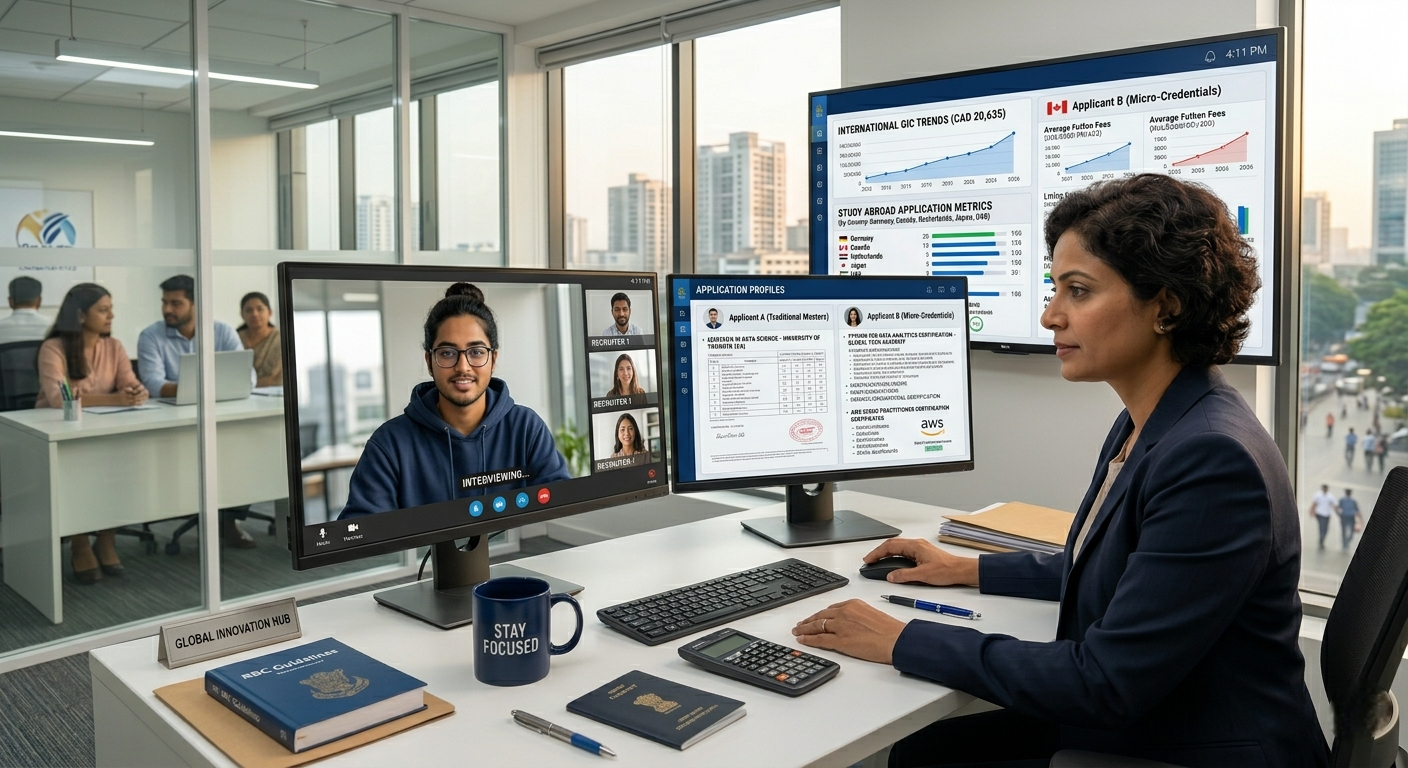
Online micro credentials abroad versus a full masters for Indian students is a comparison that needs to be made on two separate axes. The first is the credential itself - what does the certificate say, who issued it, and what does an employer see when they evaluate it. The second is the experience - what networks, practical exposure, and post-course pathway options does each route open.
On the credential axis, an online certificate from MIT OpenCourseWare and an in-person certificate from MIT's residential executive education programme may carry the same institutional name but are treated very differently by hiring managers who have experience with both. The residential, cohort-based experience builds a peer network and an alumni community that the online version does not. For Indian students whose primary goal is building an international professional network, the in-person component is not a convenience feature. It is the core of the value proposition.
On the experience axis, going abroad physically for even a short programme builds cross-cultural fluency, language exposure, and direct market knowledge that remote participation cannot replicate. For Indian students considering this distinction, the guidance from experienced abroad admission consultants in India who have tracked outcomes across both formats is far more useful than the marketing materials of the institutions themselves.
Why This Decision Needs the Right Guidance From the Start - and Why Yastudy Gives It for Free:
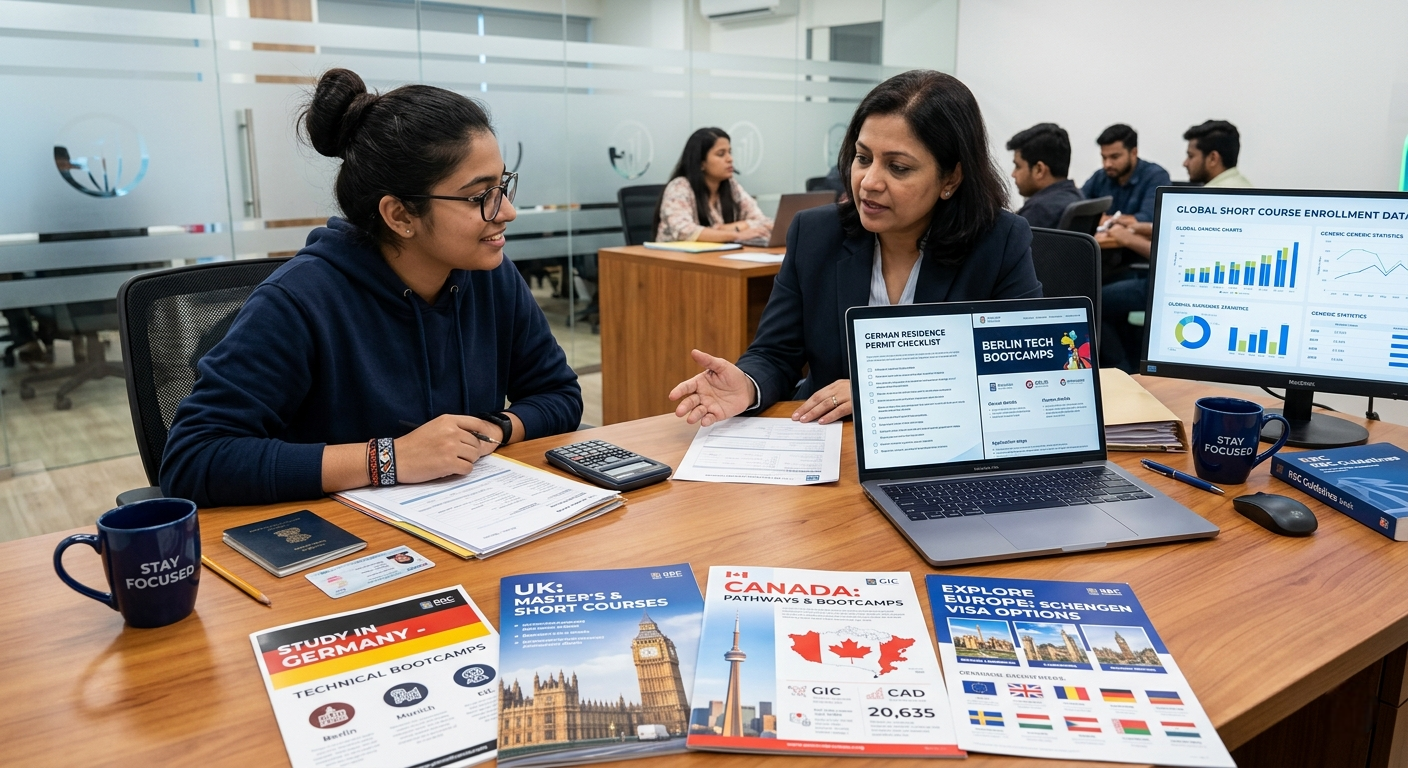
The micro credentials versus full degree question sits at the intersection of career planning, financial planning, visa strategy, and employer market knowledge. Getting it right requires someone who is current on all four dimensions simultaneously, who has no financial incentive to push you toward the more expensive option, and who treats your specific profile and goals as the starting point rather than a standardised recommendation.
This is what Yastudy does, and it does it at no cost to the student whatsoever.
Yastudy is the No.1 study abroad consultancy in Noida and the No.1 study abroad consultancy in Patna, and the foundation of its reputation is a service model that removes the conflict of interest that compromises advice at most consultancies in this market. Yastudy does not charge students - not for consultation, not for document processing, not for application support, not at any stage of the engagement. The consultancy charges the universities and partner institutions it works with, which means its counsellors are genuinely free to recommend the option that is right for you rather than the option that generates the highest fee.
For a student weighing a six-month coding bootcamp abroad against a two-year masters programme, that independence of advice is not a small thing. It is the difference between guidance that serves your interests and guidance that serves someone else's revenue model.
Yastudy's counsellors are among the most current overseas education consultants near you in Noida and Patna when it comes to understanding exactly how short-course visa categories work in Germany, the UK, Canada, and across Europe. They understand which bootcamp and micro credential programmes qualify for which visa categories, what the post-course options are, and how to position a short course credential most effectively in the Indian and international job market for your specific target role.
For students in Noida, the study abroad consultancy in Noida Sector 132 is open for walk-in consultations with no appointment and no obligation. For students and families across Bihar, the study abroad office in Patna Boring Road offers the same free study abroad consultation from counsellors who are tracking both short-course and full-degree options across all major destination countries in 2026.
Whether you are looking for study in Germany consultants in Noida to explore tuition-free masters options alongside short-course alternatives, UK study visa consultants in Patna to understand the visa requirements for a specific programme, study in Europe consultants in Patna for a broader comparison of short and long-format options, or simply an honest conversation about whether a micro credential abroad or a full masters is the right move for your career and your financial situation, Yastudy is where that conversation happens - at no cost to you.
FINAL WORDS:
In 2026, choosing between a fast-paced micro-credential and a traditional full degree abroad isn't about finding a universal "better" option—it's about finding what is right for you. While short courses and bootcamps offer a cheaper, faster route to high-demand technical skills and narrow employer recognition gaps, they come with intricate visa limitations and require an existing professional foundation to truly pay off. Conversely, a full master's degree remains the gold standard for global networking, structural immigration pathways, and broader industry recognition.
Before you commit your time and financial resources to either path, make sure your decision aligns with your target industry, long-term career destination, and visa realities. For honest, conflict-free guidance tailored to your specific profile at zero cost, you can explore your options and book a free consultation with the experts at Yastudy
Start Your Study Abroad Journey
Join thousands of students who achieved their dreams with Yastudy.