Blockchain Is Now Verifying Your Degree Abroad - And Fake Certificates Are Getting Caught Faster Than Ever
Soumili
Recently • 8 min read

If you are an Indian student planning to study abroad in 2026, there is something you need to understand before you submit a single document. Universities in Australia, Germany, the United Kingdom, Canada, and across Europe are no longer relying solely on human verification teams to check the authenticity of your academic credentials. They are using blockchain.
Blockchain degree verification of fake certificates for Indian students abroad is not a future policy being discussed in university boardrooms. It is an active, operational system already running at institutions across multiple continents, and it is catching discrepancies, inconsistencies, and outright fabrications at a speed and scale that was simply not possible three years ago.
Planning to Study Abroad?
Get personalized guidance from experienced education counselors.
This matters for honest students just as much as it matters for dishonest ones. If your genuine degree was issued by an Indian university that has not yet integrated with digital verification systems, your legitimate credentials could face delays, additional scrutiny, or outright rejection at the verification stage. Understanding how this system works, what it means for your application, and how to prepare your documents correctly is now a non-negotiable part of applying abroad in 2026.
What Is Blockchain Degree Verification and Why Are Universities Using It:
The Technology Behind the Shift:
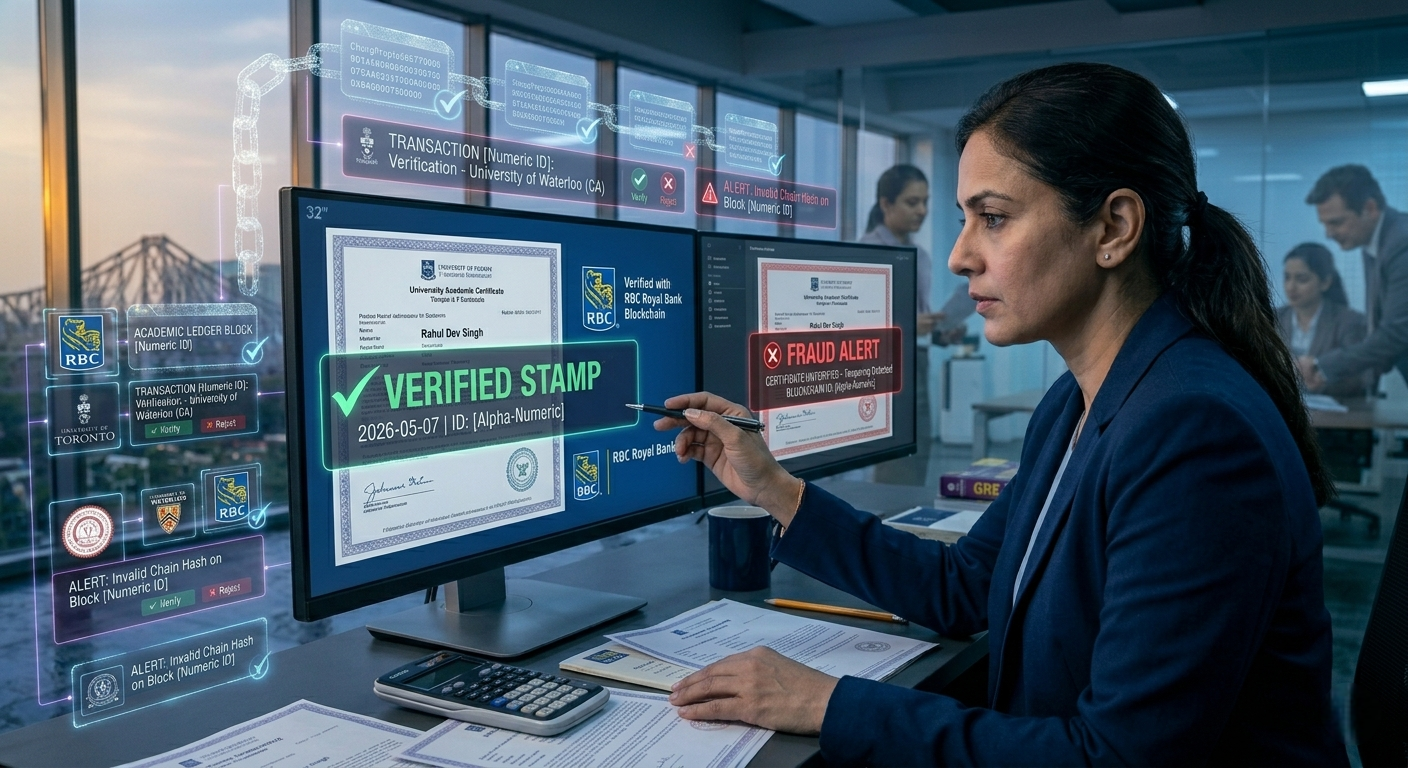
Blockchain academic transcript verification at universities works by recording credential data on a distributed, tamper-proof digital ledger. When a university issues a degree or transcript using a blockchain-backed system, every detail of that credential - the institution, the programme, the dates, the grades, the student identity - is encoded and timestamped in a way that cannot be altered after the fact.
When a foreign university receives your application and initiates a verification check, instead of sending a manual request to your Indian institution and waiting weeks for a response, the system can cross-reference the credential data you submitted against the blockchain record in a matter of seconds. If the two match, your credential is verified. If they do not, a flag is raised immediately.
The reason universities are adopting this technology rapidly is straightforward. Document fraud in international admissions has been a persistent and growing problem globally, and Indian students, fairly or unfairly, have been disproportionately flagged in several destination countries in recent years.
The Australia Crackdown and What It Signals:
Australia's fake certificate crackdown on Indian students has been one of the most publicly documented examples of where this trend is heading. Australian immigration and university authorities have significantly tightened their credential verification processes following a series of high-profile cases involving fraudulent documents submitted by international applicants. The consequences for students caught with falsified credentials have been severe - immediate visa cancellation, permanent bans from re-entry, and in some cases, criminal referrals.
What makes 2026 different from previous years is that the detection is no longer dependent on a human reviewer noticing something suspicious. The blockchain verification layer catches discrepancies automatically, which means students who might previously have slipped through a manual review process are now being flagged consistently and without exception. If you are exploring study in Australia consultants in Noida or any abroad admission consultants in India, ensure they are giving you current advice about how Australian institutions are now processing credential verification before you apply.
The Fake Degree Problem - What Is Actually Happening in 2026:
Why Fake Certificates Still Surface Despite the Risks:
Fake degree certificates for Indian students abroad caught in 2026 continue to be a documented problem despite the severe and well-publicised consequences. The reasons are not simple. Some students are submitting certificates that were issued by degree mills operating within India, institutions that have the surface appearance of legitimacy but are not recognised by the UGC or NAAC. Others have had legitimate credentials altered - grades changed, dates modified, or missing coursework added - by agents who assured them it was a routine service. Some students are entirely unaware that the certificate they purchased or received is fraudulent.
In each case, the outcome in 2026 is the same. Blockchain verification systems do not distinguish between deliberate fraud and innocent receipt of a fraudulent document. The discrepancy is flagged, the application is rejected, and depending on the country and institution, the student's name may be reported to immigration authorities.
The Pressure Points That Create This Problem:
The underlying issue is a combination of intense competition for seats at reputable foreign universities and a consultancy ecosystem in India where a portion of agents have historically been willing to promise outcomes they cannot legitimately deliver. Students from smaller cities and towns, under significant family pressure to secure an admission offer, are particularly vulnerable to agents who suggest that document enhancement is a standard and acceptable practice.
This is precisely why choosing trusted study abroad consultants in Noida and Patna who operate with complete ethical transparency is not just a matter of getting better advice. It is a matter of protecting your future.
How to Verify Your Indian Degree for an Abroad Application Correctly:
The Official Channels You Need to Know:
How to verify an Indian degree for an abroad application correctly begins with understanding which official systems your credentials should be passing through.
The ABC Academic Bank of Credits India abroad recognition system - the Academic Bank of Credits launched by the Government of India under the National Education Policy - is one of the most significant recent developments in this space. The ABC system creates a digital academic repository for students, allowing credits and credentials from Indian institutions to be stored, accessed, and shared digitally. As more Indian universities integrate with ABC, the pathway to internationally recognised digital credentials becomes clearer.
For degree verification specifically, the primary official channel in India is the National Academic Depository, or NAD. NAD is a government-maintained digital storehouse of academic awards and certificates issued by universities, boards, and institutions across India. Degrees stored and verified through NAD carry a level of authenticity that foreign universities and verification services can independently confirm.
For students whose credentials need to be recognised in specific countries, the following official interlinks are directly relevant. The Association of Indian Universities at aiu.ac.in handles equivalency certificates for Indian degrees being presented to foreign institutions. For Australian applications, the Australian Government's Department of Home Affairs provides current information on document requirements. For UK applications, UCAS and individual university credential verification portals are the relevant starting points. For Germany, the database maintained by the German Standing Conference allows you to check the recognition status of your Indian institution and degree.
Digital Credentials and What Indian Students Should Be Preparing Now:

Digital credentials for abroad universities from India in 2026 are increasingly the expected format, not a supplementary option. Several Indian universities have already begun issuing blockchain-backed digital degrees and transcripts, and the number is growing rapidly following UGC directives encouraging adoption.
If your institution is among those that have adopted digital credentialing, request your digital certificate and transcript as part of your application preparation rather than defaulting to physical copies. Digital credentials issued through verified systems significantly reduce processing time at foreign universities and eliminate the risk of physical document tampering during transit or submission.
If your institution has not yet adopted blockchain-backed credentialing, the NAD and DigiLocker pathways remain your most credible alternative for demonstrating authenticity to foreign admissions teams. A knowledgeable study visa consultant in Noida or Patna will be able to advise you on the specific documentation pathway that applies to your institution and your target country.
Why This Changes What You Need From a Study Abroad Consultant:
The shift toward blockchain verification and digital credential systems changes what good consultancy support actually looks like in 2026. It is no longer sufficient for a consultant to know visa timelines and country-specific intake requirements. The best overseas education consultants near you in Noida and Patna now need to understand how credential verification works at the institutional level in each destination country, which Indian universities have integrated with digital systems, and how to guide students through the documentation preparation process in a way that holds up under automated scrutiny.
This is a meaningful bar, and not every consultancy in the market is meeting it. Many are still operating with frameworks and document checklists that were built for a manual verification world. Students who rely on outdated guidance are the ones showing up to the verification stage unprepared, facing delays, and in the worst cases, having legitimate applications rejected because their documentation was not assembled in the way that current verification systems expect.
If you are exploring options as a Noida study visa consultant or looking for Patna study visa experts, the question to ask any consultancy is direct: do you understand how blockchain verification is being applied at the specific universities and in the specific countries I am applying to? The answer will tell you a great deal about whether that consultancy is genuinely equipped to support you in 2026.
Why Students Across Noida and Patna Trust Yastudy for Study Abroad Guidance:

Among the consultancies operating in this space, Yastudy has established itself as the No.1 study abroad consultancy in Noida and the No.1 study abroad consultancy in Patna through a combination of expertise, ethical practice, and a service model that is genuinely student-first in a way that very few consultancies in India can claim.
The most immediate thing to understand about Yastudy is that it does not charge students. Not a consultation fee, not a processing fee, not a document handling charge, not a hidden cost at any stage. Yastudy's entire service is free to students because the consultancy charges the universities and partner institutions it works with, not the people it is trying to help. This model removes the financial pressure that causes students at other consultancies to feel they must commit before they are ready, and it eliminates the incentive structure that leads some agents to prioritise commission over honest advice.
For students from Noida, Yastudy's office in Sector 132 is accessible and operates as an open, walk-in environment. Students looking for a study abroad consultancy near them in Patna can visit the Boring Road office for the same zero-cost, no-obligation counselling. Both locations offer free study abroad consultation with counsellors who are working with current, programme-level knowledge about destination countries including Germany, the UK, Canada, Australia, and across Europe.
On the specific question of credential verification and document preparation, Yastudy counsellors are among the most current abroad admission consultants in India when it comes to understanding how blockchain verification and digital credential requirements are affecting Indian applicants right now. Whether a student needs guidance on NAD-based verification, DigiLocker credentials, or institution-specific documentation pathways for their target country, the counselling support at Yastudy covers it - completely free of charge.
Yastudy supports students across a wide range of destinations and programme types. From study in Germany consultants in Noida for students pursuing tuition-free public university programmes, to UK study visa consultants in Patna for those targeting postgraduate programmes, to MBBS abroad consultancy in Noida for students pursuing medical education internationally, the breadth of expertise available at Yastudy reflects years of successful placements across multiple countries and disciplines. The consultancy also offers study abroad without IELTS consultancy support for students exploring pathways where alternative language proficiency routes are available, and its fast student visa processing track record has made it one of the most recommended names among students seeking a 100% visa success consultancy in Noida.
For students across Bihar looking for the best consultants for abroad studies in Bihar, Yastudy's Patna presence at Boring Road means that world-class overseas education guidance is not something you need to travel to Delhi or Mumbai to access. It is available to you, for free, where you are.
You can explore the full range of Yastudy's services, partner universities, and student success stories at yastudy.com. If you are looking for the best study abroad consultancy in Noida or the best study abroad consultancy in Patna that will give you honest, current, expert guidance without charging you a single rupee, Yastudy is where your search ends.
What You Should Do Right Now If You Are Applying Abroad in 2026:
Start with your documents, not your shortlist. Before you identify the universities you want to apply to, verify that your credentials are in order through NAD at nad.digilocker.gov.in and check whether your institution has integrated with the ABC Academic Bank of Credits system. If your degree or transcripts exist in a digital, verified format, request those copies now rather than waiting until the application window opens.
Check the recognition status of your Indian institution in your target country. For Germany, use the anabin database. For Australia, check the Department of Home Affairs guidance. For UK institutions, refer to UCAS and the specific university's international admissions page. For any country, the Association of Indian Universities at aiu.ac.in can issue an equivalency certificate if required.
Then sit down with a counsellor who understands all of this, at no cost to you, and build an application strategy that reflects both where you are genuinely competitive and how to present your credentials in the format that 2026 admissions systems actually expect.
That conversation is available to you at Yastudy - the top overseas education consultant in Noida and the top overseas education consultant in Patna - completely free of charge.
Conclusion:
The shift toward blockchain-based degree verification in 2026 makes flawless document preparation essential for Indian students. Navigating these automated compliance systems requires expert, up-to-date guidance to ensure your international ambitions stay on track.
As the top overseas education consultant in Noida and Patna, Yastudy provides comprehensive application and visa support completely free of charge. Visit yastudy.com or stop by our offices today to secure a verified, seamless path to your study abroad journey.
Start Your Study Abroad Journey
Join thousands of students who achieved their dreams with Yastudy.