MBBS in Germany for Indian Students 2026 — Top Universities, Fees & Eligibility
Tarun Chandel
Recently • 8 min read

Thousands of Indian students look overseas every year if they don't pass NEET with a high enough rank or if they can't pay the ₹50–80 lakh capitation fees of private Indian medical colleges. The UK is pricey. After 2022, quality is a problem for both Russia and Ukraine. There are obstacles to MCI recognition in Georgia and the Philippines.
And then there is Germany.
One of the most underappreciated, truly world-class alternatives open to Indian students is MBBS in Germany, and it merits considerably more attention than it currently receives from the Indian student community.
Planning to Study Abroad?
Get personalized guidance from experienced education counselors.
Germany is home to some of the world's oldest and most prestigious medical schools. Its medical education system is rigorous, well-known worldwide, and substantially dependent on research. German medical degrees are accepted throughout Europe, the USA, Canada, Australia, and increasingly India thanks to the Foreign Medical Graduate Examination (FMGE) and the new NExT pathway.
For Indian families, this is the crucial factor: MBBS tuition at German public universities is essentially free, even for international students.
This guide will teach you everything. Top universities, eligibility requirements, the true cost breakdown, language requirements, job options, and how to complete the process without paying a single rupee for a consultant.
Is MBBS in Germany Worth It for Indian Students?
Let's answer this before anything else, because it's the question every Indian family asks.
Global Recognition of German Medical Degrees
A medical degree from a German university is recognised by:
The European Union — you can practice medicine in any EU country
The United States — German medical graduates are eligible for USMLE and residency matching
The United Kingdom — GMC recognises German medical qualifications
India — German medical degrees are eligible for FMGE/NExT, subject to NMC guidelines
Australia and Canada — recognised with additional licensing examinations
This level of global portability makes a German MBBS one of the most flexible medical qualifications in the world.
Quality of Medical Education in Germany
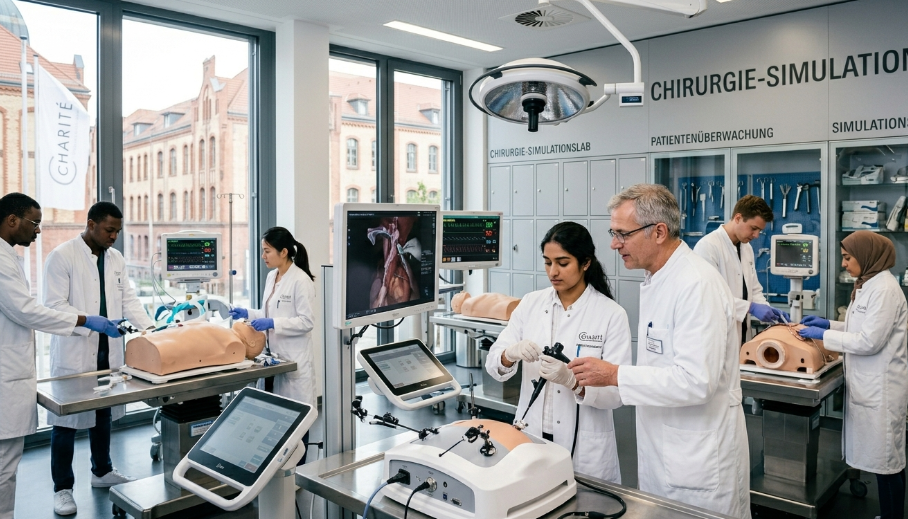
German medical schools are frequently ranked among the top in the world. Hospital rotations begin in the third year, and the curriculum combines rigorous academic training with early clinical contact. There is a high student-to-faculty ratio with excellent research facilities, university hospitals, and simulation labs.
Furthermore, Germany is home to some of the world's top university hospitals, including Charité Berlin, which is ranked in the top three globally, Heidelberg University Hospital, and Klinikum der LMU Munich.
MBBS in Germany — Understanding the Degree Structure
To be clear, Germany does not use the word "MBBS." The Doctor of Medicine (MD/Dr. med.) degree is granted after passing the Staatsexamen (State Examination), the German medical qualification.
The program, known as Humanmedizin (Human Medicine), is comparable to MBBS in all worldwide recognized systems, including the NMC of India.
Duration of Medical Degree in Germany
The Humanmedizin program in Germany has a total duration of 6 years and 3 months, structured as follows:
Preclinical phase (Vorklinik): 2 years — basic sciences, anatomy, physiology, biochemistry
First Staatsexamen (M1): Examination after 2 years
Clinical phase (Klinik): 3 years — internal medicine, surgery, pediatrics, psychiatry, etc.
Second Staatsexamen (M2): Examination after clinical phase
Practical Year (Praktisches Jahr — PJ): 1 year of clinical rotations across departments
Third Staatsexamen (M3): Final licensing examination
After passing all three Staatsexamen, graduates receive the Approbation — the German medical license — which allows them to practice independently in Germany and across the EU.
Top Universities for MBBS in Germany for Indian Students
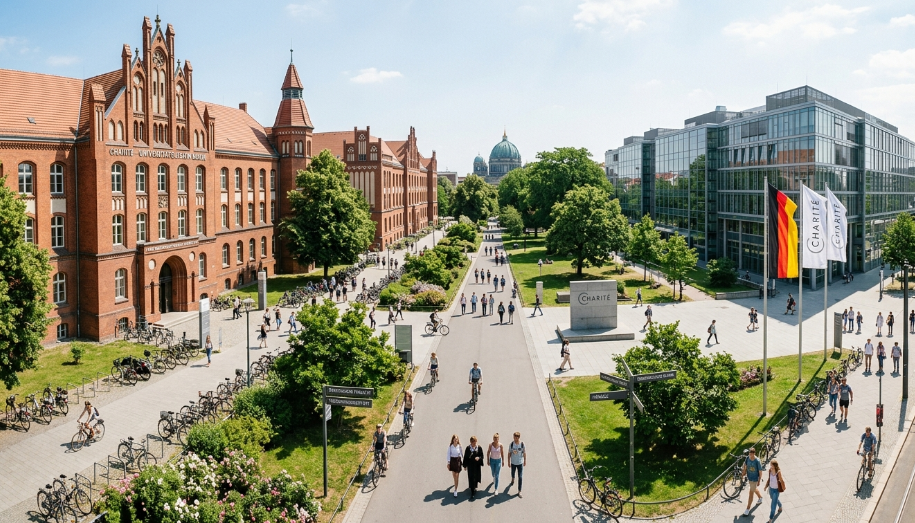
Here are the best medical universities for MBBS Germany Indian students eligibility — all public institutions with no tuition fees:
1. Charité — Universitätsmedizin Berlin
Charité is not just the most renowned medical school in Germany but also one of the largest and most prestigious medical institutions globally. It is located in Berlin and is co-managed by Freie Universität Berlin and Humboldt-Universität zu Berlin. Among Charité's alumni are Robert Koch, who discovered the tuberculosis germs, and Emil von Behring, who was awarded the first Nobel Prize in medicine.
Semester fee: ~€314 Language of instruction: German (C1 mandatory)
2. LMU Munich — Klinikum der Universität München
Ludwig Maximilian University Munich has one of Germany's top medical faculties. The associated university hospital, Klinikum der LMU, is one of the largest and most advanced in Europe. Modern research facilities and strong corporate linkages in Bavaria's life sciences industry support LMU Munich's medical program, which has produced 42 Nobel laureates in a variety of subjects.
Semester fee: ~€148 Language of instruction: German (C1 mandatory)
3. Heidelberg University — Medical Faculty
Founded in 1386, Heidelberg is the oldest university in Germany. Its medical faculty is among the best in the nation, especially in the fields of neurosciences, oncology, and molecular medicine. A national hub for cancer treatment and research is Heidelberg University Hospital.
Semester fee: ~€175 Language of instruction: German (C1 mandatory)
4. TU Munich — Technical University Munich Medical School
One of Germany's most research-intensive medical schools is TUM's medical school, which is connected to the Klinikum rechts der Isar hospital. It is particularly strong in sectors at the nexus of technology and medicine, such as precision oncology, translational medicine, and biomedical engineering.
Semester fee: ~€144 Language of instruction: German (C1 mandatory)
5. University of Hamburg — UKE (Universitätsklinikum Hamburg-Eppendorf)
One of Germany's most advanced university hospitals, the Münsklinikum Hamburg-Eppendorf (UKE), is connected to Hamburg's medical school. Early patient contact and integrative clinical training are highly valued aspects of the curriculum.
Semester fee: ~€360 Language of instruction: German (C1 mandatory)
6. University of Freiburg — Medical Faculty
Freiburg has one of Germany's oldest and most prestigious medical faculties, and it is situated close to the borders with France and Switzerland. With access to the Black Forest region and a distinctively international campus setting, it provides outstanding training in internal medicine, immunology, and neurosciences.
Semester fee: ~€175 Language of instruction: German (C1 mandatory)
7. RWTH Aachen University — Medical Faculty
Because of its strong connections to engineering and technology research, the medical faculty at RWTH Aachen is unique in Germany. Students interested in medical technology, biomedical devices, and multidisciplinary medicine will find it very appealing. The university hospital is a Level 1 trauma center that serves Germany, Belgium, and the Netherlands.
Semester fee: ~€310 Language of instruction: German (C1 mandatory)
MBBS Germany Indian Students Eligibility — Complete Requirements
MBBS Germany Indian students eligibility is structured differently from most countries. Here is exactly what you need:
Academic Eligibility
Completion of Class 12 with Physics, Chemistry, and Biology
Minimum aggregate of 70–80% in PCB (varies by university — Charité and LMU are significantly more competitive)
Strong Mathematics scores are advantageous
NEET qualification — mandatory for Indian students seeking recognition in India under NMC rules
APS Certificate — Mandatory
The APS (Akademische Prüfstelle) certificate is required for all Indian candidates to German universities, including those that offer medical programs. It verifies your academic qualifications through the submission of paperwork and an in-person interview.
Start at least five months ahead of the application date because APS processing takes four to eight weeks.
German Language Requirement — The Critical Factor
For Indian students pursuing an MBBS in Germany, this is the most important prerequisite and the one that necessitates the earliest preparation.
There are virtually no MBBS programs taught in English at German public universities; all medical programs are taught in German. You'll require:
C1 level German for university admission
TestDaF minimum TDN 4 in all four components, or DSH-2 certificate
Most universities recommend reaching C1 before applying and C2 during clinical years
In actuality, going from zero to C1 requires 18 to 24 months of regular study. For pupils who begin studying German in Classes 10 or 11, this is the ideal location. Those beginning after Class 12 should allow for a two-year language training period before applying.
Studienkolleg for Medical Aspirants
Since Indian students complete 12 years of study instead of Germany's 13, you will likely need to complete a Studienkolleg (one-year foundation program) before being admitted directly to a university, unless you can demonstrate equivalency with exceptional grades and other credentials.
For medical students, the Studienkolleg offers advanced courses in biology, chemistry, mathematics, physics, and German (T-Kurs track).
MBBS in Germany Fees — The Complete Realistic Breakdown

Here is what MBBS in Germany fees actually look like across the full 6-year program:
Tuition Fees
Tuition at all public universities in Germany is €0 each semester. Indians and other international students are covered by the $0 tuition policy.
Transportation pass, student union, and administrative services are covered by the €150–€370 semester contribution.
Over 13 semesters (6 years + 3 months): total semester fees of €1,950 to €4,810
Living Expenses
Expense | Monthly Cost |
Accommodation (student housing) | ₹31,500 – ₹54,000 |
Food and groceries | ₹13,500 – ₹22,500 |
Health insurance | ₹9,900 – ₹10,800 |
Transport (often covered by semester ticket) | ₹0 – ₹4,500 |
Books, materials, equipment | ₹2,700 – ₹5,400 |
Personal expenses | ₹4,500 – ₹9,000 |
Total Monthly | ₹62,100 – ₹1,06,200 |
Living expenses each year: roughly ₹7,45,200 to ₹12,74,400; total living expenses for six years: roughly ₹44,71,200 to ₹76,46,400 (₹45–78 lakh over six years).
At a number of private medical schools in India, the capitation fees alone can range from ₹50 to 1,00,000 per year, not including living costs, additional fees, and contributions. The costs for MBBS in Germany are different than this.
Navigate the Entire MBBS Germany Process — Free With YaStudy
The path to MBBS in Germany is really challenging for Indian students. Each step has its own dates, documentation requirements, and potential risks, such as language preparation, APS certification, Studienkolleg navigation, university applications, prohibited accounts, and visa processing.
Most students either pay consultants outrageous amounts that shouldn't be required, or they do this on their own and lose a year as a result of avoidable mistakes.
YaStudy — Noida's most trusted and student-first study abroad consultancy — provides complete guidance for the MBBS Germany Indian students eligibility and application journey at absolutely zero cost to students.
Not a reduced fee. Not a scholarship to cover the consultation. Zero. Free. Always.
The YaStudy Model — Why It's Free and Why It Works
YaStudy is funded entirely by its university partnerships — universities pay YaStudy for connecting qualified Indian students to their programs. This means:
Every recommendation YaStudy makes is genuinely in your interest
There is no pressure to choose any particular university or country
No hidden charges appear at any stage — not for SOP review, not for visa help, not for pre-departure support
The guidance you receive is the same quality that students at expensive consultancies pay lakhs for
What YaStudy provides at zero cost for MBBS Germany aspirants:
Eligibility assessment — realistic evaluation of your profile for German medical programs
German language roadmap — which courses, which timeline, reaching C1 efficiently
Studienkolleg guidance — selection, application, and preparation support
APS certificate support — document preparation and interview readiness
University application assistance — through uni-assist and direct portals
NEET compliance guidance — ensuring NMC recognition pathway is maintained
Blocked account and visa documentation — complete support before your consulate appointment
Scholarship identification — DAAD and other funding for medical students
Pre-departure orientation — everything from accommodation to health insurance registration
If you are serious about pursuing MBBS in Germany for Indian students, YaStudy is now the most capable, reliable, and simply available support system in India, regardless of whether you are in Class 11 or 12 or have completed your studies.
Career Pathways After MBBS in Germany
After completing your medical degree and receiving your Approbation (German medical license), your options are exceptional:
Practice in Germany
Due to a serious physician shortage, more than 5,000 medical positions remain unfilled in Germany each year. As a licensed physician, you are immediately eligible to work in German clinics and hospitals. The monthly pay for junior physicians (Assistenzarzt) starts at €4,500 to €6,000 and rises significantly with specialization.
Specialisation and Residency in Germany
After being approved, you can complete Facharzt (specialist) training in Germany, which requires five to six years of paid residency in your chosen profession. This strategy results in senior physician (Oberarzt) positions paying between €8,000 and €15,000 per month.
Practice Across the EU
According to EU medical recognition directives, your German approval is automatically recognized in all 27 EU member states. France, the Netherlands, Austria, Switzerland, and more places are available for practice.
Return to India — FMGE and NExT
Indian students can take the FMGE (Foreign Medical Graduate Examination) or the new NExT exam to gain Indian medical registration if they pass NEET before to departing and finish their German medical degree.
Conclusion — The Medical Degree That Opens Every Door
Obtaining an MBBS in Germany is not the easiest path to becoming a doctor for Indian students. Not every student is prepared for the commitment and planning that the German language requirement alone demands. For those who are, however, it provides an outstanding medical education, nearly free MBBS expenses in Germany, a European medical license, and employment opportunities across continents.
Students who plan ahead, take their preparation seriously, and receive the proper supervision from the start are the ones who succeed in Germany's medical system.
That advice, the kind that is truthful, knowledgeable, and totally free, is already accessible.
Start Your Study Abroad Journey
Join thousands of students who achieved their dreams with Yastudy.